
Why “It’s Black Stone” Is Not a Specification
Among granite surface plate and machine base buyers, one worry comes up again and again: is the stone really precision granite, or is it a softer, more porous marble â or ordinary building stone â dressed up as a premium material? The substitution is hard to detect by eye, because polished black marble and polished black granite look similar to a non-specialist. The difference shows up later, as slower wear, higher water uptake, drifting geometry, and surfaces that will not hold a grade through years of use.
The defense is simple and non-negotiable: material data from testing, not appearance. This article compares precision black granite and marble on the properties that matter for machine bases â density, water absorption, compressive strength, elastic modulus, and thermal expansion â explains what our own material reports state for ZHHIMG black granite, and gives buyers simple checks to apply before and after delivery.
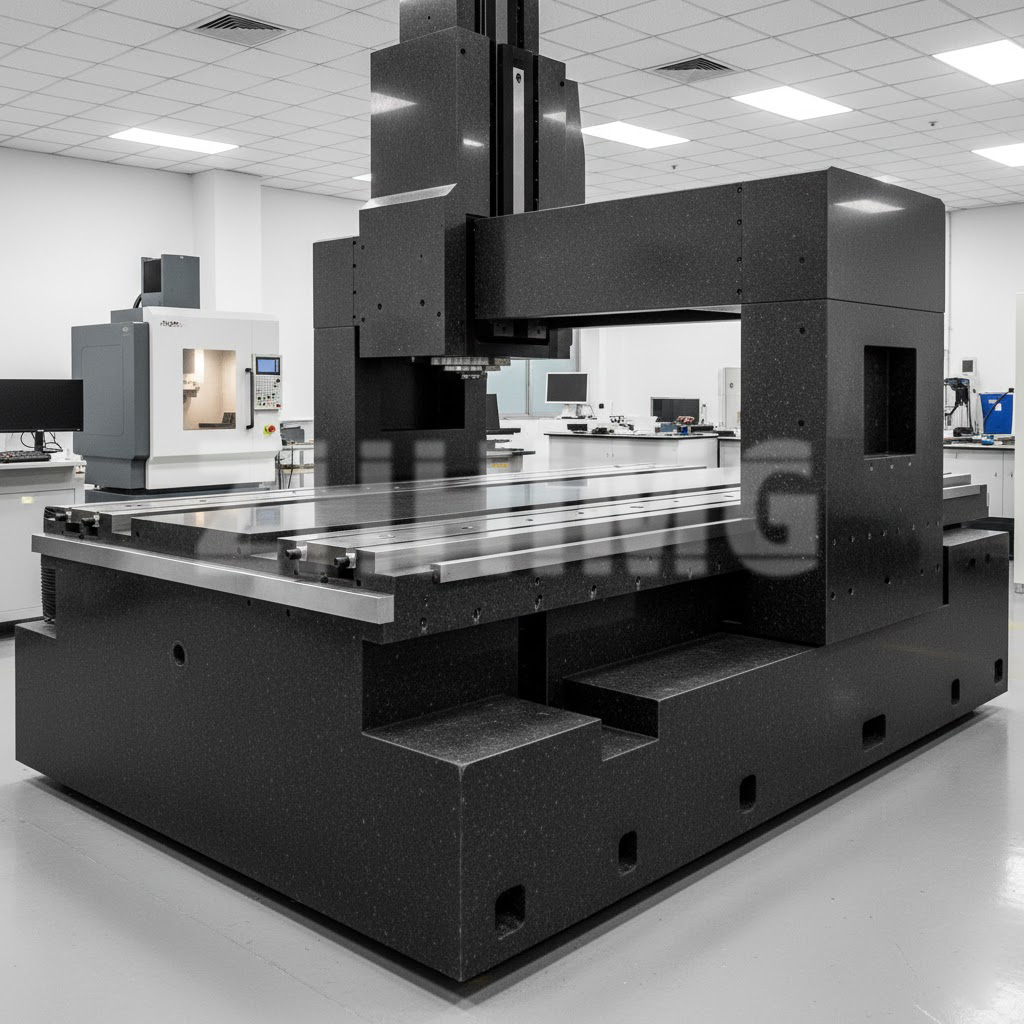
Why the Distinction Matters for Machine Bases
A machine base or surface plate lives under conditions that building stone never sees: heavy concentrated loads, precision lapped surfaces that must hold flatness for years, humidity cycles in non-climate-controlled workshops, and repeated re-lapping at the end of its service life. Each of these demands specific material behavior:
- Density and grain structure determine how finely a surface can be lapped and how well it resists wear at contact points.
- Low water absorption keeps the material dimensionally stable through humidity swings; a porous stone microscopically swells, and a lapped surface drifts.
- Compressive strength and stiffness carry the loads between support points without the stone deforming locally under heavy parts.
- Thermal expansion behavior sets how the reference geometry moves as room temperature changes.
Marble is a metamorphic carbonate rock â softer, typically more porous, and more chemically reactive than the fine-grained black granite (basalt/diabase family) used for precision plates. In building interiors it is excellent; under a CMM it is the wrong material, which is precisely why substitution matters.
Why does substitution happen at all? Both stones are quarried, sawn, and polished on similar equipment, and to a casual eye a polished black marble slab resembles a polished black granite one. The price difference, however, is real: suitable precision granite is a scarcer resource with stricter selection at the quarry, while decorative marble is abundant. That gap is exactly the margin a dishonest producer can harvest â and it is why buyers who specify “black stone” without material data effectively invite the substitution they fear.
The Property Comparison
The table below compares the two materials on the five properties buyers should always see in a material report. Values for ZHHIMG black granite come from our material test reports issued with orders; marble figures are indicative ranges from published reference literature for common marble types and are shown for orientation. In both cases, the binding values for a purchase are the ones on the supplier’s own test report for the actual stone lot â never assume, always request the report.
| Property | ZHHIMG Black Granite (per test report) | Marble (indicative literature range) | Why It Matters for a Base |
|---|---|---|---|
| Density | â 3,100 kg/m³ | â 2,500â2,800 kg/m³ | Denser, fine-grained stone laps to finer finishes and wears slower |
| Water absorption | < 0.1% | â 0.1â0.4% (varies widely by type) | Low absorption keeps geometry stable through humidity cycles |
| Compressive strength | High (report value per lot) | Typically well below granite | Carries heavy parts and support loads without local distress |
| Elastic modulus | High; stiff under load | Typically lower | Stiffness between support points preserves flatness under load |
| Thermal expansion | Low, stable (black granite family) | Higher and more variable | Reference geometry moves less as room temperature changes |
Note the pattern: granite is better on every axis that matters for a precision base, and in some cases by a wide margin â most dramatically in wear resistance at lapped contact surfaces and in long-term dimensional stability under humidity change. Marble can be polished to a beautiful shine; shine is not stability.
How to Verify Stone Yourself: Three Practical Checks
Beyond paperwork, there are simple checks any buyer or receiving inspector can perform:
- The knock test â tap the stone with a small metal object. Dense, sound granite gives a clear, ringing tone; porous or internally fractured material sounds dull. It is not a laboratory method, but a plate that sounds dead deserves scrutiny before acceptance.
- The water drop test â place a drop of water on a less visible polished area. On low-absorption precision granite, the bead sits and evaporates slowly; on porous stone it darkens and absorbs visibly within minutes. Run the same drop on a known sample if you have one, and compare.
- The material report â the decisive check. Ask for the material test report for the actual production lot, stating density, water absorption, and compressive strength from testing. A supplier who sources stone responsibly can produce this on request; one who cannot, or who offers a generic datasheet without lot traceability, leaves the substitution question open.
Also inspect the polished surface in raking light: fine, uniform grain with a consistent dark color is characteristic of precision black granite; cloudier banding, larger crystals, or a softer-looking texture suggests a different stone. And check the delivered weight against the invoiced dimensions â density is mass per volume, so a significantly light part is a red flag anyone with a scale can catch.
What Our Material Reports State
Every ZHHIMG order can be accompanied by a material test report for the stone used. Our black granite shows a density of approximately 3,100 kg/m³ and water absorption below 0.1% per our testing â figures that place it firmly in the precision granite family and far above the porous stones sometimes substituted in low-cost production. We are glad to have customers verify these values independently, and to supply samples for comparison testing where a project warrants it.
Material is the foundation of everything else we publish about our products: the flatness grades we certify, the surface finish we lap to, and the decades-long stability our bases are expected to hold. If the stone were ordinary, none of those promises would survive an audit â which is why we treat the material report as part of the product, not an optional attachment.
What to Ask For When Ordering
- A material test report for the production lot: density, water absorption, compressive strength, and stone type/lithology.
- The quarry or stone source identified, so reports can be compared across orders and years.
- A sample or coupon for your own verification, where project scale justifies it.
- The delivered weight recorded on the packing documents, so receiving can cross-check against dimensions and density.
To request a material report, a sample, or a quotation for a precision granite base or plate, send your requirements through our contact page. Our precision granite product line and granite machine base range pages show the formats we supply with full material documentation.
Frequently Asked Questions
How can I tell black granite from black marble by appearance?
You often cannot, reliably. Both polish to a deep black. Grain structure in raking light helps â granite shows a fine, uniform crystalline texture â but the definitive method is a material test report with density and water absorption values for the actual lot, plus simple field checks such as the knock test and water drop test on delivery.
Is a density of 3,100 kg/m³ really meaningful for buyers?
Yes. Density is easy to verify independently â it is weight divided by volume, and both are checkable on delivery. A stated density near 3,100 kg/m³ with matching delivered weight is strong evidence of the dense, fine-grained stone that precision applications require, and it is one of the first numbers to cross-check when auditing a supplier.
Does marble ever make sense as a machine base material?
For decorative or very light-duty applications, marble can be adequate. For precision bases and surface plates, its lower hardness, higher and more variable water absorption, and lower strength make it a poor substitute â particularly because the deficiencies appear gradually, as wear and drift, rather than as an obvious failure at delivery.
What exactly should a material test report contain?
At minimum: stone type and lithology, density, water absorption, and compressive strength, with the test methods identified and traceability to the production lot. Reports that state values without a method, or without lot linkage, cannot be verified against the stone you actually receive.
Can we test a sample before placing an order?
Yes. We supply samples for customers who want independent verification before committing a project, and we encourage it â a supplier confident in their material has nothing to fear from the customer’s own testing. Contact us with your project details and we will arrange the sample and the report together.
Post time: Nov-04-2026