
The global ultra-precision manufacturing sector is undergoing a significant shift toward larger formats. Driven by the rapid development of next-generation semiconductor fabrication, large-panel Automated Optical Inspection (AOI) systems, perovskite solar cell coating machinery, and high-load XY linear motor platforms, the industry is requiring larger operational envelopes than ever before.
As structural dimensions expand, maintaining sub-micron geometric tolerances across multi-meter spans becomes increasingly difficult. For equipment OEMs and system integrators, the challenge lies in sourcing foundational beds that offer both massive physical scale and absolute dimensional stability.
The Engineering Challenge of Scale in Modern Precision Stages
In advanced manufacturing fields like commercial X-ray inspection, industrial CT scanners, and lithium battery testing setups, throughput is directly tied to the velocity and acceleration of the moving stages. High-speed linear motors require rapid positioning, which exerts massive dynamic forces on the underlying machine bed.
[High-Speed Linear Motor Acceleration]
                 │
                 ▼  (Generates Massive Dynamic Kinetic Energy)
[Foundational Machine Base] ───► Must possess: 1. Extreme Structural Mass (100t)
                                               2. Perfect Surface Flatness (≤1µm)
When scaling these machine bases up to 5,000mm or longer, standard engineering materials face critical limitations:
-
Structural Deflection: As a component’s length increases, its susceptibility to bending under its own weight expands exponentially.
-
Dynamic Resonance: Large frames often act as structural antennas, amplifying low-frequency vibrations from the factory floor and extending the settling time of inspection cameras or laser heads.
-
Thermal Gradients: A long structural base is highly vulnerable to uneven ambient temperature distributions, which can cause volumetric twist and compromise axis alignment.
To overcome these challenges, advanced systems rely on high-density black granite foundations (≈ 3100 kg/m³). This material provides the necessary mass, rigidity, and low thermal expansion to keep multi-axis platforms perfectly aligned during high-speed operations.
Heavy Industrial Infrastructure: Breaking the 20-Meter Barrier
Processing ultra-large granite components requires specialized heavy industrial capability and infrastructure. Moving from raw block extraction to a finished, metrology-grade machine bed demands advanced equipment and significant manufacturing capacity.
┌────────────────────────────────────────────────────────────────────────┐
│                      ZHHIMG® MONOLITHIC CAPABILITIES                   │
├───────────────────────────┬───────────────────────────┬────────────────┤
│    Max Weight Capacity    │        Max Length         │   Max Width    │
├───────────────────────────┼───────────────────────────┼────────────────┤
│         100 Tons          │         20 Meters         │    4,000 mm    │
└───────────────────────────┴───────────────────────────┴────────────────┘
Advanced Machine Tools for Large Components
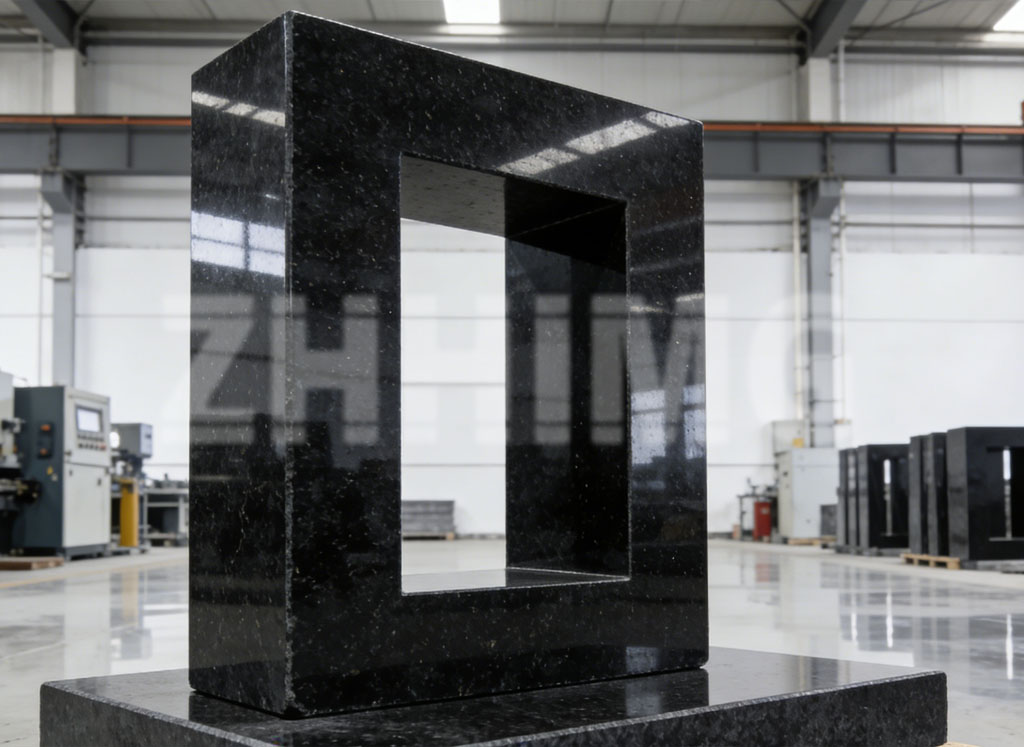
Establishing precise geometries on large surfaces requires exceptional grinding equipment. Facilities tailored for large-scale production utilize high-end precision grinding installations, such as Taiwanese Nante grinding systems valued at over $500,000 per unit. These large machine tools can grind both metallic and non-metallic surfaces across lengths up to 6,000mm, providing a highly precise baseline before components move to the final manual lapping stage.
Production Capacity and Throughput
In the B2B supply chain, scale involves both physical size and volume capacity. While small workshops can occasionally process individual large blocks over extended periods, high-volume industries like semiconductor packaging and new-energy battery inspection require continuous, predictable delivery.
Operating multiple advanced production lines allows top-tier manufacturers to achieve major throughput milestones, such as producing up to 20,000 sets of 5,000mm precision beds per month. This scale of operation enables OEMs to secure their supply chains and rapidly scale up their own machine assembly lines.
Cross-Industry Applications of Large Granite Components
Ultra-large precision foundations serve as the structural backbone for many advanced modern technologies:
-
Semiconductor Lithography & AOI: Provides an ultra-flat reference surface (often accurate to the nanometer level) for high-frequency optical scanning and wafer transport systems.
-
Perovskite Solar Coating Machinery: Ensures exact slot-die coating gaps across wide glass substrates, where variations of just one micron can ruin the film layer.
-
High-Speed XY Tables & Linear Motor Platforms: Offers the high structural mass needed to neutralize the reaction forces of rapid motor reversals, maintaining system stability.
-
Precision CNC & Laser Machining: Prevents structural twisting during high-speed femtosecond and picosecond laser processing operations.
Securing Long-Term Stability for Global Supply Chains
For global engineering groups, purchasing a large-scale precision foundation represents a multi-decade capital investment. The risk of using unverified suppliers includes structural shifting over time, which can lead to expensive field recalibrations and warranty claims.
Choosing partners with comprehensive international certifications—such as ISO 9001, ISO 14001, and ISO 45001—ensures that every large-scale component is processed under strict quality controls. When extensive production capacity is backed by validated material science and rigorous metrology traceability, system integrators can confidently design next-generation machines, knowing their foundations are built to last.
Post time: Jul-13-2026