
Oversized granite beds over 5 meters are essential substrates for semiconductor inspection, large-format CMM and high-power laser equipment. A pervasive industry headache plagues most manufacturers: long granite slabs retain massive internal residual stress after rough cutting. If ground in one single pass, uneven stress release triggers post-processing warpage, drifting flatness and persistent precision decay under long-term static load. As the benchmark ultra-precision component supplier ZHHIMG pioneers segmented stepwise grinding technology to solve this pain point. By machining long granite workpieces section by section with staged stress relief, we thoroughly disperse internal rock stress and machining stress, delivering permanently stable nanometer-level flatness for extra-large granite structures. This refined processing technique embodies our quality tenet: The precision business can’t be too demanding.
1. Hidden Risks of Residual Stress in Long Granite Components
ZHHIMG adopts high-density black granite at 3100kg/m³, far denser and more rigid than marble and European & American granite variants. Even so, lengthy blanks up to 20 meters carry dual residual stress sources: original geological stress formed during mineral crystallization, and new cutting stress generated by heavy CNC roughing.
Traditional one-time full-length grinding locks stress inside the stone temporarily. Days or months after delivery, stress slowly releases, causing irreversible bending and surface distortion. For customers operating 24-hour continuous production lines, deformed granite bases lead to frequent equipment recalibration, unstable AOI and X-Ray detection data, and substantial production losses. Many small factories skip stress relief procedures entirely and even substitute cheap marble, resulting in severely defective finished products. ZHHIMG firmly rejects such deceptive production methods.
Our four dedicated granite machine bed production lines process thousands of long granite workpieces monthly. Without targeted segmented stress relief, consistent long-term dimensional stability would be impossible to guarantee for mass orders.
2. Core Mechanism & Standard Workflow of ZHHIMG Stepwise Grinding Technology
Our proprietary stepwise grinding divides ultra-long granite workpieces into independent equal sections, matching segmented grinding with staged natural aging to release residual stress layer by layer and section by section. The complete standardized procedure follows three key phases:
Phase 1: Segmented rough grinding & primary stress relaxation
We split 5–20m granite blanks into multiple uniform sections on heavy-duty CNC gantry machines. Only one section receives rough grinding per cycle instead of the whole slab. After rough machining, the workpiece is transferred to our 20,000 m² raw material yard for static aging to release cutting stress generated locally. This avoids cross-regional stress accumulation across the full length.
Phase 2: Interim fine grinding & secondary stress balancing
After each segment completes rough grinding and aging, we carry out partial fine grinding on the same zone with Taiwan Nantong ultra-large grinders (single unit value over USD 500,000). Local micro-deformation from fine grinding is eliminated via short-term placement inside the 10,000 m² constant temperature & humidity workshop, where stable 20℃±0.5℃ ambient conditions accelerate uniform stress dispersion. The workshop’s 1000mm thick super-hard concrete floor and surrounding 500mm×2000mm anti-vibration trenches eliminate external vibration interference during stress balancing.
Phase 3: Full-length finishing & final stress homogenization
Once all individual sections finish segmented grinding and independent stress relief, we execute full-length ultra-fine lapping as the final procedure. Our veteran grinders with over 30 years of hand-polishing experience adjust grinding volume precisely at micron scale to smooth tiny stress boundaries between sections. Post-finishing, workpieces undergo 24-hour constant-temperature standing before full-area laser interferometer inspection with Renishaw equipment. Only when residual stress is fully balanced can products move to assembly or delivery.
This sectional processing mode prevents concentrated stress points on long granite components, completely eradicating post-delivery warpage caused by delayed stress release. 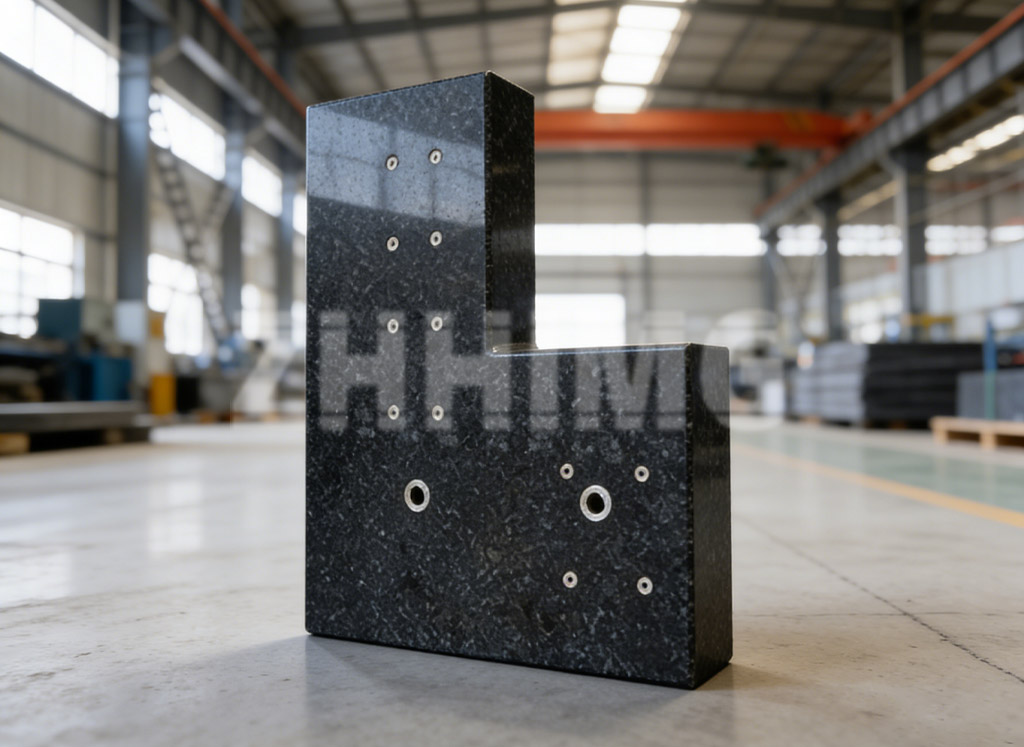
3. Full-System Matching Ensures Technical Implementation Effect
Stepwise grinding performance relies on matched factory infrastructure, inspection standards and employee competence unique to ZHHIMG:
Equipment support: Four exclusive granite production lines are equipped with segmented positioning fixtures and silent overhead cranes, enabling safe segmented handling of single 100-ton workpieces without artificial collision-induced new stress.
Authoritative inspection criteria: Post-grinding flatness, straightness and deformation are verified via German Mahr gauges, Mitutoyo roughness testers and Swiss Wyler electronic levels. All measuring instruments hold calibration certificates traceable to national metrology institutes. Our teams master global standards including DIN, ASME, JIS and GB to unify stress evaluation benchmarks.
Raw material pre-treatment: All granite blanks undergo long-term natural aging in our dedicated stone yard before machining to remove initial geological stress, laying a foundation for efficient stepwise stress release.
As the only manufacturer in this sector holding ISO9001, ISO14001, ISO45001 and CE certifications, we have registered over 20 international patents and trademarks across EU, US and Southeast Asia covering segmented grinding and anti-deformation processing techniques. Our full product portfolio spans precision granite, ceramics, mineral casting, UHPC, carbon fiber beams and 3D printed parts, applying similar staged stress relief logic across all rigid precision substrates.
4. Global Customer Application Feedback
Long granite machine beds processed via ZHHIMG stepwise grinding technology are widely supplied to Fortune 500 clients including Samsung, Apple, GE, Oracle, SCHUNK and Bosch, alongside metrology institutes in UK, France, USA and Singapore.
A leading semiconductor equipment maker ordered 6-meter granite air-bearing bases manufactured with our sectional stress relief process. After 12 months of continuous heavy static load, flatness deviation remained under 0.004mm/m with zero obvious warpage, stabilizing wafer inspection precision and lifting production yield significantly. Metrology labs also adopt our stepwise-ground granite surface plates and straightedges as calibration benchmarks, thanks to their permanent stress-free geometry.
Post time: Jul-21-2026