
1. Substrate Selection and Purification Pre-Treatment: Build a Solid Foundation for Cleanliness
The final surface treatment quality fundamentally depends on substrate performance. For clean-lab applications, porous and loose marble or low-grade stone materials are strictly prohibited. Only high-density, highly homogeneous, and dimensionally stable black granite is adopted. Featuring compact structure, high compression resistance, and ultra-low deformation rate, qualified granite substrates avoid sand loosening, dust shedding, and moisture deformation, laying a reliable foundation for high-precision machining and long-term dust-free operation.
Systematic pre-treatment is mandatory before fine machining. First, manual and mechanical combined inspection eliminates substrates with internal cracks, loose textures, and pore impurities to prevent dust accumulation, contamination, and structural cracking in subsequent service. Second, multi-stage rough grinding corrects tool marks, height differences, and surface irregularities to ensure overall flatness and unified benchmarking. Finally, a combined process of high-pressure dust-free blowing, ultrasonic cleaning, and constant-temperature drying thoroughly removes residual dust, debris, and internal impurities. All procedures comply with international precision metrology standards to create an optimal substrate for fine grinding and sealing treatment.
2. Ultra-Precision Multi-Stage Grinding: Fabricate Nanometer-Level Reference Surfaces
Granite gantries provide critical precision benchmarks for precision instruments and motion platforms, making ultra-precision grinding the core procedure that distinguishes laboratory-grade components from ordinary industrial stone parts. Multi-stage fine grinding replaces traditional rough mechanical polishing for key functional areas, including equipment fitting surfaces, guide rail mounting surfaces, and main load-bearing planes.
The grinding process proceeds progressively from rough trimming, semi-finish shaping, finish calibration to ultra-finish precision optimization. It eliminates micro surface irregularities and optimizes flatness, parallelism, and perpendicularity step by step. With professional ultra-precision grinding techniques, the core working surfaces achieve nanometer-level flatness with micron-level dimensional tolerance, fully compatible with high-end equipment such as femtosecond laser systems, CMM coordinate measuring machines, and semiconductor precision inspection devices.
Beyond precision improvement, ultra-fine grinding optimizes surface compactness for cleanroom applications. The process compacts and closes micro pores on the granite surface, effectively preventing dust retention, moisture penetration, and oil contamination. All grinding procedures are completed in a professional constant-temperature, constant-humidity and vibration-isolated workshop with silent operating systems, ensuring consistent accuracy without local deviation caused by vibration interference.
3. Mirror Polishing and Nano Sealing: Achieve Dust-Free and Easy-to-Clean Performance
High-grade clean laboratories have zero tolerance for dust and contamination. Ordinary matte stone surfaces with micro uneven textures easily absorb suspended particles and cleaning residues, leading to substandard cleanliness. Therefore, exterior surfaces, side walls, and non-working top surfaces of granite gantries require integrated mirror polishing and nano sealing treatment.
Graded imported ultra-fine abrasives are applied for progressive mirror polishing to eliminate micro burrs and surface defects, forming a high-flatness mirror finish. The dense and smooth surface leaves no dust adhesion points, enabling thorough cleaning via simple dry wiping with no dead corners, fully meeting cleanroom operation standards.
Professional nano sealing is implemented after polishing. Environment-friendly stone-specific sealing materials penetrate and fill micro pores while forming a thin protective film on the surface. The transparent film does not affect the original precision and physical properties of granite, but provides excellent waterproof, anti-fouling, anti-aging, and weak acid/alkali resistant performance. It blocks external moisture, dust, and chemical contaminants, preventing weathering, discoloration, and sand shedding to extend the service life of gantries in clean environments. 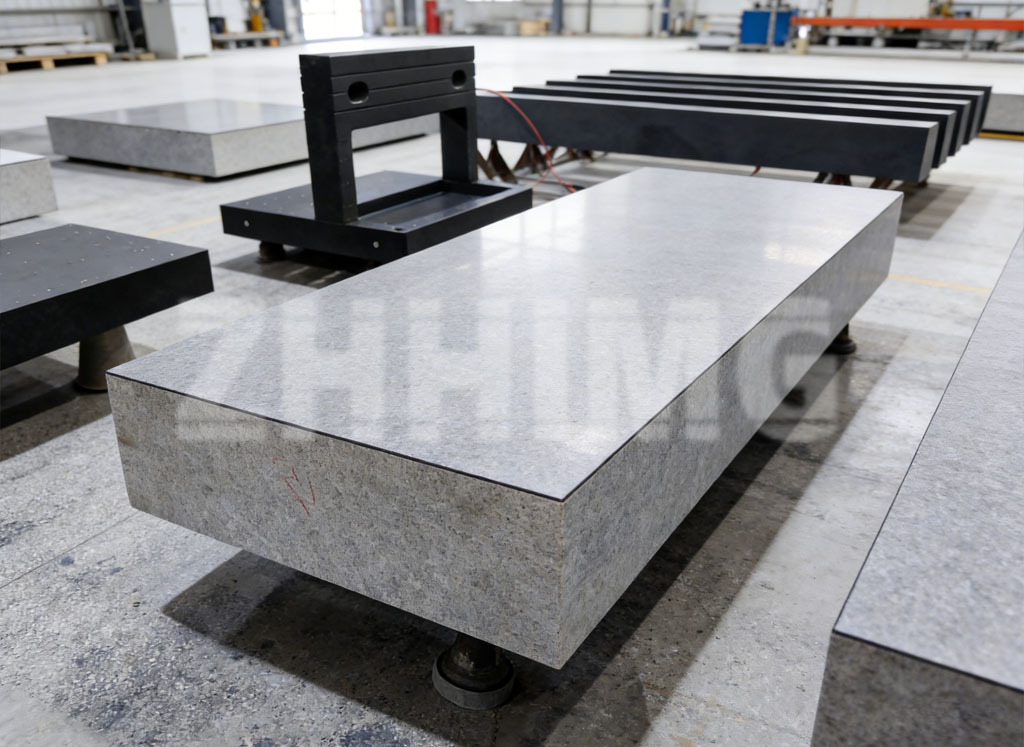
4. Edge Rounding and Blunting: Eliminate Dust Dead Corners and Enhance Structural Stability
Sharp right-angle edges of traditional stone parts are easily overlooked dust and particle sources in clean laboratories. Sharp edges are fragile and prone to chipping and particle falling during installation and maintenance, forming unclean dead corners that accumulate fine dust and pollute the clean environment. All edges, splicing joints, and contours of cleanroom-grade granite gantries require standardized rounding and blunting treatment.
Professional precision grinding tools are used to convert sharp right angles into smooth standard rounded corners with no chipping, burrs, or notches. This process completely eliminates cleaning dead corners and structural dust accumulation risks. Meanwhile, it optimizes the overall stress structure of the gantry, improving collision and wear resistance and preventing particle generation during long-term operation. The standardized appearance also matches the construction requirements of high-end laboratories.
5. Anti-Static and Anti-Corrosion Reinforcement: Adapt to High-End Precision Cleanroom Scenarios
High-grade clean laboratories for semiconductors, precision optics, and metrology require strict control over static electricity and material corrosion. Static charges absorb airborne micro particles, causing contamination of precision lenses and electronic components. In addition, daily cleaning agents and trace corrosive gases in laboratories may erode ordinary stone surfaces, resulting in material aging and precision drift. Hence, high-end cleanroom granite gantries require additional anti-static and anti-corrosion surface reinforcement.
Based on polished and sealed surfaces, a professional anti-static coating is applied to form a uniform and stable protective layer that releases static electricity effectively and prevents particle adsorption. The reinforced surface resists erosion from common acid-base cleaners and trace corrosive gases, avoiding surface oxidation, aging, and discoloration. It maintains stable surface condition and structural precision long-term, adapting to high-load, high-precision, and ultra-clean laboratory operating conditions.
6. Full-Range Precision Inspection and Dust-Free Finishing: Ensure Qualified Final Delivery
After all surface treatment procedures are completed, full precision inspection and dust-free finishing are mandatory before delivery. Adhering to international multi-standard metrology specifications, professional high-precision testing equipment verifies flatness, perpendicularity, surface finish, anti-static performance, and sealing quality to fully comply with high-grade clean laboratory standards. Qualified products undergo final dust removal and sealed protection in a dust-free workshop to avoid secondary contamination during transportation and installation, delivering fully qualified granite gantries that provide stable, clean, and high-precision load-bearing support for precision laboratory equipment.
Post time: Aug-13-2026