
Introduction: The Foundation of Modern Manufacturing
In the high-stakes world of advanced manufacturing, the axiom “you can’t make it if you can’t measure it” has never been more relevant. For QC Engineers, Lab Managers, and B2B procurement specialists, the pursuit of nanometer-level accuracy is a constant challenge. The performance of any high-end equipment—from Coordinate Measuring Machines (CMMs) to semiconductor lithography steppers—is ultimately limited by the stability of its foundational structure.
Traditionally, cast iron and steel have served as the standard materials for machine bases and metrology platforms. However, as industries demand tighter tolerances and faster throughput, the physical limitations of metal—namely thermal expansion, internal stress relaxation (“creep”), and susceptibility to corrosion—have become significant bottlenecks. This has triggered a technological iteration in the industry: a decisive shift toward advanced materials like natural black granite, precision ceramics, and mineral casting.
This article explores how upgrading to these ultra-precision metrology platforms is not just a material change, but a strategic operational upgrade that directly boosts quality and efficiency in the high-end equipment industry.
The Material Revolution: Beyond Cast Iron
The core of the technological iteration lies in the transition from metallic bases to non-metallic, dimensionally stable materials. At ZHHIMG, we have observed that the most successful high-end equipment manufacturers are those that treat the machine base not as a passive support, but as an active component of the precision system.
1. Natural Black Granite: The Standard for Stability
Natural black granite remains the gold standard for metrology due to its unique geological properties. Unlike cast iron, which is poured and cooled (locking in internal stresses), granite has been under immense pressure for millions of years, making it naturally stress-free.
Natural black granite remains the gold standard for metrology due to its unique geological properties. Unlike cast iron, which is poured and cooled (locking in internal stresses), granite has been under immense pressure for millions of years, making it naturally stress-free.
- Zero Creep: Granite does not warp over time. Once machined to DIN 876 or ASME B89.3.1 standards, it maintains that geometry indefinitely, ensuring the equipment remains accurate for decades without recalibration drift.
- Corrosion Resistance: In environments involving coolants or humidity, granite is chemically inert. It does not rust, pit, or oxidize, eliminating a major source of measurement error and maintenance cost.
- Thermal Stability: With a lower coefficient of thermal expansion compared to steel, granite is less affected by ambient temperature fluctuations, a critical factor for maintaining accuracy in non-climate-controlled production floors.
2. Precision Ceramics: The Next Generation
For applications requiring even higher performance, specifically in semiconductor and optical inspection, precision ceramics (often aluminum oxide-based) represent the cutting edge.
For applications requiring even higher performance, specifically in semiconductor and optical inspection, precision ceramics (often aluminum oxide-based) represent the cutting edge.
- Extreme Hardness: Ceramics are significantly harder than granite, offering superior resistance to dings, scratches, and wear.
- Ultra-Low Density: Ceramic components can be up to 40% lighter than granite, allowing for faster acceleration and deceleration in moving gantry systems without sacrificing rigidity.
Technical Analysis: How Platform Stability Drives Efficiency
When evaluating the Return on Investment (ROI) for ultra-precision platforms, decision-makers must look beyond the initial purchase price. The true value lies in the reduction of measurement uncertainty and the increase in throughput.
Damping Capacity and Vibration Isolation
One of the most critical yet often overlooked specifications is damping capacity—the material’s ability to absorb vibration.
One of the most critical yet often overlooked specifications is damping capacity—the material’s ability to absorb vibration.
- The Problem: High-speed motors and nearby factory traffic create micro-vibrations that can blur optical sensors or cause contact probes to chatter, leading to noisy data and scrapped parts.
- The Solution: Natural granite and mineral casting possess damping capacities up to 10-30 times higher than steel or cast iron. By absorbing this energy, the metrology platform provides a “quiet” surface, allowing sensors to take readings faster and with higher confidence. This directly translates to higher inspection throughput.
Coefficient of Thermal Expansion (CTE) Comparison
Temperature is the enemy of precision. As machines heat up from internal motors or ambient shifts, the base material expands.
Temperature is the enemy of precision. As machines heat up from internal motors or ambient shifts, the base material expands.
| Material | Approx. CTE (10⁻⁶/K) | Impact on Precision |
|---|---|---|
| Steel | ~11.5 | High sensitivity to temp changes; requires strict climate control. |
| Cast Iron | ~10.5 | Moderate sensitivity; prone to thermal gradients. |
| Black Granite | ~6.0 – 7.0 | Superior stability; roughly half the expansion of steel. |
| Precision Ceramic | ~4.5 – 5.5 | Ultimate stability; ideal for sub-micron applications. |
By selecting a material with a lower CTE, equipment manufacturers can relax the environmental requirements of the end-user’s facility, making the equipment more robust and versatile.
Integration of Air Bearings and Mechanical Components
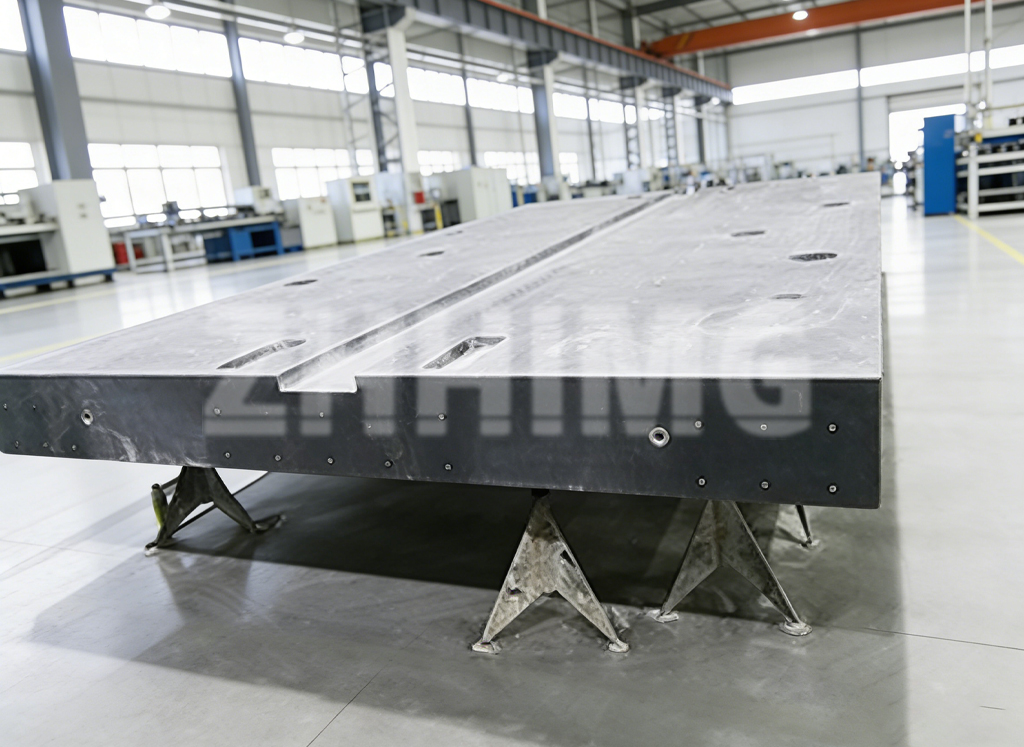
Modern ultra-precision platforms are rarely just a block of stone. The technological iteration includes the integration of precision-machined features directly into the base.
Modern ultra-precision platforms are rarely just a block of stone. The technological iteration includes the integration of precision-machined features directly into the base.
- Vacuum & Air Holes: Deep hole drilling allows for the integration of air bearings directly into the granite or ceramic, creating frictionless motion systems essential for smooth, high-accuracy scanning.
- Threaded Inserts: High-strength anchoring systems allow for the secure mounting of linear motors and guides without compromising the structural integrity of the stone.
Application Scenarios: Quality in Action
The shift to these advanced metrology platforms is most visible in industries where failure is not an option.
Semiconductor & Electronics
In wafer inspection and PCB manufacturing, the equipment must be non-magnetic and electrically insulating. Granite and ceramic bases provide the perfect platform for electron microscopes and wire bonders, ensuring that the measurement of microscopic circuits is not distorted by magnetic interference or thermal drift.
In wafer inspection and PCB manufacturing, the equipment must be non-magnetic and electrically insulating. Granite and ceramic bases provide the perfect platform for electron microscopes and wire bonders, ensuring that the measurement of microscopic circuits is not distorted by magnetic interference or thermal drift.
Aerospace & Automotive Metrology
Large-scale CMMs and laser trackers rely on massive granite or mineral casting bases. The high mass-to-weight ratio and superior damping allow these machines to measure large turbine blades or car chassis with high speed and repeatability, significantly reducing the time-to-market for new vehicle models.
Large-scale CMMs and laser trackers rely on massive granite or mineral casting bases. The high mass-to-weight ratio and superior damping allow these machines to measure large turbine blades or car chassis with high speed and repeatability, significantly reducing the time-to-market for new vehicle models.
Precision Optics
For the manufacturing of lenses and mirrors, surface finish is paramount. The non-porous nature of precision ceramics ensures that no contaminants are released into the cleanroom environment, maintaining the quality of the optical coatings.
For the manufacturing of lenses and mirrors, surface finish is paramount. The non-porous nature of precision ceramics ensures that no contaminants are released into the cleanroom environment, maintaining the quality of the optical coatings.
Conclusion: Building for the Future of Precision
The technological iteration of metrology platforms is not merely a trend; it is a necessary evolution to meet the demands of Industry 4.0. By moving away from traditional metals and adopting natural black granite, precision ceramics, or mineral casting, manufacturers are solving the fundamental physics problems that limit accuracy.
For QC Engineers and Lab Managers, investing in equipment built on these superior foundations means:
- Higher Quality: Reduced measurement uncertainty and better repeatability.
- Higher Efficiency: Faster scanning speeds due to better vibration damping.
- Lower Lifecycle Costs: Immunity to corrosion and aging means the equipment holds its value and accuracy longer.
At ZHHIMG, we specialize in transforming raw geological and synthetic materials into ultra-precision mechanical components. Whether you require a massive granite base for a gantry system or a complex ceramic stage for an optical device, our manufacturing capabilities ensure your foundation is as precise as your application demands.
Ready to upgrade your equipment’s foundation? Visit www.zhhimg.com to explore our full range of precision granite, ceramic, and mineral casting solutions, or contact our engineering team for a custom consultation.
Post time: Sep-01-2026