
Twenty years ago, specifying a granite base for a piece of production equipment was still something you had to defend in a design review. It looked unconventional next to cast iron and welded steel, and purchasing departments generally wanted to know why anyone would pay more for stone. That conversation has largely reversed. On a lot of semiconductor, metrology, and optical equipment today, the unconventional choice is metal — and the shift didn’t happen because non-metallic materials got trendy. It happened because tolerances tightened faster than metal could keep up.
What Actually Pushed the Shift
Precision requirements didn’t creep upward gradually; in several industries they jumped. Semiconductor lithography, wafer inspection, and advanced CMM work moved into tolerance ranges where thermal expansion in metal structures stopped being a minor correction factor and became the dominant source of measurement error. A welded steel frame that performed fine at ±10 micron tolerances becomes a liability at ±1 micron, not because the steel got worse, but because the acceptable margin for its known weaknesses — thermal drift, internal stress relief, vibration transmission — shrank to nearly nothing. Engineers didn’t abandon metal by preference. They ran out of room for its limitations.
Granite’s Shift From Niche to Standard
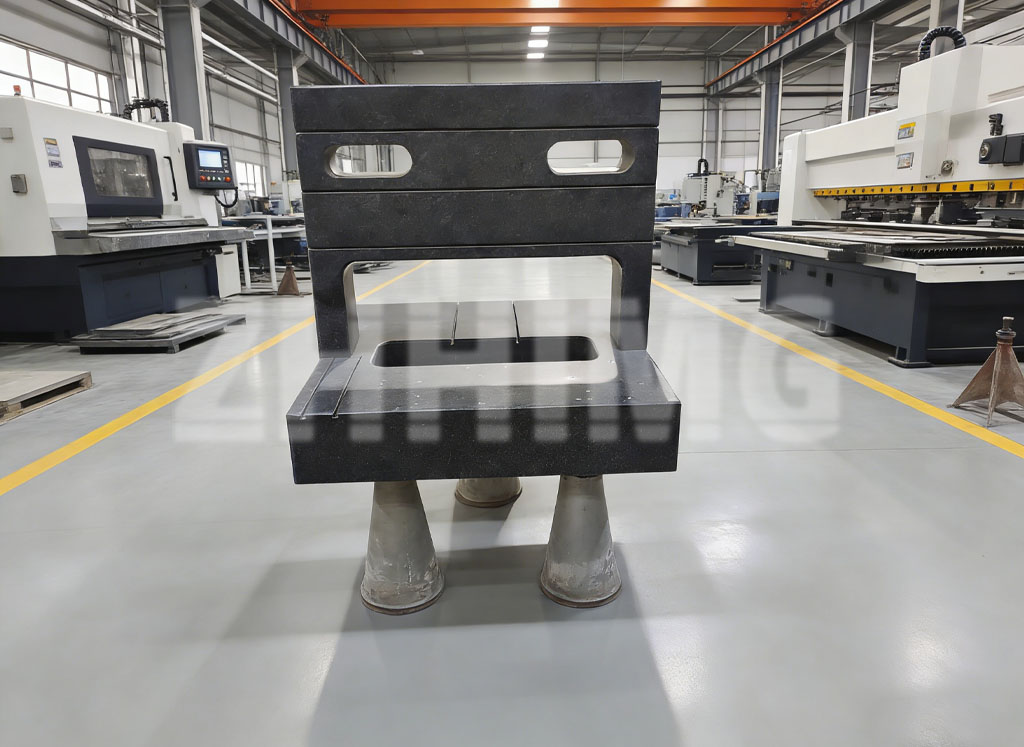
Granite was the first non-metallic material to move from lab curiosity to production standard, largely on the strength of two properties: low thermal conductivity and high damping. It doesn’t just expand less than steel — it responds more slowly to ambient change, which matters more in real factory conditions than a lab CTE spec sheet suggests. What changed the adoption curve wasn’t the material discovery, which is old; it was manufacturing capability. Machining large, single-piece granite structures with tight flatness and squareness used to be slow and expensive enough to limit granite to smaller reference tooling — surface plates, gauge blocks — rather than full machine bases. Advances in large-format grinding equipment changed that math, making single-piece granite beds and gantry structures practical at scales that would have required segmented, bolted assemblies a generation ago. We’ve built our own production around that shift, running equipment capable of machining single granite pieces up to 20 meters in length, which simply wasn’t a realistic production line a couple of decades back.
Ceramic’s Narrower but Deeper Role
Ceramic components followed a different adoption path — narrower in application but often deeper in performance requirement. Where granite solves structural and base-level stability, technical ceramics get specified when electrical insulation, extreme wear resistance, or very low outgassing is non-negotiable, particularly in vacuum-adjacent semiconductor equipment and high-precision measuring instruments. Ceramic hasn’t displaced granite so much as claimed the tier of applications where granite’s properties, while good, aren’t quite good enough — a smaller slice of the market, but one that’s grown as vacuum and cleanroom-adjacent manufacturing expanded.
Mineral Casting and the Middle Ground
Mineral casting occupies a middle position that’s worth understanding on its own terms rather than as a granite substitute. It offers strong vibration damping and design flexibility — complex geometries that would be difficult or slow to machine from solid granite can be cast instead — at some trade-off in achievable stiffness and long-term dimensional certainty compared to natural stone. For machine tool bases and structures where geometry complexity matters more than absolute peak stability, mineral casting has carved out a legitimate and growing role rather than functioning as a budget alternative.
Carbon Fiber’s Entry Into Structural Precision
The more recent development is carbon fiber moving into structural precision roles — bridge beams and gantry structures where weight matters as much as stiffness. Granite’s mass is an advantage for damping but a real constraint for high-speed motion systems, where a heavier moving structure limits achievable acceleration and settling time. Carbon fiber precision beams address that directly: high stiffness-to-weight ratio, low thermal expansion along the fiber axis, and enough design flexibility to tune stiffness directionally. It’s a smaller share of the non-metallic components market today, largely because the manufacturing cost and complexity are higher, but it’s the clearest sign that “non-metallic” is no longer a single strategy — it’s a materials toolkit, with granite, ceramic, mineral casting, UHPC, and carbon fiber each solving a different part of the precision problem.
Where This Is Heading
The direction is fairly clear even without predicting specifics: as tolerance requirements keep tightening in semiconductor, optical, and advanced measurement equipment, material selection is becoming a first-order design decision rather than something finalized after the mechanical layout is locked. That’s a meaningful shift in how equipment gets engineered, and it’s changed what purchasing teams need to evaluate — not just cost per part, but thermal behavior, damping characteristics, and manufacturing capability at the scale a given design actually requires. The metal-versus-non-metal question isn’t really a question anymore in high-precision segments. The real question is which non-metallic material fits a specific application, and that’s a more interesting problem to solve.
Post time: Aug-07-2026