
The modern manufacturing floor is a symphony of motion. Automated precision inspection equipment, from high-speed coordinate measuring machines (CMM) to advanced optical profilers, operates with relentless speed and accuracy. Yet, the performance of these dynamic systems is entirely dependent on a static foundation. As automation pushes the boundaries of throughput and tolerance, the role of the granite base plate has evolved from a simple work surface to a highly engineered structural component. For engineering purchasers and quality managers, understanding the critical function of this foundation is essential for maintaining metrology integrity in automated environments.
Automated inspection systems introduce unique mechanical challenges. The rapid acceleration and deceleration of gantries, the impact of probing cycles, and the continuous operation of linear motors generate significant dynamic forces. A foundation that flexes or vibrates under these loads will immediately degrade measurement repeatability. This is where the inherent physical properties of high-density black granite become indispensable. With a density approaching 3100 kg/m³, premium granite offers exceptional mass and structural rigidity. This mass acts as a kinetic energy sink, absorbing and dissipating the dynamic forces generated by automated systems before they can distort the measurement plane.
Thermal stability is another critical factor in automated environments. High-speed machinery and integrated lighting systems generate localized heat. A base plate with poor thermal conductivity or a high coefficient of expansion will warp under these thermal gradients, introducing systematic errors that are difficult to compensate for. High-density granite’s low thermal expansion coefficient and superior thermal inertia ensure that the reference plane remains stable, even as the automated system operates continuously. This stability is particularly vital in semiconductor manufacturing and optical inspection, where tolerances are measured in nanometers and even microscopic thermal shifts can render a batch of components non-compliant.
The integration of granite base plates into automated systems also requires precise engineering. Modern CMMs and inspection platforms often utilize air bearings to achieve frictionless motion. These systems demand a surface that is not only flat but also dimensionally stable over decades of use. The manufacturing process for such base plates must be uncompromising. It requires massive, climate-controlled cleanrooms where temperature fluctuations are strictly controlled, and foundations are isolated from ground-borne vibrations through anti-vibration trenches and ultra-thick concrete bases. Only within such an environment can master craftsmen, leveraging decades of tactile experience, achieve the nanometer-level flatness required for air-bearing systems.
For quality managers evaluating automated inspection solutions, the specification of the granite base plate should be as rigorous as the selection of the metrology equipment itself. The market is unfortunately not immune to cost-cutting measures, with some suppliers offering lower-density marble or inferior granite as a substitute. These materials lack the structural integrity and damping performance required for high-precision automation, leading to premature wear and measurement drift. Engineering purchasers must verify material certifications, demand traceable calibration certificates, and assess the manufacturer’s production environment.
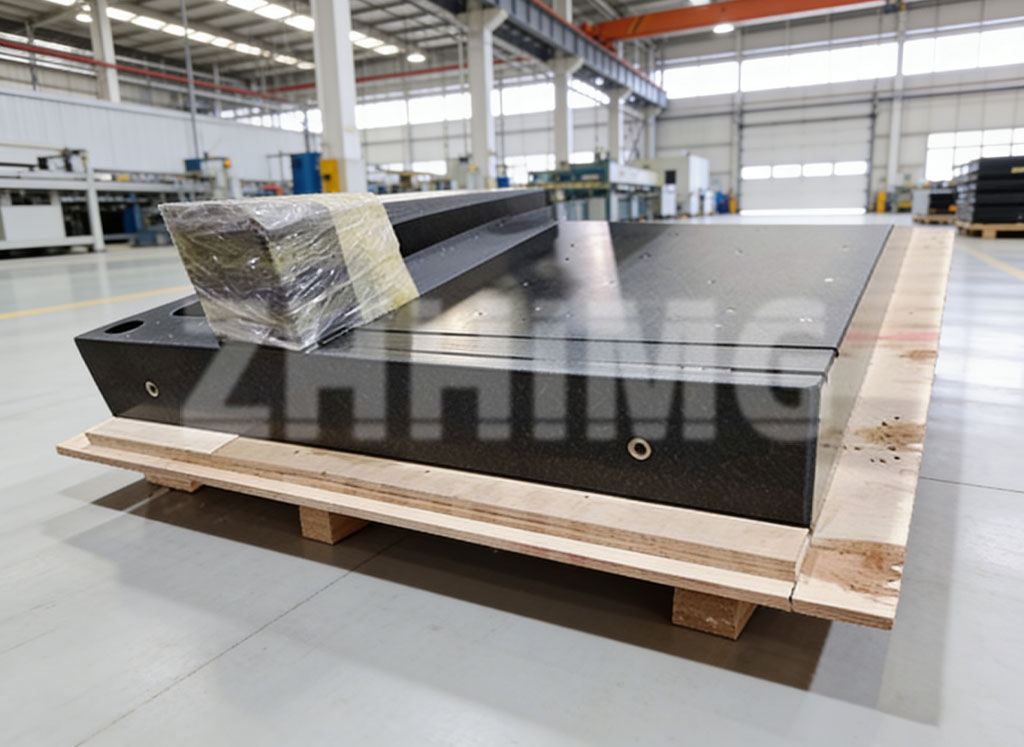
The application of granite base plates in automated precision inspection is a testament to the principle that true accuracy is built from the ground up. As manufacturing continues to demand higher speeds and tighter tolerances, the foundational role of high-density granite will only become more critical. It is the silent, stable partner to the dynamic, high-tech inspection systems that define modern quality control. By investing in a properly engineered granite foundation, manufacturers ensure that their automated systems can deliver on their promise of precision, day after day, year after year.
Post time: Aug-04-2026