
High-speed laser metrology makes small motion errors visible. A stage can appear smooth to the eye and still introduce velocity ripple, angular error, vibration, or short-term drift that affects a laser-based measurement result.
For this reason, ultra-precision ceramic air bearings are increasingly considered in systems that combine rapid motion with demanding measurement requirements. They are used in high-speed scanning stages, laser interferometer systems, optical inspection equipment, semiconductor metrology, precision calibration platforms, and motion assemblies where conventional rolling-contact guideways may limit repeatability.
The principle is straightforward. Pressurized air forms a very thin film between the bearing surface and its guide surface. The moving member floats without direct mechanical contact. That removes many error sources associated with rolling elements, including friction variation, stick-slip, lubrication effects, contact wear, and recirculating bearing noise. Air-bearing stages are widely used where smooth constant velocity, minimal hysteresis, and high positioning resolution are required.
Ceramic materials add another engineering dimension. When correctly selected, processed, and integrated into the bearing architecture, they can provide a rigid, wear-resistant, thermally stable bearing surface for demanding laser metrology applications.
Why Motion Quality Matters to Laser Metrology
Laser interferometers measure displacement by comparing optical path lengths. Their speed and bandwidth make them highly effective feedback devices for precision scanning stages, including applications such as lithography and other high-speed optical measurement systems.
That measurement capability also exposes weaknesses in the motion platform.
A laser measurement system may be evaluating a linear scale, guideway, precision part, optical component, or machine-axis error map. If the stage experiences micro-vibration, pitch, yaw, velocity fluctuation, or direction-reversal disturbance, the platform can contribute to the uncertainty being measured.
At low travel speeds, a conventional mechanical guideway may perform adequately for many industrial tasks. At high scan speeds, bearing contact behavior becomes more significant. Rolling elements pass through loaded zones, lubricant films change, cages move, and friction can vary at reversal. These effects do not mean rolling bearings are unsuitable; they remain practical across a wide range of machines. They do mean that a non-contact motion solution deserves consideration when the measurement objective moves toward nanometer-scale resolution, high-speed scanning, or strict repeatability.
An aerostatic bearing guideway removes direct sliding or rolling contact from the load path. With a stable air film, the carriage can move with very low friction and without the stick-slip behavior that can complicate slow, incremental, or reversing motion. Manufacturers of air-bearing stages identify constant velocity, reduced vibration, low hysteresis, and excellent straightness as key advantages for inspection, scanning, and metrology use.
What Ceramic Contributes
Ceramic air bearings are not simply conventional air bearings made from a harder material. The ceramic element must work as part of a complete system that includes guideway flatness, air-supply quality, restrictor design, preload arrangement, carriage stiffness, structural support, drive system, encoder or interferometer feedback, and environmental control.
Technical ceramics can offer several useful characteristics:
- High stiffness relative to mass, supporting rigid bearing interfaces and compact moving structures.
- Strong wear resistance, particularly valuable during assembly, transport, or an unplanned loss of air supply.
- Corrosion resistance and chemical stability for clean manufacturing and laboratory environments.
- Electrical insulation and non-magnetic behavior, which may be useful around sensitive sensors, optics, or electromagnetic equipment.
- Good dimensional stability when material grade and temperature range are properly matched to the application.
Glass ceramic and related precision-engineered ceramic bearing concepts are also used where controlled thermal behavior and high running accuracy are important. Fraunhofer IOF notes that glass and glass-ceramic air bearings can provide high bearing rigidity, thermal stability through low-expansion materials, and reduced risk of ductile deformation at the contact interface.
The important qualification is that ceramic selection should be based on actual operating conditions. Different ceramics have different thermal expansion behavior, fracture toughness, machinability, porosity, and cost. A design that works well for a short-travel optical stage may not be the right choice for a large gantry, a high-load machine base, or a system exposed to large ambient-temperature changes.
Air Film Quality Is a System Issue
The performance of a ceramic air bearing depends heavily on the quality and consistency of its air film.
Compressed air should be clean, dry, and regulated. Moisture, oil contamination, particulate matter, and pressure fluctuation can affect bearing behavior or damage precision surfaces. Air-supply design should therefore include appropriate filtration, drying, pressure monitoring, shutoff logic, and in some cases a reservoir to manage short pressure disturbances.
Bearing geometry matters as well. Orifice-fed and porous-media air bearings distribute air differently. Porous ceramic bearing materials can create a more uniform pressure distribution through many microscopic pores; this can improve load capacity, stiffness, and disturbance response compared with some conventional discrete-orifice arrangements, depending on the bearing design.
Engineers should also examine the guide surface specification. An ultra-precision air bearing cannot compensate for an unstable structural foundation or a poorly finished guideway. Straightness, flatness, parallelism, surface texture, support-point design, mounting stress, and local thermal gradients all affect the motion result.
This is why high-speed laser metrology platforms are commonly designed as integrated assemblies rather than a collection of individually accurate parts.
Typical Laser-Metrology Applications
Ceramic air bearings are particularly relevant when a system needs smooth translation or rotation while a laser interferometer, optical encoder, autocollimator, camera, or other high-resolution sensor monitors position.
Common examples include:
- Linear laser interferometer calibration systems.
- Wafer and reticle inspection stages.
- Optical scanning and imaging platforms.
- Precision surface-profile measurement equipment.
- High-speed vision-measurement machines.
- Rotary calibration tables and spindle-measurement systems.
- Laser processing equipment with precision beam-position verification.
- Research instruments that require stable, repeatable motion under controlled laboratory conditions.
In wafer scanning and tomography, constant velocity can be as important as final positioning accuracy. A stage that reaches the target position precisely but oscillates during travel may reduce image quality or require slower scans. Non-contact air-bearing motion is often chosen because it can produce smoother travel and shorter settling behavior than contact-bearing alternatives when the full mechanical and control system is properly engineered.
Practical Design Questions Before Purchase
Purchasers evaluating an ultra-precision ceramic air bearing system should request more than a nominal accuracy figure. Useful technical questions include:
- What straightness, flatness, pitch, yaw, and repeatability values are specified across the required travel?
- Are the stated values measured with a laser interferometer, autocollimator, electronic level, or another method?
- At what speed, payload, acceleration, temperature, air pressure, and support configuration were they verified?
- What air cleanliness, dew point, filtration, and pressure-stability requirements apply?
- How does the system respond to an air-supply interruption?
- Which components establish the measurement datum: the bearing, guideway, machine base, or external metrology frame?
- Is the ceramic used as a bearing pad, guideway, structural element, or a combination of these?
These questions help separate a well-integrated precision motion system from a bearing specification considered in isolation.
From Bearing Surface to Machine Structure
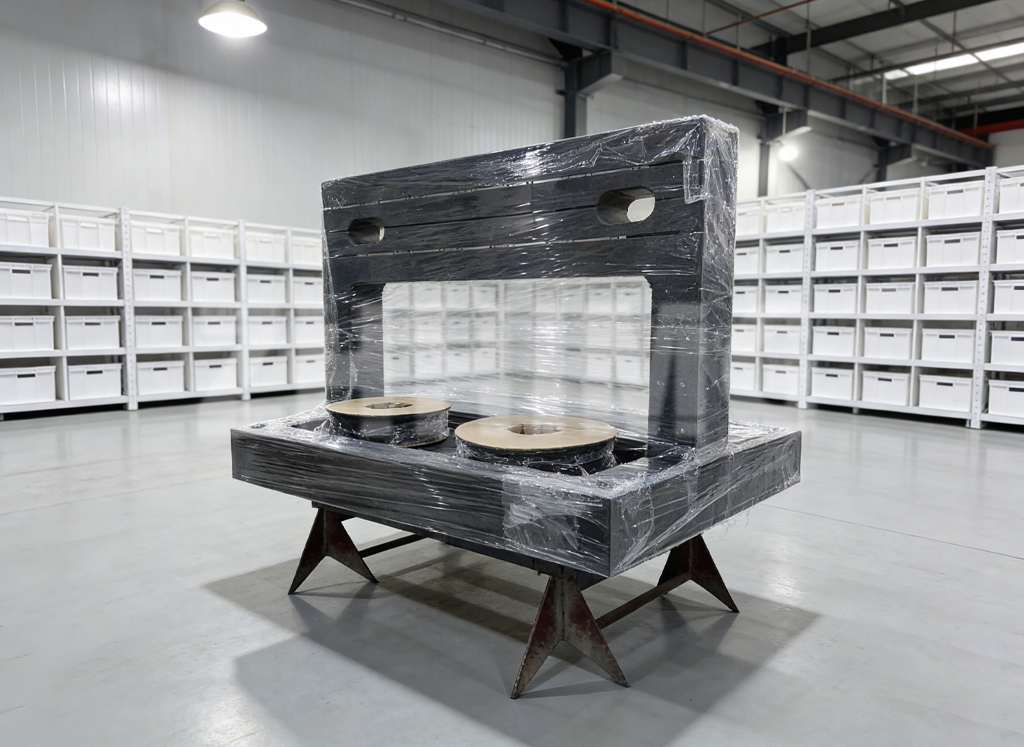
In our work with precision granite, ceramic components, and granite air-bearing structures, the bearing material is only one part of the accuracy chain. The base must provide stable reference geometry; the guideway interfaces must be finished and inspected correctly; inserts and mounting features must not introduce avoidable distortion; and final assembly must be checked in a controlled environment.
ZHHIMG® supports custom precision structures for metrology, laser, semiconductor, and optical-equipment projects, including precision granite components, ceramic precision parts, and air-bearing-related structural assemblies. Material selection is reviewed against the complete machine requirement—travel, load, environmental control, sensor resolution, and assembly method—rather than treated as a standalone purchasing decision.
For high-speed laser metrology, ceramic air bearings can provide a strong technical foundation. Their value is realized when air quality, guideway geometry, structural stability, thermal control, and measurement verification are engineered together.
Post time: Aug-21-2026