
Ask any experienced metrologist about the biggest challenge in maintaining measurement accuracy, and temperature will come up quickly. It’s not that technicians don’t know temperature matters—they do. But understanding exactly how temperature variations affect measurement results, and what can be done about it, requires digging deeper than most training covers.
This is particularly true in workshop environments where temperature fluctuations are a fact of life rather than a controlled laboratory condition. If your facility doesn’t have precision climate control throughout your metrology areas, the behavior of your measurement equipment in response to temperature changes becomes a critical consideration.
This article examines how granite gauges respond to temperature variations, why that behavior matters for your measurements, and what practical steps you can take to account for—or minimize—thermal effects in your daily operations.
Why Temperature Matters So Much in Precision Measurement
Before getting into granite specifically, it’s worth spending a moment on why temperature deserves the attention it gets in metrology discussions.
Dimensional measurements express length in relation to defined reference conditions—typically twenty degrees Celsius, or sometimes another specified temperature. When your measurement environment deviates from those reference conditions, the math becomes imperfect. Every material expands or contracts as temperature changes, and the dimensional difference can be substantial at precision tolerances.
Consider a steel gauge block that nominally measures one hundred millimeters. At twenty degrees Celsius, it’s exactly 100.000mm—assuming it started there. But if the ambient temperature rises to twenty-three degrees, that steel gauge expands by roughly thirty-five microns. For reference, a human hair is about seventy microns in diameter. If you’re working to tolerances measured in microns, a thirty-five micron error isn’t a rounding error—it’s a catastrophe.
The same physics applies to granite, aluminum, and every other solid material. The question isn’t whether temperature affects your measurements—it definitely does. The question is how much, and whether your equipment and procedures account for that effect adequately.
The Thermal Behavior of Granite
Granite expands with increasing temperature, just like metals. But granite’s thermal expansion coefficient is roughly half that of steel and significantly lower than aluminum or brass. This is one of the material’s fundamental advantages in precision applications.
The coefficient for natural granite typically ranges from five to seven microstrain per degree Celsius—written as 5-7 × 10⁻⁶ /°C. Steel runs around eleven to thirteen × 10⁻⁶ /°C. Aluminum can exceed twenty × 10⁻⁶ /°C. These numbers represent how much a meter of material grows per degree of temperature rise.
The practical difference is significant. A one-meter granite surface plate experiences roughly half the dimensional change of a comparable steel artifact for the same temperature shift. A granite gauge with a hundred-millimeter reference dimension expands by about five microns per degree, while a steel gauge of the same length expands by eleven microns.
This doesn’t make granite immune to thermal effects. But it does mean granite responds more slowly and less dramatically to temperature changes, giving you more time to achieve thermal equilibrium before measurements and reducing the magnitude of dimensional shifts you need to account for.
What Happens in a Real Workshop
Workshop environments rarely maintain the stable temperatures found in controlled metrology laboratories. Temperature variations throughout a workday are common—sometimes substantial.
Morning start-up temperatures often run several degrees below the afternoon peak. Direct sunlight through windows creates localized hot spots. Nearby equipment—CNC machines, compressors, heat-treating furnaces—adds thermal load to surrounding spaces. Even HVAC systems cycling on and off create temperature oscillations.
These fluctuations affect your measurement equipment in two ways: directly, as the equipment itself changes temperature, and indirectly, as the workpiece being measured changes temperature before or during measurement.
The indirect effect is often larger than expected. A machined aluminum part that was measured in a temperature-controlled lab may read differently when brought to a shop floor environment—even if the measuring equipment itself remains stable. The part’s temperature may not equal ambient air temperature if it was just sitting near a heat source or coming out of a machining operation.
Granite measurement equipment helps with the direct effect because of its lower expansion coefficient and its excellent thermal mass. Large granite components resist rapid temperature changes due to their thermal mass. A massive granite surface plate doesn’t heat up or cool down as quickly as a thin steel plate of the same area. This thermal inertia acts as a buffer against short-term temperature fluctuations.
Thermal Equilibrium: The Critical Factor
The real question in workshop temperature management isn’t whether temperature is stable—it’s whether your measurement system has reached thermal equilibrium before you take readings.
Thermal equilibrium means all components of your measurement system—the gauge, the workpiece, the surrounding air, and the reference surface if you’re using one—are at the same temperature and have stabilized at that temperature. When equilibrium exists, you can apply corrections based on a single measured temperature value. When equilibrium doesn’t exist, temperature gradients within your measurement system create unpredictable errors.
Achieving equilibrium takes time. A small gauge block might reach ambient temperature in minutes. A large granite surface plate with substantial mass might require hours. The time required depends on the mass of the object, its starting temperature, the temperature difference involved, and how air circulates around it.
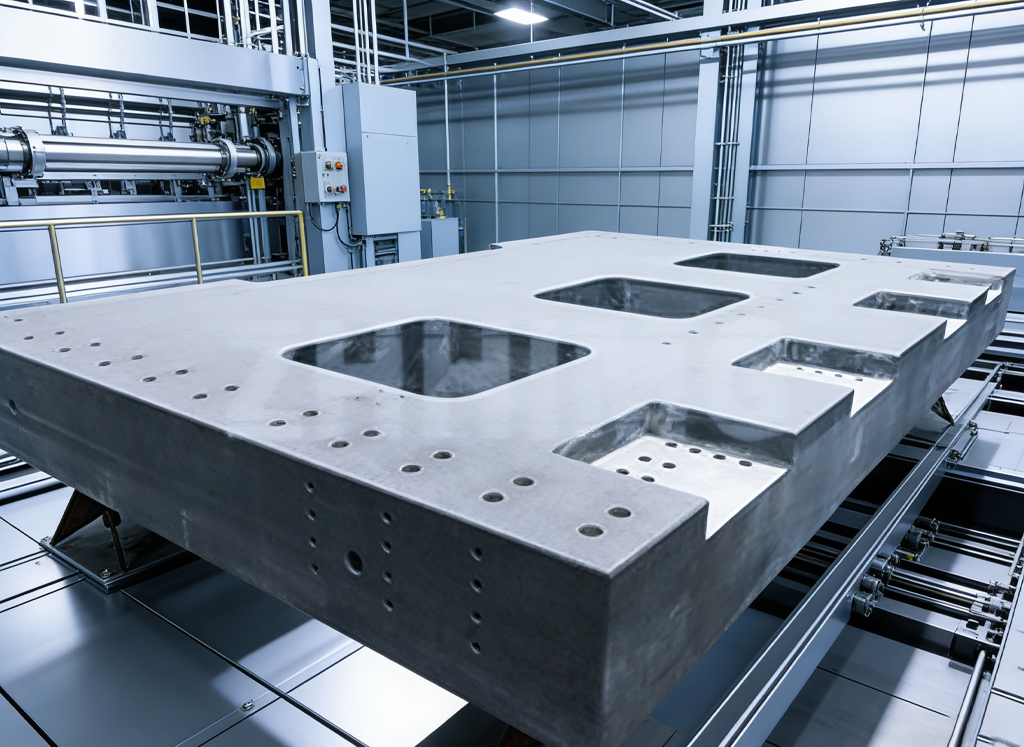
This is where granite’s thermal properties provide another advantage. Granite conducts heat relatively slowly compared to metals. When a granite surface plate’s top surface is warmer than its bottom surface—a common situation when overhead lights heat the working surface—the temperature gradient through the material creates internal stresses that distort the surface flatness. Granite’s slow thermal conduction limits how quickly these gradients develop and how severe they become.
In contrast, a steel plate of the same dimensions would equilibrate faster, but would also develop the same temperature gradients more quickly when conditions change. The practical result is that granite surfaces tend to maintain their reference geometry more consistently through thermal transients, even if reaching full equilibrium takes longer.
Practical Strategies for Workshop Environments
If your metrology operations happen in environments with significant temperature variation, several approaches can help manage thermal effects.
Strategic timing matters more than most people realize. If your facility has predictable temperature patterns—cooler in the morning, warmer after equipment has been running—schedule your most critical measurements for the stable period. Many shops find that mid-morning to early afternoon, after the facility has warmed up but before it cools again, provides the most consistent conditions.
Give equipment time to equilibrate. When you bring a gauge or workpiece from storage into the measurement area, allow adequate time for thermal equalization before beginning measurements. For large granite components, several hours may be necessary. For smaller items, thirty minutes to an hour is often sufficient. The investment in waiting pays off in more reliable results.
Use temperature correction when appropriate. For measurements where thermal effects would exceed acceptable uncertainty limits, applying temperature corrections based on measured temperatures can restore accuracy. This requires knowing the material’s expansion coefficient and measuring the temperature of the item being measured with adequate precision.
Consider facility modifications where practical. Installing local air circulation near measurement stations, using insulating covers during idle periods, and positioning measurement equipment away from heat sources or cold drafts can substantially improve thermal stability without full climate control throughout the facility.
Document your thermal environment. Recording temperature and humidity at the time of measurement provides traceability and helps identify when environmental conditions exceeded acceptable ranges. This information supports both quality assurance and troubleshooting when measurement results seem inconsistent.
Understanding Thermal Distortion
Beyond simple dimensional change, temperature variations can cause geometric distortion in measurement equipment—a more subtle but potentially more serious problem.
A granite surface plate that’s cooler on the bottom than the top develops internal stress patterns that can bow the working surface slightly. The same effect occurs when the plate’s edges cool faster than its center, or when localized heating creates temperature gradients across the surface.
These distortions are usually small—measured in fractions of a micron—but at the precision levels modern manufacturing demands, they can be significant. A surface plate that reads flat under uniform temperature conditions might show measurable departure from flatness when temperature gradients exist.
For the most demanding applications, allowing measurement only after temperature gradients have dissipated provides the most reliable geometry. For routine work where this level of control isn’t practical, understanding that some additional uncertainty exists during thermal transients allows appropriate uncertainty budgeting.
Matching Your Approach to Your Requirements
The appropriate response to thermal effects depends on your measurement requirements. For routine inspection where tolerances are measured in thousandths of an inch or coarser, awareness of temperature effects may be sufficient. For precision work pushing toward micro-inch tolerances, active thermal management becomes necessary.
Know your tolerance-to-uncertainty ratio. Your measurement uncertainty should be no more than one-tenth of your tolerance band. If your tolerance is 0.001 inches and your measurement uncertainty is 0.0001 inches, thermal effects that contribute more than a few microinches to your uncertainty budget demand attention.
Consider the material of the workpieces you measure most often. Aluminum expands roughly twice as much as steel per degree, and three to four times as much as granite. Temperature control matters more for aluminum workpieces than for steel ones.
For high-volume precision production, the economics of improved thermal control often favor investment in better measurement environments. Reduced scrap, fewer re-measurements, and more confident acceptance decisions can justify climate control improvements that initially seem expensive.
The Bottom Line on Thermal Stability
Temperature variation is a fact of workshop life. It cannot be eliminated—only managed. Understanding how your measurement equipment responds to temperature changes is essential for anyone pursuing reliable results in non-laboratory environments.
Granite measurement components offer meaningful advantages in thermal management. Lower expansion coefficients reduce dimensional change per degree. Greater thermal mass buffers against short-term fluctuations. Slower heat conduction limits distortion from temperature gradients.
These advantages don’t eliminate the need for good measurement practice. Thermal equilibration time, temperature monitoring, and appropriate corrections all remain important. But granite’s inherent thermal stability makes achieving adequate measurement accuracy more achievable in challenging environments than it would be with materials that respond more dramatically to temperature changes.
Ready to explore how granite measurement components can improve your thermal management? Our technical specialists can help you evaluate your specific requirements and recommend equipment configurations suited to your operational environment. Whether you’re working in a climate-controlled lab or a fluctuating workshop, we’ll help you find solutions that deliver the measurement accuracy your quality goals demand.
Contact us to discuss your thermal stability challenges and discover practical paths forward.
Post time: May-21-2026