
Vibration damping is one of the most important and frequently misunderstood requirements in precision machinery. A structure can be heavy, strong, and stiff, yet still transmit or sustain vibration long enough to affect machining quality, optical alignment, positioning repeatability, or measurement uncertainty.
This distinction matters in CNC machine tools, laser systems, semiconductor equipment, coordinate measuring machines, optical inspection platforms, and precision automation. As axis acceleration and process speeds increase, the machine frame must manage forces generated internally while also limiting vibration entering from the floor, nearby equipment, pumps, operators, and material-handling activity.
Cast iron remains a proven material for machine structures. Natural granite has a long history in metrology and precision motion systems. Ultra-high-performance concrete (UHPC) is gaining attention for custom machine bases and hybrid structures. Each material has a different balance of stiffness, damping, thermal behavior, manufacturability, and integration options.
The best material is not simply the one with the highest quoted damping value. It is the one that supports the complete machine design and its required error budget.
Damping and Stiffness Are Different
Machine builders often discuss stiffness and damping together, but they perform different functions.
Stiffness determines how much a structure deflects under a static or dynamic load. High stiffness helps maintain rail alignment, spindle position, gantry geometry, and tool-to-workpiece relationships. Damping determines how quickly vibration energy is dissipated after a disturbance. Good damping reduces the amplitude and duration of oscillation.
A high-speed CNC machine needs enough stiffness to resist cutting forces and enough damping to prevent vibration from continuing through repeated tool engagement. A laser machine requires stable alignment between the motion system, optical components, and work zone. A metrology platform needs low structural movement during scanning, probing, or image acquisition.
Natural frequency also matters. Every structural assembly has resonant modes. If forcing frequencies from spindle rotation, servo motion, linear motors, or external sources coincide with those modes, vibration can increase sharply. Material selection changes the picture, but geometry, mass distribution, joint design, guideways, foundation stiffness, and control tuning remain equally important.
Cast Iron: A Proven Structural Material
Cast iron has been used for machine beds and machine frames for generations. It offers good compressive strength, practical stiffness, established manufacturing processes, and the ability to create complex ribbed forms through casting.
For conventional CNC machines, lathes, machining centers, and heavy-duty equipment, cast iron remains a sensible choice. Its mass helps resist movement, and grey cast iron provides better inherent damping than many fabricated steel structures. It can be machined accurately after stress relief and can accommodate rails, bearing housings, drive systems, and precision interfaces.
Its limitations become more visible in highly dynamic precision equipment. Cast iron is still a metal structure, so its internal damping is generally lower than that of engineered composite materials, UHPC, or natural granite. It can also respond relatively quickly to localized heat sources. Motor heat, spindle heat, coolant temperature, sunlight, and uneven ambient conditions can create thermal gradients that influence machine geometry.
This does not make cast iron unsuitable for precision work. It means thermal design, rib geometry, damping treatments, and environmental control become more important as required accuracy increases.
Natural Granite: A Stable Metrology Reference
Natural granite is widely used for granite surface plates, CMM bases, optical equipment, air-bearing structures, linear-motion platforms, and precision inspection machines. Its appeal comes from its dimensional stability, low thermal conductivity, non-magnetic behavior, corrosion resistance, and useful natural vibration damping.
A granite machine base does not conduct heat as rapidly as metal. This can reduce the speed at which short-term thermal disturbances travel through the structure. For measurement systems operating in controlled environments, that slower thermal response can help maintain a more stable reference geometry.
Granite also absorbs vibration energy differently from metal structures. Its mineral composition and internal crystalline structure provide greater damping than many conventional metallic frames. Precision granite suppliers identify its thermal stability and vibration-damping performance as key reasons for use in metrology, electronics production, optical systems, and precision mechanical engineering.
Granite has design constraints. It is not cast into complex near-net shapes like iron, and extensive machining, bonding, inserts, or assembly work may be needed to create integrated functions. Long bridges and large assemblies require careful handling, transport planning, support design, and joint engineering. Edge loading, thread inserts, rail mounting areas, and lifting features should be specified during the early design stage.
At ZHHIMG®, natural granite is frequently used for precision bases, surface plates, straightedges, square rulers, air-bearing components, and assembled structures. In applications where long-term stability and a precise common datum are central requirements, granite remains a practical solution.
UHPC: Engineered Damping and Design Freedom
UHPC is an engineered cementitious composite that can be formulated for high strength, dense microstructure, and low porosity. In machine-base applications, it offers a combination of mass, thermal stability, vibration damping, and shape flexibility.
UHPC structures can be cast around embedded inserts, conduits, cooling channels, and reinforcement features. This allows a machine designer to integrate functions that would otherwise require separate fabricated parts. It is especially relevant for custom precision machine frames, large automation bases, hybrid steel-concrete structures, and equipment requiring complex internal geometry.
Industry sources describe UHPC and similar high-strength concrete materials as having low thermal conductivity, low thermal expansion, and material damping that can substantially exceed metal structures. One precision-granite supplier reports UHPC damping at approximately eight times that of metal for certain applications, but actual performance depends on the specific formulation, structure, and test conditions. Machine-bed suppliers also use UHPC-based compounds to damp vibration and influence natural frequencies in hybrid steel or cast-iron structures.
UHPC is not a simple substitute for granite or cast iron. Its curing process, shrinkage control, insert design, machining allowance, and long-term moisture management require specialized manufacturing knowledge. Critical rail seats and reference surfaces may require post-casting machining or the integration of precision granite and metal elements.
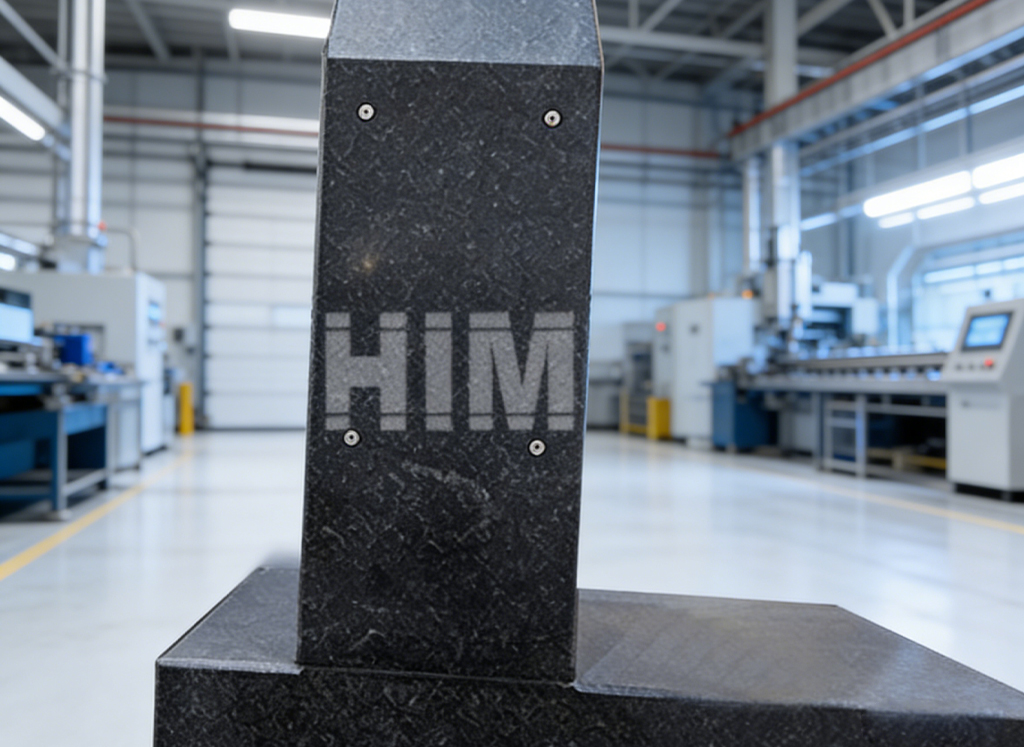
Material Comparison for Machine Bases
| Property | UHPC | Cast iron | Natural granite |
|---|---|---|---|
| Vibration damping | Typically high; formulation dependent | Moderate to good, especially grey iron | High natural damping |
| Thermal response | Slow and stable when properly designed | Faster heat transfer than UHPC or granite | Low thermal conductivity and stable response |
| Design flexibility | High; can include cast-in features | High; complex cast forms possible | Moderate; requires machining and assembly |
| Precision reference surfaces | Usually post-machined or paired with precision inserts | Machined after casting and stabilization | Can be lapped directly to high flatness |
| Typical applications | Hybrid frames, large custom bases, high-dynamic equipment | Machine tools, heavy-duty equipment, production CNC | Metrology, optics, semiconductor and precision motion |
Selecting the Right Structure
The decision should begin with the machine’s intended function.
Choose cast iron when proven machine-tool architecture, complex cast geometry, robust stiffness, and established production methods are priorities. Consider natural granite when the machine requires a stable precision datum, low thermal sensitivity, corrosion resistance, or strong damping for metrology and optical work. Consider UHPC when the project benefits from high mass, engineered damping, embedded features, and custom structural geometry.
Hybrid designs are increasingly common. A UHPC or cast-iron body may use precision granite rails, inserts, or reference surfaces. A granite base may incorporate metal mounting interfaces, linear guides, and air-bearing components. A fabricated steel frame may be backfilled with a damping compound. These combinations can be effective when each material is assigned to the function it performs best.
Research and industry experience consistently show that composite and polymer-based materials can deliver significantly higher damping than conventional metal structures, but geometry and assembly quality still determine machine-level results.
Damping Starts With System Design
Vibration damping in precision machinery cannot be specified by material alone. A successful machine base combines appropriate material selection with controlled structural geometry, rail interfaces, heat management, foundation design, cable routing, moving-mass balance, and acceptance testing.
UHPC, cast iron, and natural granite each have a valid place in precision engineering. The most reliable choice is the one verified against the actual dynamic, thermal, and metrology requirements of the equipment—not the material that appears strongest in a general comparison.
Post time: Aug-13-2026