
In the R&D of ultra-precision motion stages, inspection machines and CNC equipment, magnetic interference is often an overlooked source of hidden errors. Many equipment manufacturers only discover during commissioning that weak magnetism from the machine bed disturbs motion components and destabilizes positioning. Thanks to its natural mineral composition, ZHHIMG granite mechanical systems feature stable non-magnetic performance. This property is more than a supplementary parameter; it forms the foundation for a clean motion environment for the whole precision system, especially suitable for high-end equipment integrated with linear motors, magnetic encoders and optical detection modules.
1. Eliminate magnetic field distortion of linear motors for smoother thrust output
Linear motors generate power through electromagnetic interaction and are highly sensitive to surrounding magnetic conductive materials. If the machine base contains ferromagnetic substances, it will alter magnetic field distribution and create uneven local magnetic strength, directly triggering thrust ripple. Such ripple translates into tiny stage jitter, reduces positioning smoothness and impairs nano-level positioning performance. The non-magnetic substrate of ZHHIMG granite will not absorb or deflect motor magnetic fields, keeping the magnetic circuit between stator and mover as originally designed. Motor thrust fluctuation is effectively suppressed, and the stage achieves smoother start-stop and constant-speed feeding. For equipment requiring continuous reciprocating scanning and micro feeding, the non-magnetic substrate greatly improves the consistency of motion trajectories.
2. Protect optical and magnetic sensing components to prevent signal drift
Many precision inspection machines are equipped with optical scales, magnetic scales, laser interferometers and optical readheads. These sensors are sensitive to ambient magnetic changes. Magnetic disturbance from metal beds or stone substrates containing iron impurities causes reading jumps, higher signal noise, unstable measurement data and inconsistent repeated test results. Adopting ZHHIMG non-magnetic granite mechanical systems creates a benchmark carrier with low magnetic interference. Mounted on non-magnetic reference surfaces, sensors are free from continuous magnetic disturbance from the base. Signal acquisition becomes cleaner and more stable, reducing the burden of later software compensation and lowering risks of false triggering and false readings, ensuring reliability of measurement and positioning data.
3. Prevent adsorption of metal dust and reduce wear risk of precision motion pairs
Metal processing workshops produce large amounts of metal chips and ferromagnetic dust. Ordinary metal beds attract metal powder. Long-term accumulated dust near guideways, air gaps and optical scales gets trapped between moving parts and continuously abrades working surfaces, shortening service life of motion components. Surfaces of ZHHIMG non-magnetic granite do not attract ferromagnetic dust. Dust settles only by gravity and can be easily removed by blowing or wiping. For equipment with air bearing guideways featuring micron-scale gaps, it avoids accumulation of adsorbed metal particles, reduces scratching risks on air bearing surfaces, maintains uniform and stable air films, extends service life of air bearing assemblies and cuts equipment maintenance workload. 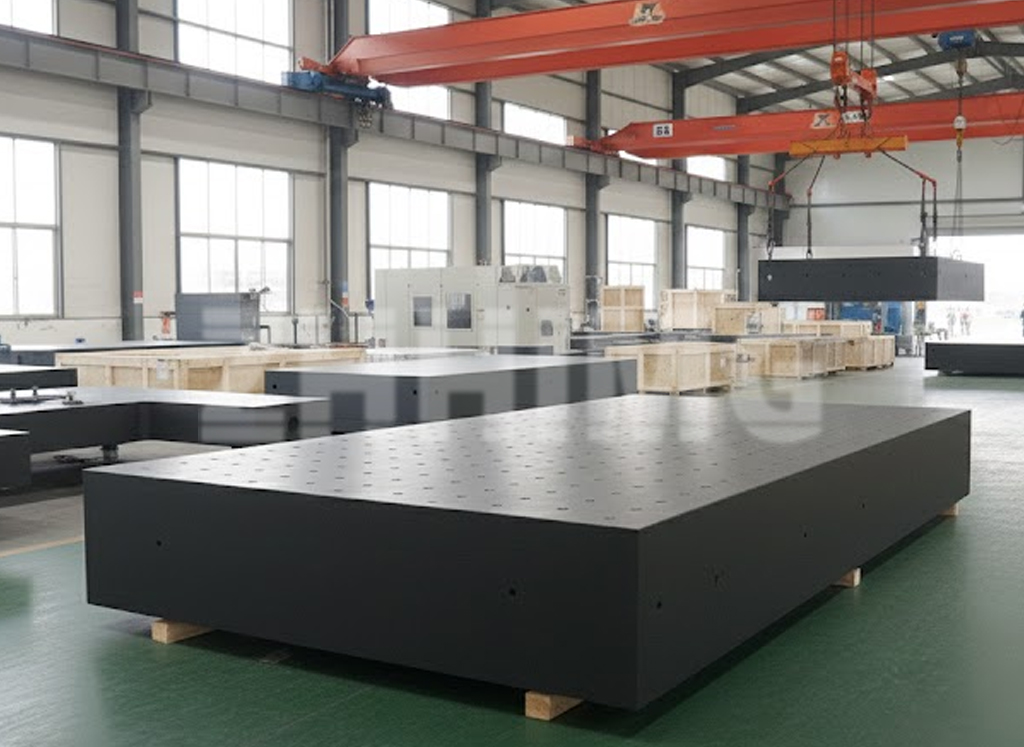
4. Compatible with inspection scenarios for magnet-sensitive workpieces and samples
In many optical inspection, semiconductor inspection and precision metrology scenarios, workpieces under test carry magnetism or are weakly magnetically sensitive. If the machine substrate is magnetically conductive, mutual coupling between substrate magnetic field and sample magnetic field will alter the original magnetic state of samples and distort inspection results. ZHHIMG non-magnetic granite platforms will not introduce magnetic disturbance to test samples. Samples retain their original magnetic state. In weak magnetic testing, wafer inspection, optical scanning and high-precision CMM measurement, non-magnetic benchmarks guarantee authentic and reliable test results and eliminate systematic deviation caused by substrate magnetism.
5. Simplify electromagnetic shielding design and reduce equipment R&D difficulty
Magnetic beds often require additional shielding plates and magnetic isolation layers to protect motion and sensing parts from magnetic interference. Extra magnetic shielding components increase overall weight, occupy assembly space and introduce new problems caused by mismatched thermal expansion of different materials, raising difficulty in structural design and assembly commissioning. ZHHIMG granite is inherently non-magnetic, so heavy additional magnetic shielding structures are unnecessary. The whole machine can be more compact. Equipment designers can focus on optimizing motion performance, cut structural design costs for electromagnetic shielding and shorten the R&D cycle. Meanwhile, it avoids thermal deformation risks caused by stacking dissimilar materials.
Conclusion
The core value of non-magnetic granite mechanical systems lies in building a benchmark platform free from magnetic interference. ZHHIMG non-magnetic granite mechanical systems neither distort linear motor magnetic fields nor interfere with sensor signals. They do not adsorb ferromagnetic dust, protect magnet-sensitive samples and simplify electromagnetic shielding design. In high-end equipment such as linear motor stages, air bearing motion platforms, semiconductor inspection and optical metrology tools, non-magnetic performance works together with granite’s low thermal deformation and high damping characteristics, delivering a clean and stable benchmark environment for sub-micron and nano-level precision motion and inspection.
Post time: Sep-18-2026