
In high‑end equipment such as coordinate measuring machines, gantry inspection machines, long‑travel optical inspection platforms and linear‑motor gantry modules, beams act as core motion‑carrying parts, which directly determine the overall machine’s measurement accuracy, motion smoothness and service life. Compared with other beam materials including cast iron, aluminum alloy and mineral casting, granite gantry beams deliver extensive application in precision‑equipment industries thanks to natural material properties and ultra‑precision machining processes. Many equipment R&D personnel only focus on finished‑product accuracy indicators, lacking systematic understanding of the comprehensive application advantages of granite gantry beams. Drawing on practical experience from numerous gantry‑equipment supporting projects, ZHHIMG analyzes the core application strengths of granite gantry beams from multiple dimensions: inherent material properties, dynamic operating performance, anti‑interference capability against environmental factors, later‑stage operation & maintenance, and long‑term service value.
Outstanding dimensional thermal stability that mitigates accuracy disturbances caused by temperature fluctuation serves as a prominent core merit of granite gantry beams. Temperature fluctuations are inevitable in workshops and metrology environments. Metallic beams feature high thermal expansion coefficients; minor temperature changes will trigger obvious expansion‑contraction deformation, directly altering the straightness and span of guide‑rail benchmarks. Formed by hundreds of millions of years of geological deposition, granite substrates feature densely interwoven mineral grains and low thermal expansion coefficients. Under slight ambient temperature variation, its overall deformation is kept at an extremely low level. Even with diurnal shop‑floor temperature shifts, the beam maintains its configuration, reducing measurement drift induced by thermal expansion and contraction, especially for large‑span gantry equipment. In multi‑shift continuous‑production quality‑inspection workshops, frequent shutdown for calibration is unnecessary, effectively boosting equipment uptime.
High rigidity and superior damping‑vibration‑reduction properties suit dynamic reciprocating operating conditions. Granite boasts high modulus; under identical cross‑section conditions, it delivers excellent bending resistance and can sustain continuous loads from sliding tables and probe assemblies. More importantly, the dense mineral structure inside stone provides remarkable damping performance. When vibration shocks are generated by high‑speed start‑stop and rapid scanning sampling, granite gantry beams dissipate vibration energy rapidly and suppress resonance. Metallic beams exhibit slow vibration attenuation after impact, and residual vibration disturbs sampling readings. In contrast, granite gantry beams realize fast vibration suppression, enabling probes and sliding tables to reach stable conditions quickly. They greatly enhance repeat positioning accuracy and consistency of measured data, perfectly matching high‑frequency dynamic‑acquisition scenarios of CMMs and optical‑scanning equipment.
Natural wear and corrosion resistance adapts to long‑term sliding service of air‑flotation guide rails. Most granite gantry beams are paired with air‑flotation guide‑rail systems. After ultra‑precision grinding, stone benchmark surfaces feature hard, uniform texture with high hardness and strong scratch‑resistance. Though direct friction does not occur under air‑flotation status, granite surfaces resist indentation and local damage upon equipment start‑stop, accidental contact or particle invasion. Furthermore, granite is rust‑proof, moisture‑resistant and immune to common shop‑floor cutting fluid and coolant erosion. Unlike cast iron prone to rust and peeling, or aluminum alloy whose oxide layer may flake off and contaminate air‑flotation gaps, granite preserves original surface quality of benchmark surfaces for long periods and avoids accuracy degradation caused by substrate wear and corrosion.
Stable stress status and superior accuracy retention enable minimal drift over long‑term service. Qualified granite gantry beams go through complete workflows including raw‑blank static aging, stress relief after rough machining and secondary stress release post forming to fully eliminate internal residual stress. Cast iron parts tend to suffer creep due to aging, while aluminum alloy may deform from stress release. Properly aged granite gantry beams show negligible geometric variation over a service life of more than ten years. With reasonable mounting‑support conditions, key geometric tolerances such as beam straightness and parallelism can be maintained steadily. Repeated disassembly and calibration of the whole machine are reduced, cutting later‑stage maintenance costs, which brings prominent value for continuous‑running mass‑production inspection lines.
Great potential for benchmark‑surface machining supports integrated forming of multi‑functional surfaces. Far more than simple load‑bearing beams, granite gantry beams allow ultra‑precision integrated machining for guide‑rail mounting surfaces, positioning benchmark surfaces, assembly mating surfaces, avoidance slots, weight‑reduction cavities and embedded thread‑sleeve interfaces within a single component. Via grinding in constant‑temperature workshops, multiple functional benchmark surfaces can achieve micron‑ even nanometer‑level flatness and straightness simultaneously. Integrated forming eliminates cumulative assembly errors brought by splicing, unifies benchmark traceability of the whole gantry structure and prevents benchmark dislocation caused by multi‑part assembly. Non‑magnetic substrate options are also available upon equipment requirements to satisfy special anti‑magnetic‑interference demands of optical and semiconductor inspection equipment. 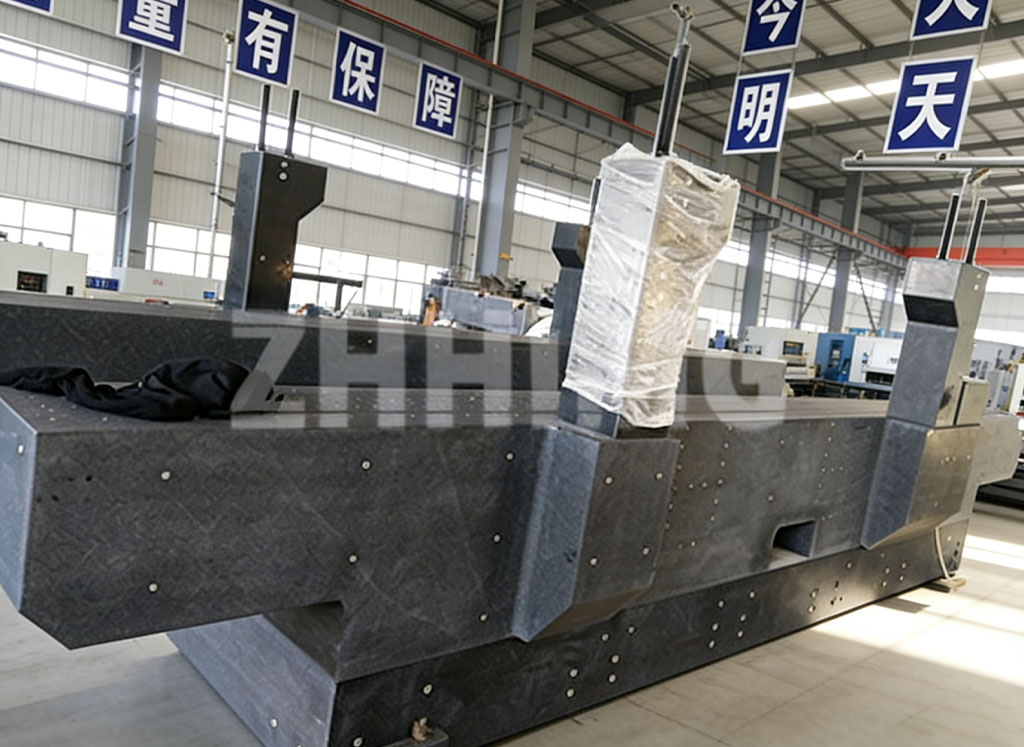
Self‑weight‑derived structural advantages improve the complete machine’s anti‑overturning performance. With relatively high density, granite gantry beams deliver larger dead weight. Cooperating with gantry‑equipment bases, they increase overall machine inertia and restrain whole‑machine shaking triggered by ground disturbances. In high‑speed commutation scenarios for long‑travel applications, reaction force generated by sliding‑table direction change can be partially counteracted by the beam’s self‑weight, lowering shaking amplitude and improving equipment operating stability. With a reasonably‑optimized rigidity‑to‑weight ratio, it will neither overload driving units due to excessive self‑weight nor sacrifice anti‑interference capacity.
Nevertheless, granite gantry beams carry the inherent brittleness of stone materials. They are sensitive to localized heavy impact and excessive bolt‑tightening torque. Matching treatments shall be completed in structural design, embedding processes and installation specifications. ZHHIMG provides guidelines for installation, bolt tightening and transportation at early project phases to maximize material merits while circumventing drawbacks.
Possessing ISO three‑system certifications, CE and CNAS qualifications, ZHHIMG keeps supplying granite gantry beam components for various domestic and imported high‑precision gantry‑type equipment. Through raw‑material screening, multi‑stage aging treatment, constant‑temperature ultra‑precision grinding and embedding‑process control, ZHHIMG gives full play to granite material properties, delivering stable and reliable operation performance for precision inspection equipment and supporting high‑end manufacturing inspection sectors including auto‑parts, aerospace, semiconductor and mold industries.
Post time: Sep-07-2026