
As intelligent manufacturing evolves toward high‑speed, high‑precision and unmanned continuous mass production, high‑end equipment such as semiconductor packaging machines, SMT placement machines, precision sorting systems, automatic inspection units and linear servo modules impose disruptive requirements on the stability, response speed and anti‑interference performance of core mechanical structures. Under working conditions of high‑frequency reciprocation, high‑speed start‑stop and long‑hour continuous operation, conventional cast‑iron and aluminum‑alloy structural parts tend to suffer residual vibration, thermal deformation, metal fatigue, surface wear and oxidation. These issues bring production pain points including equipment positioning deviation, fluctuating product yield and frequent shutdowns for calibration. Nowadays, a growing number of high‑end automation equipment adopt precision granite parts in batches, such as granite bases, columns, sliding beams and mounting reference seats. With years of expertise in manufacturing precision granite components for automation equipment, ZHHIMG analyzes the differentiated core strengths of granite mechanical structures applied in intelligent machinery, considering the unique operating conditions of continuous‑run automated production lines.
High‑damping vibration‑absorbing properties adapt to high‑frequency dynamic operating conditions of automation equipment and greatly boost operational stability and production efficiency. Automation equipment is characterized by high‑speed reciprocating motion, frequent start‑stop cycles and continuous cyclic operation. High‑speed servo commutation and rapid module movement constantly generate high‑frequency vibration and inertial impact. Metallic structures feature low damping coefficients, slow vibration attenuation and long‑lasting residual vibration, which result in positioning lag, pick‑and‑place offset and blurred vision sampling, directly dragging down output and yield. Thanks to its natural mineral composition, granite boasts excellent vibration absorption capacity, with damping performance far superior to cast iron and aluminum. It rapidly dissipates high‑frequency vibration induced by high‑speed equipment operation, suppresses structural resonance and shortens the settling‑to‑stable time. In high‑speed automated production lines, granite structures enable motion modules, vision inspection systems and precision actuators to reset and stabilize quickly. No lengthy anti‑shake waiting periods are required, effectively improving equipment cycle time and UPH output, and perfectly meeting demands for unmanned continuous mass production.
Ultra‑low thermal deformation addresses accuracy drift caused by temperature variation in automated production environments. Automated production workshops usually run non‑stop around the clock. Heat generated by continuous equipment operation, diurnal temperature swings and air‑conditioning zone fluctuations all trigger thermal expansion and contraction of metal structures. Over time, positioning reference offset occurs and causes dimensional deviation for mass‑produced products. Granite has an extremely low thermal expansion coefficient, roughly one‑third that of steel, and is barely sensitive to temperature changes. Even with minor workshop temperature fluctuations and accumulated heat from long‑time equipment operation, its overall structural dimensions and reference surfaces remain nearly unchanged. Unlike metal components that require frequent shutdown‑based calibration to compensate thermal errors, granite mechanical parts sustain consistent references over long periods. They drastically cut calibration frequency and equipment downtime, guarantee consistent precision for mass production and effectively reduce scrap rates.
Free from metal fatigue and time‑dependent deformation, granite fits long‑term continuous service of automation equipment. Automated machinery is designed for stable multi‑year non‑stop operation. Subjected to cyclic loads and reciprocating stress over long periods, cast‑iron and aluminum‑alloy structures are prone to metal fatigue and micro‑deformation, leading to structural loosening and year‑on‑year accuracy degradation. Periodic disassembly, maintenance and reference correction are required, raising maintenance costs and downtime losses. Fully‑aged precision granite components feature dense and stable internal texture without metal‑fatigue behaviour. No plastic deformation or stress drift occurs under long‑term cyclic loads. For automation‑oriented components, ZHHIMG applies multi‑stage stress‑relief processes to completely eliminate residual machining stress. Structural parts maintain stable geometric dimensions and reference accuracy under years of high‑frequency operation and sustained loads, greatly extending service life of core automation structures and lowering full‑lifecycle maintenance costs.
Corrosion‑resistant and contamination‑tolerant with no coating maintenance required, granite satisfies strict standards for clean automated production lines. High‑end automated lines for semiconductors, optoelectronics and precision electronics demand extremely high cleanliness. Conventional metal parts are vulnerable to rusting, coating peeling and oil‑dust contamination, which not only hurt equipment accuracy but also pollute clean production environments. Naturally dense and pore‑free, granite does not rust or oxidize and resists erosion from cutting fluids and workshop moisture. Protective coatings are unnecessary, so there exists no risk of contamination caused by coating flaking. After ultra‑precision grinding, its surface delivers high smoothness, low dust accumulation and easy cleaning. It maintains clean and flat reference conditions long‑term, perfectly matching requirements for dust‑free workshops and clean automated lines, and eliminating production hazards from metal corrosion and particle shedding. 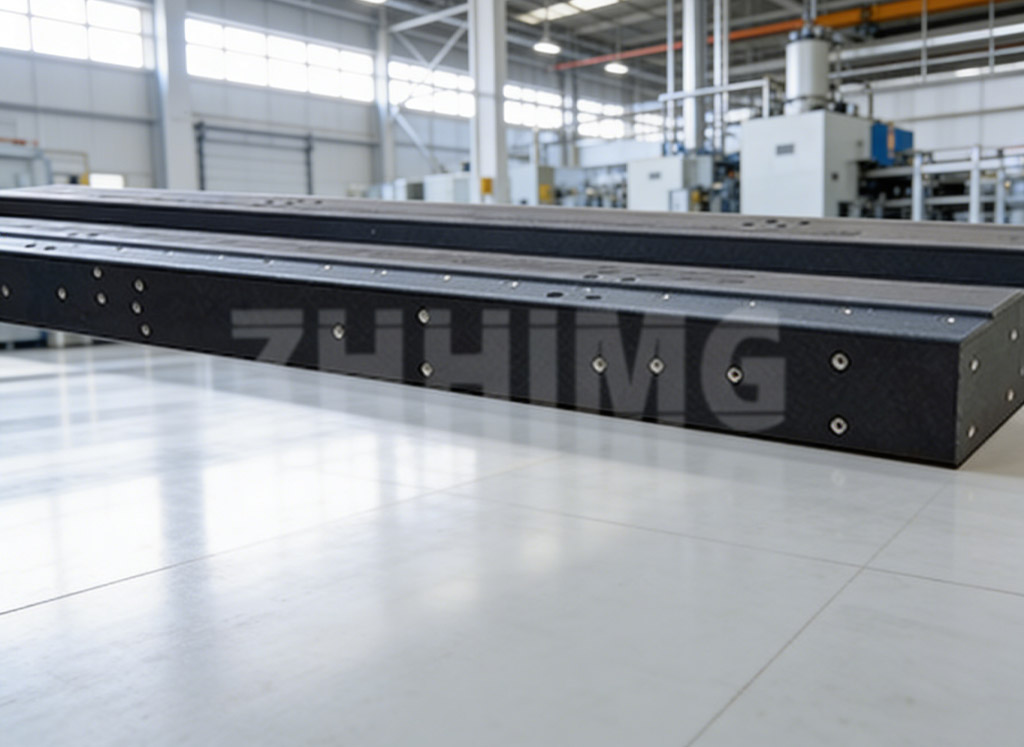
High‑precision integrated forming reduces cumulative assembly errors of automation equipment. Automation equipment features compact layout and high integration with strict requirements for reference consistency. Traditional multi‑section spliced metal structures easily produce assembly gaps and cumulative errors and impair repeat positioning accuracy. Granite components support one‑piece precision forming of bases, guide‑rail mounting surfaces, positioning references, avoidance features and embedded interfaces. Multi‑part splicing is avoided, eliminating assembly errors at source. Leveraging fine‑finishing processes in a Class‑10000 constant‑temperature‑humidity dust‑free workshop, multiple high‑precision reference surfaces can be machined in one go, achieving nanometer‑level flatness, parallelism and perpendicularity. Uniform, accurate and stable mounting references are provided for servo modules, linear motors and vision inspection systems, markedly improving repeat positioning accuracy and running smoothness of automation equipment.
Non‑magnetic and pure material properties meet anti‑magnetic‑interference requirements of precision automation equipment. Most high‑end precision automation devices are equipped with delicate sensors, optical lenses and precision electronic control components, which are susceptible to magnetic disturbance leading to inspection failure and positioning offset. Ordinary metal structures tend to be magnetized and generate magnetic noise that disturbs normal operation of precision electronic elements. As a natural non‑metallic material, granite is non‑magnetic and non‑magnetically conductive without magnetic interference. It delivers a pure disturbance‑free operating environment for optical inspection, precision sensing and micro‑part handling procedures, securing stable detection and execution accuracy of precision automation equipment.
For differentiated working conditions of automation equipment, drawing on over 30‑years of precision‑processing experience, complete stress‑control systems and world‑class testing instruments, ZHHIMG custom‑designs granite mechanical components according to equipment running speed, load level and production‑line environment. Balancing lightweight design, high rigidity and superior stability, it avoids poor compatibility from generic stone parts. With complete ISO‑system certifications, CE, CNAS approvals and multiple core patents, the company keeps delivering highly‑stable, long‑life, low‑frequency‑maintenance granite precision‑structure solutions for semiconductor automation, precision assembly, intelligent inspection and linear motion modules, enabling high‑speed, high‑precision and unmanned stable mass production for intelligent manufacturing equipment.
Post time: Sep-07-2026