
The long-term precision of a finished granite machine tool bed is largely determined the moment the raw stone blank is selected. Many projects suffer from precision drift, local deformation, or even sudden cracking during machining at a later stage. The root cause is often not the lapping process, but inadequate inspection during blank selection. Many purchasers simply judge the stone by its surface color while overlooking hidden indicators such as internal mineral composition, micro-fractures and stress conditions. Defects are only discovered at the finish machining stage, resulting in costly delays and material losses. Manufacturing granite machine tool beds requires a complete set of evaluation criteria for blank selection, covering ore source screening, internal flaw detection and physical property sampling tests.
The ore source serves as the first checkpoint for blank quality. Not all black granite is suitable for manufacturing ultra-precision machine tool beds. Rock bodies from different veins vary greatly in mineral particle ratio and impurity content. Some ore bodies contain high proportions of mica and feldspar, making the material relatively soft with weak bonding force between internal crystals. Such material tends to shed grains during machining. Under long-term workshop temperature fluctuation and micro-vibration, its surface roughness will continuously deteriorate. ZHHIMG selectively sources high-density black granite from stable ore veins. The rock is dense and uniform with a reasonable quartz proportion and tightly interlocked mineral crystals. This endows the blank with inherent low thermal expansion and high rigidity, eliminating precision risks caused by material inhomogeneity from the very beginning.
Visual inspection can only spot obvious surface defects and cannot identify hidden internal problems inside the stone. Invisible internal microcracks, interlayers and voids represent the biggest hazards for blanks. These defects are buried deep within the stone and remain undetected at the initial cutting stage. However, cracks will gradually expand during subsequent sawing, rough grinding, as well as long-term mechanical loading and alternating temperature cycles of machine tools, directly damaging the bed reference. After blanks arrive at our factory, we perform full-area scanning of each rough block by ultrasonic flaw detection to fully mark the positions of internal fractures and heterogeneous interlayers. Blanks with penetrating cracks or large loose interlayers are rejected directly. For minor local defects, we assess whether they lie in stress-bearing zones or reference working surfaces of the bed to decide whether to remove the flawed section or discard the whole blank.
Sampling physical property testing forms the core of blank selection. Density, thermal expansion coefficient and elastic modulus may fluctuate across different regions of a single rough block. Judging material quality merely based on batch ore reports is insufficient. ZHHIMG takes samples from non-machined reserved areas of blanks for physical property tests, focusing on key indicators including density (approximately 3100kg/m³), thermal expansion coefficient, water absorption and elastic modulus. Water absorption deserves special attention. Stone with high water absorption has abundant pores. It slowly absorbs and releases moisture with changing ambient humidity, leading to gradual volume expansion and contraction and triggering reference drift. Only blanks with stable and qualified physical parameters can proceed to cutting.
The internal stress state of blanks is easily ignored. Natural granite forms under underground strata pressure. Mining and sawing release original geostress and leave residual stress inside the blank. If the blank does not undergo sufficient aging treatment, stress will redistribute after substantial material removal in rough machining. This causes slow bending deformation of the component and quickly invalidates the flatness achieved in prior lapping. ZHHIMG applies prolonged natural aging to selected blanks to release residual internal stress, followed by secondary re-inspection. The aging cycle is extended accordingly for large-tonnage blanks of heavy machine beds, ensuring no spontaneous deformation after finish machining.
Blank geometry and machining allowance planning are also supporting points in material selection. When sizing rough blocks, reasonable machining allowance must be reserved to account for material loss in cutting, rough grinding, aging and fine lapping. Insufficient allowance means the entire blank will be scrapped once hidden defects are found during rough machining. Excessive allowance increases processing costs and stress release cycles. In addition, weathered outer layers of rough blocks must be avoided. The surface layer of ore bodies is loosened by long-term environmental erosion and must never be used as the reference working surface of machine beds. 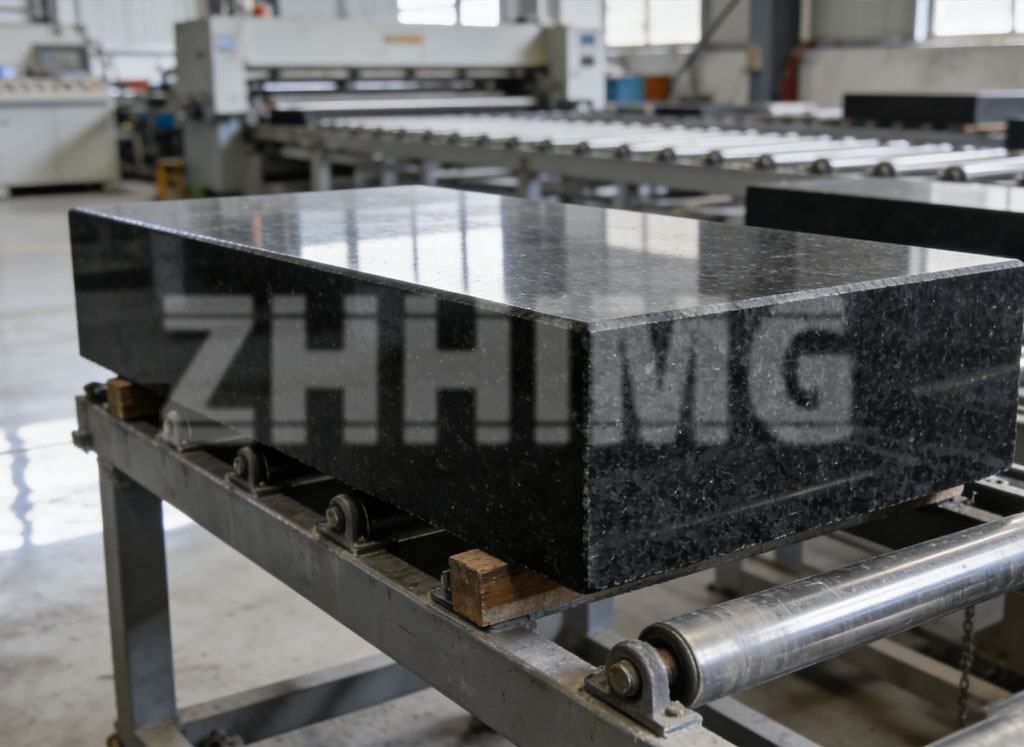
Many customers fall into a common misconception: focusing solely on blank hardness. Although hardness matters, blanks for machine tool beds require balanced performance of all physical indicators. Stone with high hardness yet poor thermal stability and abundant internal fractures is still unsuitable as a base for precision equipment. The core of material selection lies in comprehensive performance: homogeneous material, low residual stress, low thermal expansion and high damping, rather than the extreme value of a single parameter.
Drawing on years of experience manufacturing ultra-precision components, ZHHIMG has established a complete blank evaluation system. Qualified granite blanks for machine tool beds, gantry frames and inspection platforms are screened step by step through ore source selection, ultrasonic flaw detection, physical sampling and stress aging. Apart from granite, we can compare alternative base materials such as mineral castings and UHPC according to project operating conditions and recommend the most suitable base material solution for customers.
Blank selection for granite machine tool beds depends not only on appearance but also on invisible internal quality. Strict blank screening can greatly reduce scrapping risks in subsequent processing and guarantee stable geometric benchmarks of finished beds for many years of service. It acts as the prerequisite foundation for long-term high-precision operation of equipment.
Post time: Sep-17-2026