
Core Application Scenarios for Natural Granite Structural Parts
-
Metrology and Ultra‑high‑precision Inspection Equipment
Coordinate‑measuring machines, optical platforms, wafer‑inspection equipment and interferometric instruments. Such equipment demands micron‑to‑sub‑micron datum accuracy maintained over years with strict creep control. Internal stress of granite has been largely released during geological formation. With secondary artificial ageing, it exhibits minimal dimensional drift in long‑term service, making it the preferred choice for metrology‑grade datum components. Its non‑magnetic feature avoids electromagnetic interference, suitable for clean optical and semiconductor‑inspection stations.
-
Base Substrates for Air‑bearing Motion Stages
Air‑bearing sliders slide at high speed directly over the base surface, calling for high wear resistance of working surfaces. Granite scores high on Mohs hardness. After lapping, it delivers superior surface quality, resisting sanding and deformation under prolonged friction. It supports direct mounting of air‑bearing guideways and sustains long‑term linear‑motion accuracy. Mineral castings feature lower surface hardness; additional embedded metal guide plates are usually required instead of direct slider travel.
-
Constant‑temperature Laboratory and Offline Calibration Reference Platforms
Workshop calibration plates and laboratory reference bases that are fixedly installed with minimal relocation and require decades‑long accuracy retention. Granite tolerates a wider temperature range without performance degradation caused by resin ageing, making it ideal as equipment traceability references.
-
Working Conditions Unsuitable for Granite
Integrated machine bodies requiring abundant pre‑embedded cooling pipelines, dense special‑shaped inner cavities and intricate hollow reinforcing ribs; equipment with strict overall‑weight limits and frequent relocation; scenarios subject to sustained heavy impact loads. Granite hardly forms complex inner cavities, and machining numerous embedded pipes incurs high costs. Its heavy weight and poor impact resistance make it a poor fit for such cases.
Core Application Scenarios for Mineral Castings
-
Beds for High‑speed Precision Machine Tools, Engraving‑milling and Grinding Equipment
High‑speed milling, precision grinding and engraving machines focused on suppressing cutting chatter. The viscoelastic damping of mineral castings absorbs high‑frequency cutting vibration effectively. Monolithic casting integrates cooling water channels, simplifies overall assembly and shortens equipment manufacturing cycles. They fit mass‑produced medium‑precision processing machinery that balances vibration damping and complex‑structure integration.
-
Frames for Automated Non‑standard Equipment and New‑energy Assembly Machinery
Lithium‑battery assembly equipment, dispensing machines and automated test tooling. These feature numerous internal pipelines, cables and sensor points. Various inserts can be embedded during mineral‑casting pouring, cutting spliced‑part quantity, simplifying mechanical design and reducing component count and assembly man‑hours.
-
Bases for Medical‑equipment and Special‑purpose Test Instruments
Certain imaging‑inspection devices and dynamic‑balance test units with complex structures requiring special‑shaped hollows and reinforcing ribs. Medium‑precision performance and strong vibration damping are expected alongside controlled overall weight. Mineral castings realise lightweight complex geometries more easily than granite.
-
Working Conditions Unsuitable for Mineral Castings
Long‑term high‑temperature environments above 60‑70 °C will degrade epoxy‑resin matrix and trigger deformation risks; metrology‑grade ultra‑precision references and working surfaces for direct air‑bearing‑slider travel; applications requiring stringent 10+‑year creep performance, where gradual accuracy drift arises from long‑term resin ageing. Mineral castings are not recommended for metrology‑grade datum surfaces.
Key Comparison Points for Quick Engineer Decision‑making
- Long‑term‑stability requirements: Prioritise granite if datum stability over 5‑10‑year equipment lifecycles is required; select mineral castings for 3‑5‑year‑iteration equipment emphasising vibration damping and complex structures.
- Working‑surface usage: Choose granite when guideways or air‑bearing sliders travel directly on datum surfaces; mineral castings work well if sliders and guideways mount on pre‑embedded metal inserts without contacting composite substrates.
- Structural complexity: Mineral castings offer cost and cycle advantages for parts with abundant internal channels, hollow ribs and dense embedded inserts; granite delivers better cost‑performance for geometries dominated by flat planes, simple slots and through‑holes.
- Operating‑temperature conditions: Exercise caution with mineral castings where heat sources sit close to bases with sustained local heating; granite withstands wider temperature fluctuation without persistent high‑temperature exposure.
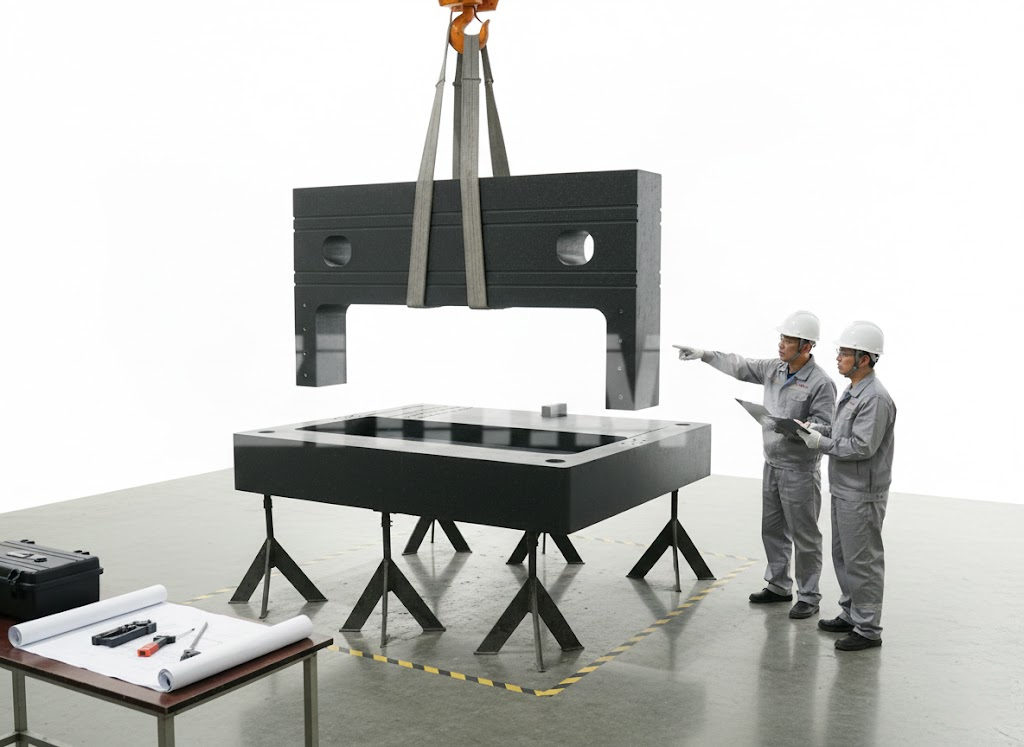
ZHHIMG Dual‑material Integrated Solution
Post time: Aug-05-2026