
The deployment scenarios of ultra‑precision equipment vary greatly. Not all machinery can be placed in ideal laboratories with constant temperature and humidity. Quite a number of devices are deployed in ordinary processing workshops, dust‑heavy production lines, and workstations with alternating dry‑wet conditions. They are subject to real‑world conditions such as high‑frequency reciprocating motion, alternating loads and intermittent shock disturbances. Under such complex conditions, metal machine bases are prone to a series of problems including rusting & wear, stress creep, thermal deformation and magnetic interference. Benefiting from the inherent physical and chemical properties of the material plus mature processing techniques, wear‑resistant granite machine bases fit multiple harsh on‑site conditions and deliver stable and reliable benchmark supports for equipment.
High‑frequency reciprocating friction is a major challenge for automatic inspection and motion‑control equipment. Linear motors, air‑bearing slides and linear modules run at high speed back and forth on the reference surfaces of machine bases, and mounting positioning surfaces bear continuous frictional loads. After long‑term friction, cast‑iron and steel bases suffer gradual surface wear and degraded flatness, which directly alter the mounting references of guide rails and linear encoders and trigger positioning deviations. Wear‑resistant granite features high surface hardness and strong anti‑friction performance. Even under long‑time reciprocating sliding and frequent module reassembly, surface loss remains minimal, and reference planes retain their original geometric accuracy. It is well‑suited for high‑speed displacement platforms and mass on‑line inspection equipment requiring non‑stop high‑frequency operation.
Granite machine bases also perform well in working conditions filled with dust and debris. Metal chips, grinding dust and granular impurities are unavoidable in precision‑processing, component‑inspection and optical‑sorting production lines. Dust particles tend to accumulate in gaps of metal bases and induce rust. Trapped particles between fitting surfaces further cause assembly offset. Granite boasts stable chemical properties and resists oxidation and rust. Its dense, low‑porosity structure hardly absorbs metallic dust and contaminants. Dust and debris merely stay on the surface and can be easily blown or wiped away without penetrating inward to form corrosion sources. Benchmark surfaces can remain intact even without clean‑room‑grade environments, reducing hidden precision loss caused by dust.
Workstations with alternating dry‑wet cycles and splashes of cutting fluid or process auxiliaries also impose stringent requirements on machine bases. Splashes of cutting coolant and weak chemical reagents may occur at certain precision‑machining and component‑cleaning inspection stations. When exposed to such media, metal bases quickly rust. Expanded rust layers jack up assembled components and destroy the original geometric relationships of equipment. As an inorganic mineral material, wear‑resistant granite will not oxidize or rust. Spattering coolant and mild chemicals only require timely wiping and will not degrade the material. It should be noted that it tolerates incidental splashes rather than long‑term immersion in strong acid or alkali. With proper usage, it adapts well to integrated processing‑and‑inspection workstations.
Alternating loads and intermittent shocks are commonplace across industrial sites. Workpiece loading‑unloading, module start‑stop and material impacts bring periodic load changes and instantaneous shocks during equipment operation. Subjected to sustained alternating loads, metal bases face metal‑fatigue risks. Internal stress releases slowly and leads to twisting deformation after long‑term service. High‑density granite delivers outstanding compressive strength and is free from metal‑fatigue effects. After thorough aging treatment, its internal stress stays stable. It resists fatigue creep under periodic load shifts and moderate intermittent impacts. Suitable for heavy‑duty inspection equipment and automatic loading‑unloading stations, it maintains stable base levelness and planar benchmarks amid frequent load changes.
Non‑ideal workshop environments with cyclic temperature fluctuations represent another advantageous application scenario for granite bases. Few factories achieve laboratory‑level constant‑temperature control. Day‑night temperature differences, seasonal changes and self‑generated equipment heat give rise to cyclic temperature variations. Metal bases feature large thermal expansion coefficients; repeated temperature rise and fall produce accumulated geometric errors. Granite has an extremely low thermal expansion coefficient, yielding negligible overall deformation under recurring temperature cycles with little cumulative geometric error. Even installed in ordinary workshops without expensive full‑scale constant‑temperature chambers, reference drift can be kept within a low range and broadens deployment possibilities for ultra‑precision machinery. 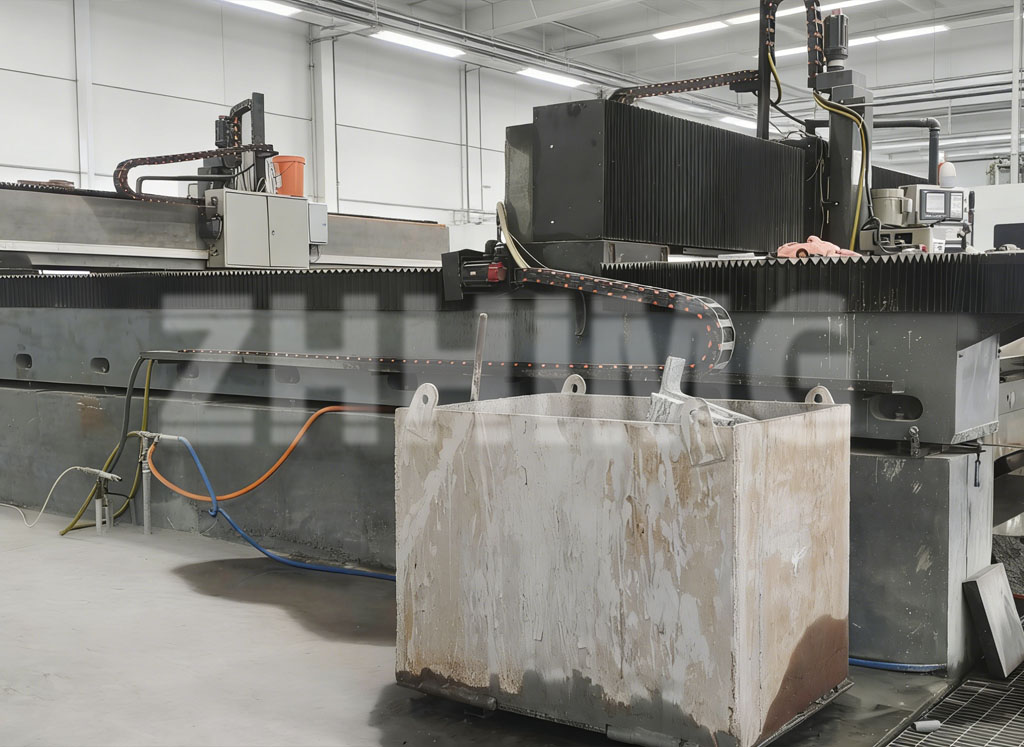
Furthermore, its non‑magnetic property enables granite machine bases for electromagnetically‑sensitive equipment. At workstations for magnetic‑sensor testing, electronic‑component assembly and semiconductor processes, metal bases can become magnetized and generate stray magnetic fields that disturb signal output from sensors and electronic parts. Completely non‑magnetic, granite introduces no extra magnetic noise and avoids data anomalies caused by electromagnetic interference for various magnet‑sensitive precision devices.
Nevertheless, material advantages do not mean unlimited adaptability to all extreme conditions. Loose ordinary marble cannot deliver the above‑mentioned comprehensive performance and fails under complex working conditions. ZHHIMG selects high‑density black granite blanks, implements multi‑stage aging processes, conducts precision grinding in constant‑temperature anti‑vibration workshops and applies full sets of traceable metrological inspection to convert intrinsic material advantages into finished‑part performance. Wear‑resistant granite machine bases are not universal solutions; extreme conditions such as prolonged immersion in strong acid‑alkali and violent impacts should be avoided. With proper operation, they reliably cope with multiple complex industrial conditions including friction‑wear, dust contamination, liquid splashes, alternating loads, temperature cycling and electromagnetic sensitivity, and sustain dependable long‑term equipment benchmarks.
Post time: Sep-08-2026