
-
High specific stiffness balances weight reduction and anti‑deformation performance
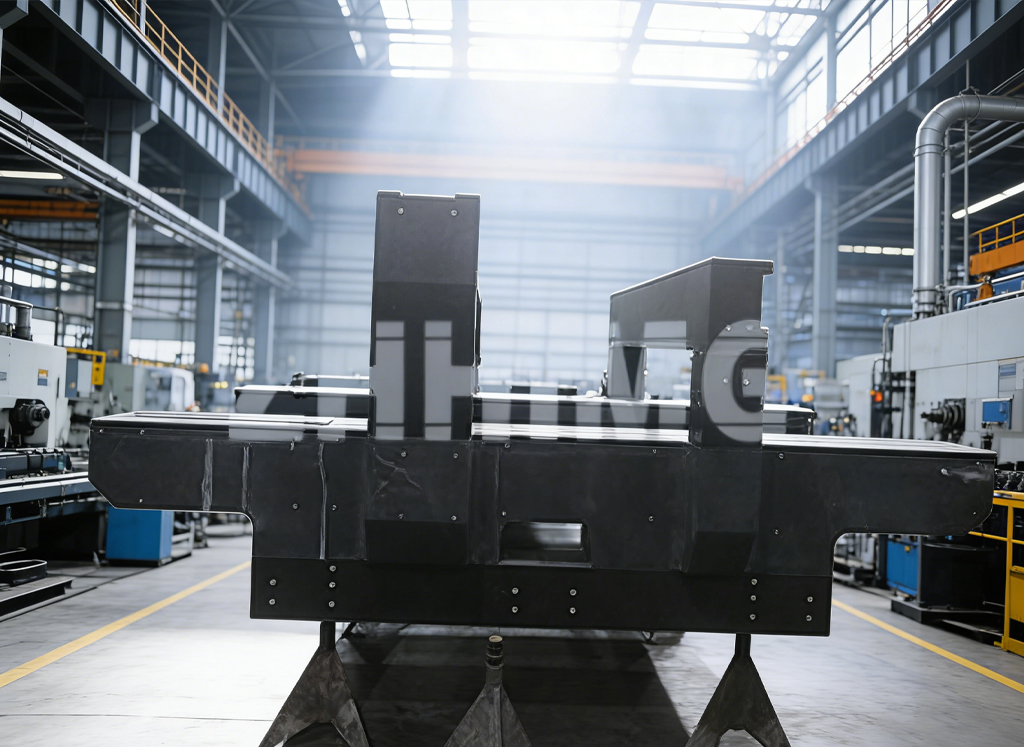
Specific stiffness is a decisive indicator for lightweight precision components. High‑grade black granite delivers remarkable rigidity without excessive component wall thickness. Compared with cast metal of equal rigidity, properly optimized granite structures can cut down overall mass effectively. When equipment designers hollow‑out, open cavities or design rib‑like structures on granite blanks, components still keep strong resistance against bending deformation. It avoids the common dilemma: metal parts become soft after weight‑reduction cutting, or remain heavy if keeping sufficient rigidity. This characteristic fits moving frames, beam bases and slide support structures of laser processing and inspection equipment.
-
Excellent vibration damping capacity after lightweight structural optimization
Even with material‑removing lightweight processing, granite maintains far better internal damping property than steel or aluminum alloy. Under dynamic working conditions such as high‑speed reciprocating movement of linear motor platforms, hollow‑out granite mechanical parts absorb micro‑vibration faster, shorten vibration attenuation time. Lightweight moving assemblies reduce driving load for motors, meanwhile do not sacrifice anti‑shock performance. For CMM, AOI optical inspection and semiconductor testing apparatus, lower residual vibration directly improves measurement repeatability.
-
Low thermal expansion minimizes thermal‑induced error for light‑weighted moving units
Lightweight moving parts are sensitive to ambient temperature fluctuation. Thin‑wall metal lightweight structures are prone to uneven thermal expansion and contraction, resulting in position offset and geometric distortion. Premium granite material features ultra‑low thermal expansion coefficient. Even for hollowed lightweight granite mechanical parts, whole‑part thermal deformation stays at a very low level. When equipment runs with heat generation from motors or environment temperature shift, lightweight granite assemblies hold datum geometry stable, lowering thermal compensation pressure for control systems.
-
Density‑stable raw material enables predictable lightweight simulation
Qualified black granite adopted by ZHHIMG owns uniform internal texture and consistent density. Material performance will not mutate after cavity digging and weight‑reduction machining. Engineers can complete finite‑element simulation accurately in the early design phase, predicting weight, deformation and dynamic response of hollow‑out granite bases and beams. Unlike some composite materials with unstable batch performance, granite supports reliable digital simulation, shortening prototype iteration cycles for equipment developers.
- No additional reinforcing filler required for lightweight customized structures
To achieve lightweight targets, metal parts usually need complex welding, casting or reinforcing rib welding procedures, introducing assembly stress. Granite mechanical parts realize weight‑reduction by direct CNC milling, cavity processing and through‑hole machining on monolithic stone blank. The whole component remains one‑piece structure, free from welding stress and assembly gaps. It reduces hidden trouble of precision drifting caused by stress release in later service period, suitable for high‑speed XY tables and air‑bearing motion frameworks.
Post time: Aug-11-2026