
In ultra‑precision equipment assembly, granite components are widely adopted as substrates, beams and gantry bases thanks to low deformation and high stability. Nevertheless, the inherent brittleness of stone creates long‑standing pain points for equipment integrators. High‑hardness yet brittle granite is notoriously tricky for tapping threaded holes directly on stone bodies. On‑site tapping easily triggers edge chipping and internal cracks. Repeated bolt assembly and disassembly often result in thread stripping or stone substrate cracking. Once threaded sections get damaged, the whole granite component is virtually scrapped. It drives up material costs and delays project delivery. Many equipment manufacturers have encountered assembly rework caused by failed threaded holes in real‑world projects.
Two conventional workarounds are commonly used: post‑bonded steel sleeves and bottom‑through bolt fastening. Bonded steel sleeves rely on adhesive agents. Under long‑term vibration and alternating temperature cycles, adhesive layers tend to delaminate and bonding strength gradually declines. The through‑bolt solution requires reserved structural space, which is unavailable for many compact precision devices, bringing inconvenience to assembly and later maintenance. To address these widespread industry pain points, ZHHIMG applies mature embedded steel sleeve technology to granite components, resolving bolt‑connection difficulties at the production source and delivering reliable mounting interfaces for precision equipment.
Embedded steel sleeve processing is far more than simply inserting sleeves into stone. The whole procedure is closely coordinated with granite grinding operations. During rough machining of granite parts, precise counter‑sinks are machined according to customer drawings. After position inspection, high‑strength alloy steel sleeves are positioned and fixed with special filling media to achieve gap‑free bonding between sleeves and granite substrates. Fine grinding and ultra‑precision finishing are carried out afterwards. Full consideration is given to the thermal expansion difference between metal and stone to prevent sleeve loosening and position offset caused by temperature fluctuation. The intrinsic structural integrity, dimensional stability and reference accuracy of granite remain intact. Standard internal threads are ready for matching standard bolts, eliminating on‑site tapping or reaming for customers.
This targeted process resolves multiple practical installation obstacles. First, it avoids stone chipping and thread failure from direct granite tapping. All bolt‑locking loads are borne by steel sleeves, so repeated bolt cycling will not damage granite and improve component reusability. Second, it overcomes poor vibration resistance of bonded sleeves. The monolithic embedded structure maintains high rigidity under continuous vibration from high‑speed linear‑motor reciprocating motion. Loosening or detachment of sleeves is prevented, eliminating accuracy errors induced by connection gaps. Third, it fits compact equipment layouts. No bottom‑through bolt clearance is required, offering greater freedom for mechanical design and simplifying on‑site integration and component servicing. Fourth, positional tolerance of multiple mounting holes is well‑controlled during embedding. Coordinates, depth and perpendicularity are strictly managed to ensure smooth module‑to‑module alignment, reducing on‑site fitting and debugging workload. 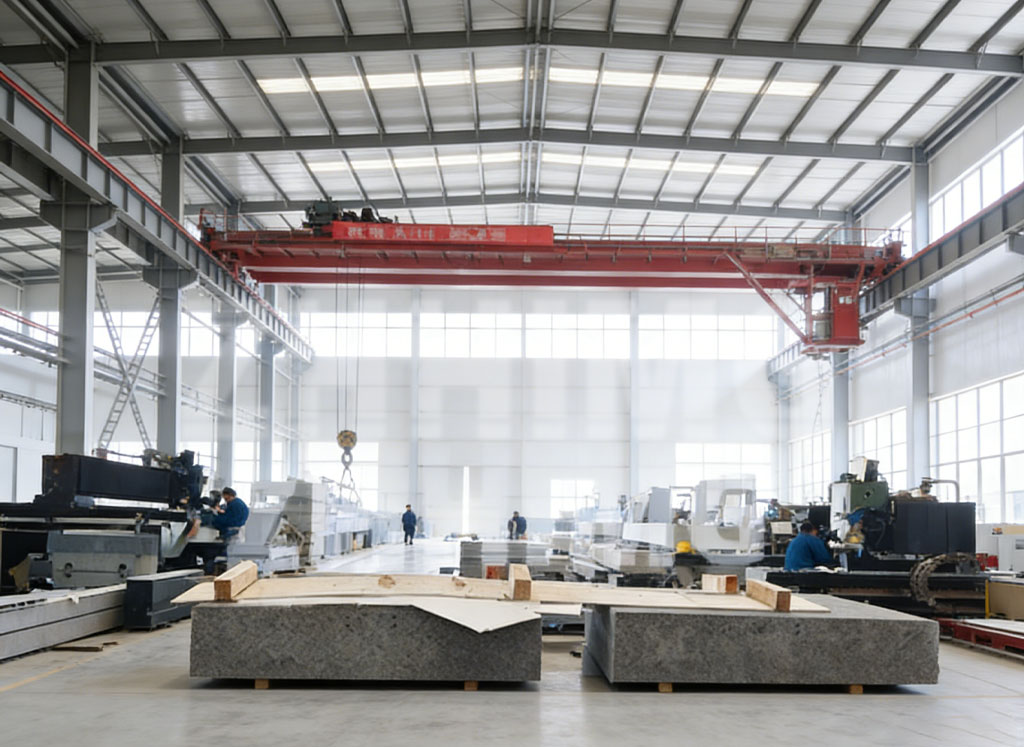
Granite components with embedded steel sleeves have been widely deployed in coordinate measuring machines, optical inspection platforms, semiconductor production machinery, laser processing systems and new‑energy testing equipment. For OEMs, pre‑fabricated granite parts with embedded sleeves support direct final assembly and cut overall manufacturing lead‑time. For mass‑produced equipment, consistent hole positions guarantee uniform assembly performance across units and lower batch debugging costs.
It should be noted that embedded steel sleeve technology demands strict machining, positioning and filling control. Improper embedding will cause sleeve offset and weak bonding, bringing hidden operational risks. Some low‑cost market products simplify procedures, resulting in poorly bonded sleeves that may loosen under vibration. Before delivery, ZHHIMG conducts torque tests and hole‑position coordinate inspections for every batch to verify bonding strength and thread accuracy, ensuring long‑term reliable performance for precision equipment.
The value of granite components lies not only in flatness and stability, but also in reliable connection interfaces that dominate final machine performance. The embedded steel sleeve process optimizes mounting interfaces at the manufacturing stage and offsets assembly drawbacks brought by stone brittleness, so that material advantages of granite can be fully exerted. ZHHIMG provides custom‑built granite bases, sliding tables, gantries and beams with embedded steel sleeves per customer drawings, catering to ultra‑precision equipment projects with diverse torque requirements and hole layouts.
Post time: Aug-13-2026