
When evaluating the quality of granite gantries, many equipment manufacturers tend to focus on immediate precision indicators such as flatness and perpendicularity shown on factory test reports, yet overlook aging treatment, a core hidden process. Qualified factory‑out inspection results only reflect precision status at the time of delivery. It is the complete stress‑relief aging workflow that determines whether benchmarks remain reliable over service life spanning several or even more than ten years. Even with high‑density premium granite blanks, skipping or simplifying aging procedures traps residual machining stress generated by rough cutting, grooving and drilling inside components. After commissioning, gradual stress release triggers subtle micro‑deformation, which directly leads to benchmark offset of complete machines, and further undermines repeatability and measurement credibility of semiconductor inspection, CMM and laser processing equipment.
Aging for granite falls into two categories: natural geological aging formed by millions‑year‑long geological evolution of raw ore, and multi‑level artificial process aging implemented during manufacturing. Natural geological aging fully relieves original internal stress of ore bodies. Nevertheless, after sawing, heavy‑stock removal cutting, hole‑opening and grooving, cutting forces generate brand‑new residual machining stress along crystal boundaries of stone materials. Invisible to naked eyes, such stress will not cause failures immediately, but releases progressively over time, under loads and cyclic ambient temperature. If components go straight into ultra‑precision grinding to achieve nanometer or micron‑level accuracy without aging, latent internal stress will relax afterwards, giving rise to sequential field failures including beam warpage, column perpendicularity offset and slow distortion of base planes. This explains why some low‑cost granite components deliver decent short‑term precision yet suffer rapid performance degradation after a period of operation.
The primary function of multi‑stage aging treatment is to eliminate residual stress induced by mechanical processing and complete deformation risk release in advance within factories. Upon rough machining, components proceed to constant‑temperature static aging together with controllable temperature cycles, so as to re‑balance internal inter‑crystal stress of stone. Some manufacturers omit static holding cycles and conduct fine grinding right after rough processing, which transfers stress‑release procedures to customer‑side equipment sites. For gantry frames processed with standardized aging, stress fields of beams, columns and bases reach equilibrium. Subjected to continuous loads from sliding tables and optical modules afterwards, they will not produce slow creep deformation due to internal stress relaxation. Geometric benchmarks established by grinding are locked in, fundamentally avoiding later‑stage benchmark drift.
Aging treatment enables early identification of potential internal material defects and reduces failure risks of finished products. Poor‑quality blanks contain concealed risks such as micro inter‑crystal cracks and uneven mineral distribution, which stay closed and hard to detect. During temperature cycling and stress relief in aging processes, internal stress redistributes. Blanks with inherent defects will show minor deformation or crack propagation, which can be screened out in factory inspection. By contrast, components without aging validation keep defects hidden. After assembled into complete machines, hidden troubles expand under combined impacts of workshop temperature alternation and vibration shock, resulting in scrappage of whole gantries and bringing high rework and production‑halt losses for equipment manufacturers. 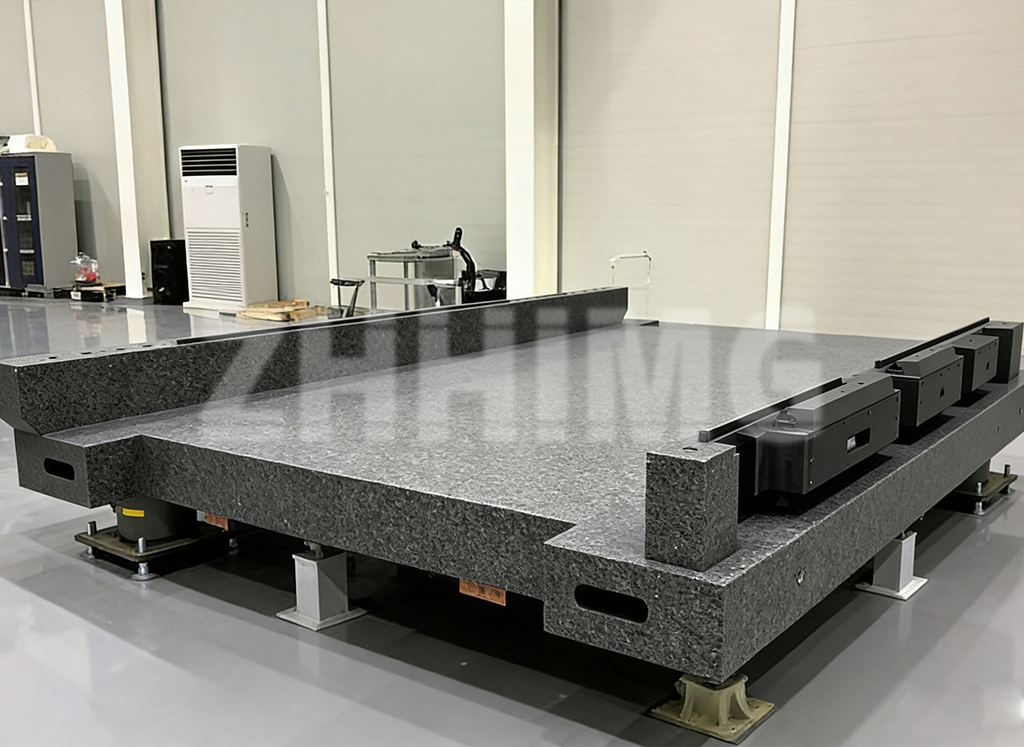
Aging treatment also improves the tolerance of granite gantries to alternating operating conditions. Production workshops inevitably witness day‑night temperature differences, seasonal temperature fluctuations and local temperature variations caused by equipment startup and shutdown. After sufficient aging treatment, lattice stress states inside stone become stable with more uniform physical properties in all directions. Cumulative micro‑deformation will not occur under repeated temperature cycling impacts. Compared with inadequately aged components under identical temperature fluctuation, gantries with thorough aging maintain extremely low fluctuation of beam straightness, column perpendicularity and base flatness. Frequent shutdown for benchmark recalibration is avoided, stable operation cycles of complete machines are extended, and on‑site maintenance and calibration workloads are reduced.
It should be noted that aging processes cannot compensate for inherent raw‑material defects. If loosely‑textured ordinary marble is used as counterfeit high‑density black granite, no aging procedure can make up for its innate drawbacks of insufficient strength and poor thermophysical performance. Real stability guarantee requires premium blanks, multi‑stage aging processes, constant‑temperature grinding environments, experienced grinding technicians and complete traceable metrological inspection working in synergy. ZHHIMG implements strict multi‑phase aging control. Stress‑relief steps are arranged for raw‑stone storage, post‑rough‑machining and post‑hole‑making processes. Supported by constant‑temperature anti‑vibration workshops and full‑range international metrological instruments verified against multiple national metrology standards, deformation risks from stress are eliminated at production phase. Delivered granite gantries not only meet precision requirements ex‑factory, but also sustain stable benchmark performance under diverse working conditions worldwide, providing long‑term reliable structural support for ultra‑precision equipment.
Post time: Sep-08-2026