
As a high-performance integrated precision measuring base that combines nanometer-level granite datum stability and flexible metal fixture positioning, granite plates with embedded T-slots have become standard supporting equipment for semiconductor assembly, precision laser debugging, industrial detection and new energy testing scenarios. While many users focus on the raw material quality and flatness accuracy of granite platforms during procurement, they often overlook the subtle operational details during workpiece installation, which are the key factor to maintain long-term measurement stability and avoid latent platform damage. As the only enterprise in the ultra-precision industry with complete ISO9001, ISO45001, ISO14001 and CE certification qualifications, and owning more than 20 international patents and trademarks, ZHHIMG summarizes professional and practical on-site installation experience based on its decades of ultra-precision processing and after-sales service practice, guiding global users to standardize workpiece installation and maximize the service performance of T-slot granite plates.
The excellent performance of ZHHIMG T-slot granite plates stems from high-density black granite raw materials with a density of 3100kg/m³ and ultra-precision processing completed in a professional constant temperature and humidity shockproof workshop. The unique composite structure of granite substrate and embedded metal T-slots avoids the inherent defects of traditional cast iron platforms such as easy deformation and rusting, and also makes up for the single functional limitation of ordinary pure granite plates. However, the brittle texture of granite and the precision bonding state between metal inserts and stone base determine that the installation and clamping of workpieces cannot adopt conventional rigid operation methods. Before placing and fixing any workpiece, users must first confirm the overall horizontal state of the platform. Long-term workshop vibration, long-term heavy pressure and slight ground settlement will subtly change the supporting balance of the granite plate. Unlevel platform conditions will produce invisible torsional stress during workpiece clamping, which will slowly attenuate the original calibration flatness of the platform and cause continuous measurement deviation in subsequent batch detection.
In the actual clamping process, operators need to maintain uniform stress balance and stable temperature balance throughout the operation. Workpieces with sharp edges and burrs cannot be in direct rigid contact with the granite datum surface, because local point pressure will leave micro-indentations on the precision stone surface that are difficult to observe with the naked eye, permanently damaging the datum accuracy. When using multiple groups of T-slot bolts to fix large-scale workpieces, irregular one-sided rapid tightening will form cross torsion at the bonding interface between metal inserts and granite, leading to hidden dangers of insert loosening and degumming. The scientific operation method is to implement symmetrical and gradual uniform locking to ensure consistent stress on the whole platform. In addition, workpieces brought from mechanical processing equipment will carry residual heat. Direct clamping and positioning before temperature balance will cause local thermal deformation of the platform, which interferes with the authenticity and accuracy of detection data. It is necessary to place the workpiece statically on the platform until the temperature of the workpiece and the granite base are completely consistent before formal positioning and measurement. 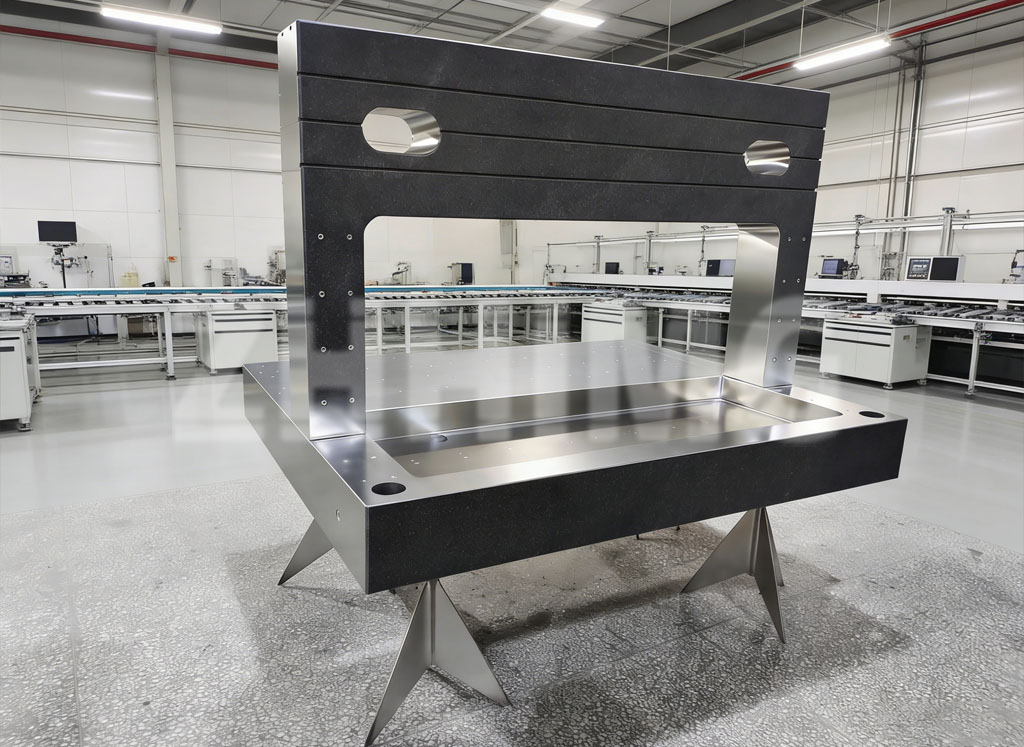
It is also crucial to standardize the daily use boundary of T-slot structures. Metal T-slots are professionally designed for workpiece fixture positioning and clamping, and cannot bear external impact, hammering and hoisting load. Many on-site misoperations such as lifting workpieces by hooking T-slots and knocking correction will destroy the embedded assembly structure of the platform, greatly shortening the service life of precision equipment. After each use, users need to clean the residual dust and debris in the T-slot gaps and on the granite surface to avoid particle jamming affecting the next clamping accuracy. All calibration and detection work is based on international mainstream standards such as DIN, ASME and GB, and all testing instruments adopted are traceable to national metrology institutions, which is consistent with ZHHIMG’s strict quality control system.
In the ultra-precision industry, high-precision equipment requires high-standard use habits. The stable performance of ZHHIMG T-slot granite plates not only depends on superior raw materials, advanced processing equipment and 30-year experienced manual grinding technicians, but also standardized installation and maintenance operations. Adhering to the service tenet of no cheating, no concealment, no misleading, ZHHIMG provides global customers with one-stop precision product application guidance, helping each user maintain the long-term stability of ultra-precision measuring equipment and create accurate and reliable industrial detection and assembly conditions.
Post time: Aug-11-2026