
Environmental control in clean laboratories relies on more than air conditioning and filtration systems to maintain airborne particle standards. As the core carrier for sample placement and instrument mounting, worktables carry hidden contamination risks from particle shedding and outgassing that are often overlooked. When ordinary finished granite surfaces operate long-term in clean environments, stone micropores and machining marks gradually release mineral particles, disturbing precision physical and chemical tests, optical measurements and micro-sample observation. Many laboratory equipment purchasers wonder: when granite worktables are deployed in clean laboratories, what targeted special surface treatments are needed to consistently meet cleanroom standards over time. ZHHIMG Group has developed a multi-layer granite surface treatment process for clean laboratory scenarios. It covers micropore sealing, surface modification and final clean passivation, enabling granite substrates to retain original ultra-precision performance while satisfying stringent requirements of clean laboratories.
The first step is base surface finishing, the prerequisite foundation for all clean surface processes. Conventional lapping only pursues flatness and leaves fine machining marks and open pores. Clean-grade finishing performs the final rounds of fine lapping inside a constant-temperature clean workshop to reduce surface roughness and smooth out tool and grinding traces. This stage is not merely polishing for gloss; it minimizes surface grooves that trap dust and inspects for surface microcracks. Workpieces with cracks are rejected directly to avoid debris generation from crack propagation later.
The second step is micropore impregnation sealing, the core of the whole process. Invisible open micropores naturally exist between granite crystals. These cavities trap fine dust and slowly release particles. ZHHIMG uses low-outgassing, non-shedding sealing compounds formulated for clean applications. Vacuum impregnation under controlled temperature and humidity drives sealant deep into near-surface stone pores. Once cured, it blocks pore channels. Unlike simple spray coating, vacuum impregnation penetrates subsurface gaps without peeling or flaking surface films, fundamentally stopping mineral particles from escaping. The sealing material passes aging validation; it releases no hazardous substances under temperature variation and will not contaminate lab samples or optical components.
The third step is edge and hole passivation. Corners, threaded holes and locating pin holes on worktables are high-risk zones for particle chipping. Even if the main plane is properly treated, sharp edges may generate tiny chips during assembly or maintenance. All outer edges and inner hole rims receive continuous rounded passivation to eliminate stress sharp points. Hole inner walls also undergo clean treatment to clear grinding dust and partial pore sealing, preventing contaminant accumulation inside holes. Many failed clean projects stem not from the main work surface, but from neglected fine treatment of holes and edges.
The fourth step is clean polishing and plasma decontamination. After sealing and curing, gentle re-polishing creates a uniform dense working surface without damaging the formed sealing layer. Plasma cleaning then removes residual organic contaminants and free micro-particles on the surface. Compared with compressed air purging alone, plasma treatment strips nano-scale contaminants adhering to granite without leaving residues or introducing new impurities. After this procedure, no loose mineral particles remain on the worktable surface.
The fifth step is cleanliness verification and protective film application. After all surface treatments, particle emission tests are carried out in a simulated clean laboratory environment. Particle generation under vibration and light friction is continuously monitored to confirm compliance with required cleanroom classes. Once qualified, a dedicated clean protective film is applied inside a clean space to prevent secondary contamination during packaging and transit. The film is only removed after equipment installation inside the end user’s clean laboratory. 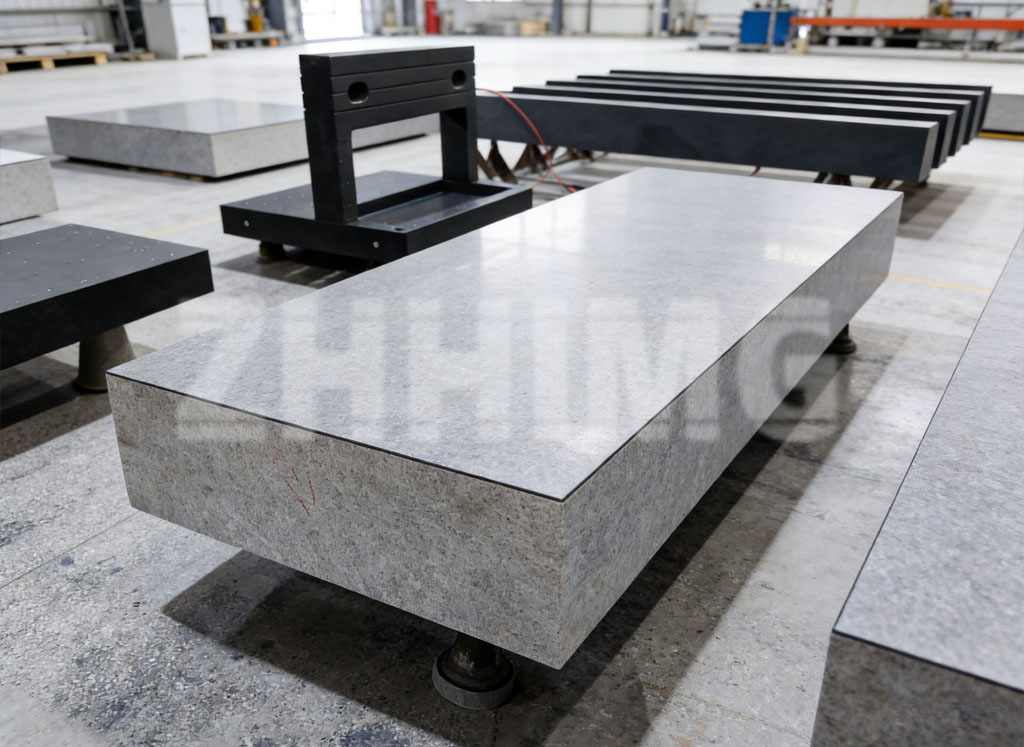
It is worth noting that all surface treatments preserve granite’s core advantages. The substrate maintains high density, low thermal expansion coefficient and excellent vibration damping. Precision indicators including flatness and straightness of reference surfaces remain unaffected by pore sealing. Compared with metal worktables, treated granite surfaces resist rust and oxide dust, delivering superior long-term stability in constant-temperature clean laboratories.
Pollution control in clean laboratories demands full-process management. Component surface treatment is not a one-time cosmetic procedure, but a vital link within the cleanliness system. ZHHIMG Group’s multi-stage surface modification solution for granite worktables in clean laboratories balances ultra-precision reference performance and low particle emission. By optimizing stone surface conditions layer by layer, particle release risks are controlled at the source. These granite worktables reliably support optical metrology and micro-nano sample inspection in clean laboratories, delivering a clean and stable reference platform for high-precision laboratory measurement.
Post time: Oct-16-2026