
Precision machinery deployed in clean production lines faces challenges far beyond accuracy requirements. In scenarios such as semiconductor wafer inspection, optical AOI and X-ray defect detection, debris or outgassing substances released from machine structural parts can directly compromise product yield. Traditional gantry components often present a dilemma: metal structures tend to rust and generate oxide dust, while ordinary stone carries risks of particle shedding. Custom-built granite gantries dedicated to cleanroom equipment are structural solutions engineered specifically for cleanroom operating conditions. ZHHIMG Group has established a complete manufacturing system for clean-grade granite, covering raw stone selection, process control and surface passivation, to deliver both structural stability and low particle emission performance.
Conventional granite components are only required to meet geometric tolerances without strict limits on surface pores and edge chipping, so they cannot be deployed directly inside cleanrooms. Residual microcracks and open micropores formed during machining will gradually release tiny mineral particles under continuous equipment vibration, acting as persistent dust sources within production lines. In contrast, the production philosophy for cleanroom-specific granite gantries is entirely different. Cleanliness control runs through the whole workflow, and it cannot be achieved merely by simple air purging and packaging after machining.
Raw material selection serves as the first checkpoint. ZHHIMG® adopts dense black granite with extremely low porosity and tightly bonded natural mineral grains, fundamentally lowering the risk of particle delamination. Raw stones go through sufficient aging treatment to fully release internal stress. Their crystal structure will not spontaneously shed powder under long-term alternating vibration and minor temperature fluctuations. Stones with loose texture and fissures are eliminated directly and will not enter the machining workflow for cleanroom components. This marks the fundamental difference between standard commercial granite gantries and cleanroom-specialized versions.
Machining procedures are carried out in an independent constant-temperature clean assembly workshop. Low-stress diamond machining technology is applied for all cutting, grinding and hole-drilling operations to reduce stone microcracks induced by machining impact. Clean coolant is continuously supplied during processing to prevent debris from embedding into stone micropores. Fine chamfering and passivation are performed on all holes and edges to remove sharp corners and eliminate risks of edge particle chipping. The whole machining process is isolated from external dust, preventing contaminants from ordinary workshops from adhering to reference surfaces and being brought into customers’ clean production lines later.
Surface treatment is the core step for particle emission control. After fine grinding, the granite surface is polished and pore-sealed to block remaining tiny open channels on the stone surface and stop internal mineral particles from escaping. Particle emission tests are conducted after treatment. Vibration loads are applied in a simulated cleanroom environment to continuously monitor micro-particle release from component surfaces and verify compliance with corresponding ISO cleanroom standards. Matching auxiliary assembly materials are also strictly screened; low-outgassing, non-shedding clean-grade adhesives and fasteners are selected to avoid auxiliary materials becoming pollution sources inside production lines.
Besides cleanliness performance, rigidity, vibration damping and thermal stability must not be compromised as the load-bearing skeleton of cleanroom equipment. Granite features a low thermal expansion coefficient and minimal deformation caused by temperature changes, so optical benchmarks hardly drift during long continuous inspection operations. Its excellent inherent damping capacity effectively suppresses vibration generated by high-speed movement of linear motors and ensures stable optical imaging. Compared with aluminum alloy and cast iron gantries, granite does not rust and produce metallic dust, presenting outstanding advantages for long-term operation in clean environments. 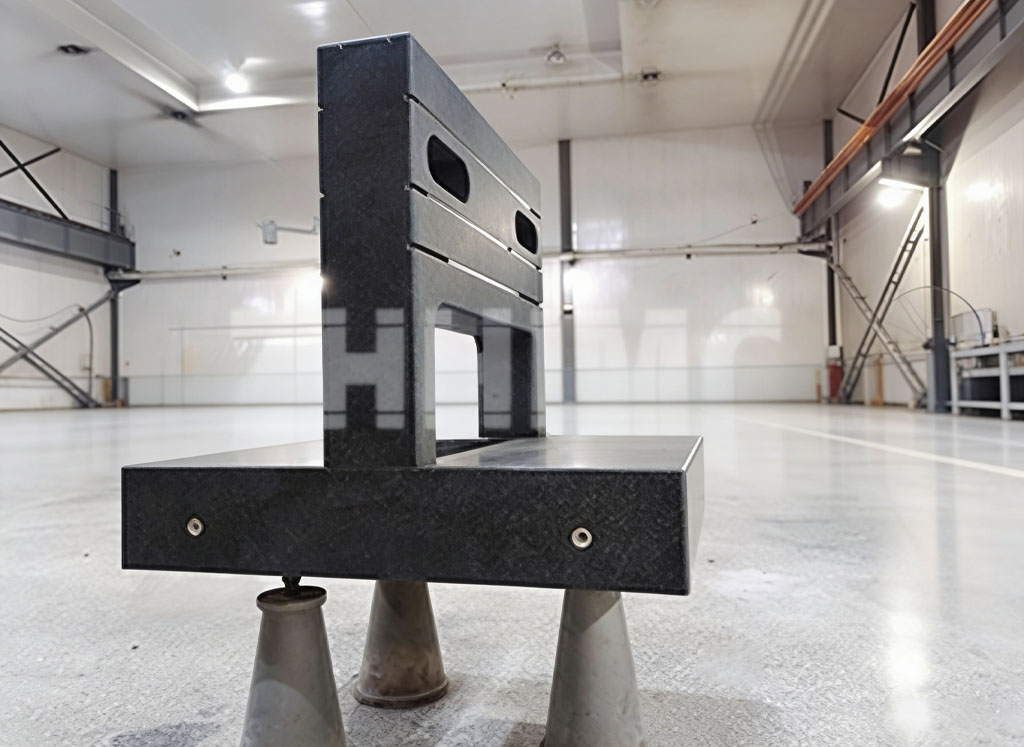
Once fully machined, components undergo special re-inspection for cleanliness in addition to standard geometric accuracy and modal tests. Qualified products are hermetically packed in clean packaging to avoid secondary contamination during transportation, so they can be directly assembled inside cleanrooms after customers unpack the goods on site.
Structural parts for cleanroom equipment need to satisfy dual requirements: cleanliness and ultra-precision stability. For cleanroom-specific granite gantries, clean design is integrated into the entire structural manufacturing chain instead of being treated as an add-on after precision is achieved. With this full set of cleanroom manufacturing processes, ZHHIMG Group supplies granite gantry structures compatible with clean production lines for global semiconductor and optical inspection equipment manufacturers. These structures maintain cleanroom environment integrity while forming a stable and reliable benchmark carrier for nano-level precision inspection.
Post time: Oct-16-2026