
During the assembly of multi-axis ultra-precision equipment, many engineers face a common dilemma. Even if a single granite component meets all flatness and straightness specifications, coaxial deviation often occurs among motion axes during machine assembly, resulting in motion jitter, positioning drift and optical image distortion. Such issues rarely stem from insufficient precision of one individual reference surface. Instead, they arise from accumulated spatial geometric errors between different reference planes. Traditional machining methods lap and inspect each reference plane separately, making it difficult to control the spatial relative accuracy of multiple working surfaces. ZHHIMG Group’s self-developed simultaneous lapping process for multiple reference planes addresses this industry pain point. It locks the spatial relationship between groups of reference planes on granite gantries at the machining source and delivers a solid coaxial foundation for multi-axis system assembly.
The conventional sequential lapping process machines the beam guide surface, column mounting surface and positioning reference surface one after another. The workpiece is repositioned to process the next surface after finishing one. Every flipping and re-clamping of the workpiece introduces new positioning deviations. With repeated clamping errors stacked layer by layer, it becomes challenging to maintain perpendicularity and parallelism between reference planes at the micron level. When equipment manufacturers receive the gantry for multi-axis integration, coaxial misalignment of X/Y/Z axes emerges. Extensive manual shimming adjustments are then required, which prolong the machine assembly cycle and leave hidden risks of long-term precision drift. Coaxial errors tend to worsen under high-speed reciprocating motion or minor temperature fluctuations.
ZHHIMG’s simultaneous multi-reference-plane lapping process reshapes this machining logic. Under one stable clamping setup, multiple interrelated reference planes of the gantry are lapped synchronously. Supported by large high-precision grinding machines and a constant-temperature machining environment, frequent disassembly and flipping of workpieces are avoided to minimize positioning errors from repeated clamping. During lapping, technicians continuously track the relative geometric relationship among multiple reference planes rather than separately controlling surface roughness and flatness of each single face. Simultaneous lapping is not merely grinding several surfaces at the same time. It dynamically matches the material removal rate of each working surface to ensure the spatial geometric relationship among beam guide references, column connection references and positioning hole references consistently complies with the coaxial design requirements on drawings.
Granite is a brittle crystalline material, so controlling material removal volume demands rich craftsmanship. ZHHIMG employs senior lapping specialists with decades of hand-lapping experience, working alongside quantitative equipment monitoring to precisely regulate material removal thickness at every position and prevent over-lapping locally, which would break the balanced geometry among multiple references. Throughout synchronous lapping, metrologists perform cross-reference inspection using laser interferometers and high-precision electronic levels to collect real-time parallelism and perpendicularity data across multiple reference planes. Lapping parameters are fine-tuned immediately if relative geometric deviation appears, instead of carrying out a single inspection only after all machining is complete.
The core advantage of this process is reflected in the downstream multi-axis equipment assembly stage. Multi-axis systems, including linear motor stages, CMM mainframes and semiconductor optical inspection equipment, require stable coaxial alignment for different motion axes. When multiple critical reference planes of the gantry are formed under the same clamping system, relative errors between references are minimized. Equipment manufacturers can achieve axis coaxiality in one pass without heavy shimming compensation, greatly cutting machine commissioning time. Moreover, geometric relationships of references are fixed during stone machining. Their relative form accuracy remains more stable under temperature variation and vibration loads, and coaxial precision degrades less over long service life. 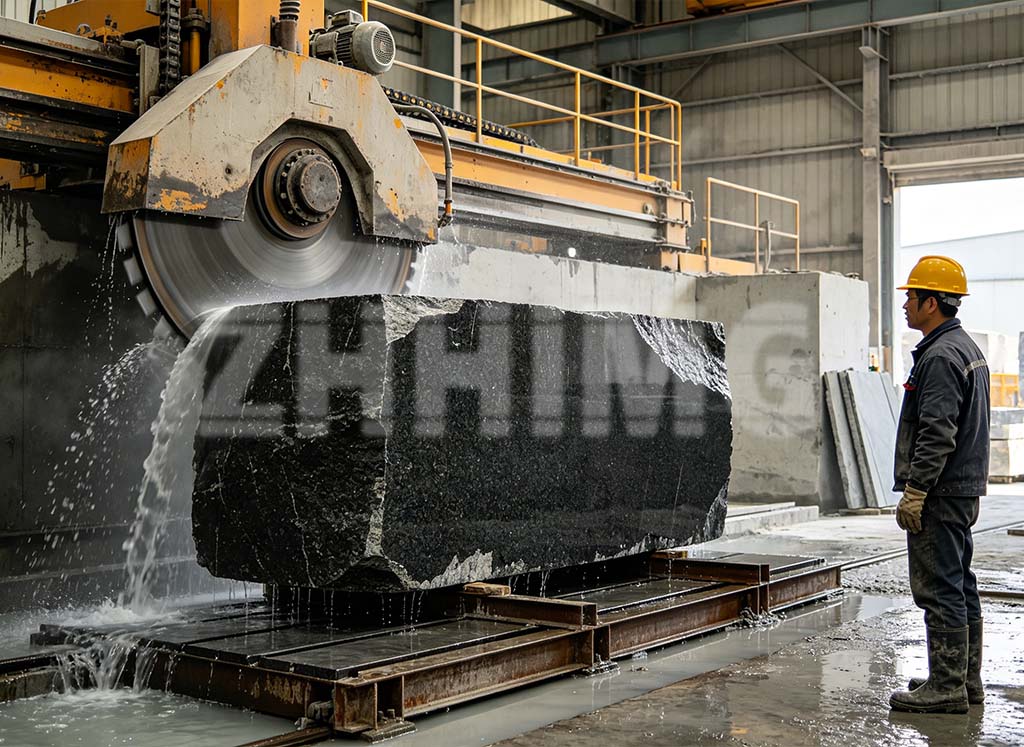
Naturally, this process imposes strict requirements on production conditions. The machining environment must stay at a constant temperature to avoid instantaneous stone deformation caused by temperature gradients that compromise synchronous lapping accuracy. Workpiece fixtures must feature high rigidity and low deformation without tiny creep during lapping. Few granite manufacturers own the hardware and process expertise to implement simultaneous multi-reference lapping; most ordinary factories are limited by metrology and equipment and have to stick to traditional separate-surface machining.
From the perspective of long-term equipment operation, the stability of coaxial accuracy carries greater value than isolated single-point precision indicators. The simultaneous lapping process for multiple reference planes moves coaxiality assurance forward to the component machining phase and reduces reliance on compensation measures during later assembly. With this customized process solution, ZHHIMG supplies granite gantries for multi-axis equipment clients in AOI, semiconductor inspection and precision laser processing. It enables the whole multi-axis system to sustain stable coaxial performance during high-speed motion and prolonged continuous operation, unlocking the designed precision potential of high-end ultra-precision equipment.
Post time: Oct-16-2026