
In semiconductor manufacturing and inspection lines, clean environments are held to extremely strict standards. Even tiny dust particles can scratch wafers or contaminate optical lenses during micron and nano-scale chip defect inspection, directly resulting in product scrap. As solid structural components that remain inside production lines, the dust generation property of equipment frames has become a key evaluation indicator for equipment manufacturers selecting gantries, alongside structural rigidity and thermal stability. Many equipment designers have a question: as a mainstream substrate for ultra-precision equipment, can granite used to fabricate gantries for semiconductor inspection equipment consistently meet cleanroom classification standards?
There is a common misconception that natural stone is porous and prone to shedding particles, making it unsuitable for cleanrooms. This view only applies to low-grade ordinary stone without special surface treatment. The clean performance of stone depends on raw material quality, precision machining, surface sealing and subsequent purification processes. ZHHIMG® has verified through multiple projects serving semiconductor equipment enterprises that high-quality granite components can fully adapt to semiconductor cleanrooms and satisfy corresponding cleanroom classes.
Low-cost inferior stone features abundant internal pores and loosely bonded mineral grains. Particle peeling easily occurs after machining, continuously generating dust. In contrast, ZHHIMG® black granite boasts dense crystal structures with minimal internal pores, fundamentally reducing the risk of particle shedding. Raw stone undergoes prolonged natural aging to fully release internal stress and stabilize its crystal structure. Under continuous vibration and minor temperature fluctuations, mineral grains will not peel off, a core advantage that ordinary marble and low-grade granite cannot match.
Premium raw material alone cannot directly satisfy cleanroom requirements. Subsequent machining and surface treatment are critical to achieving clean performance. ZHHIMG Group has developed exclusive clean-grade machining processes for semiconductor gantries. Components complete precision grinding, drilling and assembly inside a constant-temperature clean workshop to prevent machining debris from embedding into tiny pores of the stone. After machining, the granite surface receives fine polishing and passivation sealing to seal residual open micro-pores on the surface and block dust release channels. All edges and holes are finely chamfered to eliminate sharp edges and prevent particle chipping. After the full machining workflow, components go through high-pressure clean air purging and ultrasonic cleaning to remove surface micro-particles, then are sealed and packaged to avoid secondary contamination during transportation.
Beyond clean performance, semiconductor gantries must meet strict requirements for structural stability required by ultra-precision equipment. Granite has a low thermal expansion coefficient, resulting in minimal deformation under temperature changes. During long continuous operation of semiconductor inspection equipment, it can reliably maintain the optical inspection reference benchmark. Granite also delivers excellent vibration damping to suppress vibration induced by high-speed movement of linear motors, guaranteeing imaging and measurement accuracy for AOI, X-Ray and wafer inspection equipment. Compared with metal gantries, granite resists oxidation and rust, so it will not produce oxide dust — a notable advantage inside cleanrooms.
Nevertheless, granite gantries have clear limits for cleanroom application. Improper selection of adhesives and fasteners in the design phase may lead to volatile emissions or particle shedding from auxiliary materials. Even if the granite body meets specifications, the complete equipment may still fail cleanroom standards. When delivering semiconductor projects, ZHHIMG also controls matching auxiliary materials, adopting low-outgassing, non-shedding clean-grade accessories and optimizing assembly processes to reduce bonding seams and minimize dust-hiding dead zones. Finished components undergo cleanliness testing to measure particle generation under simulated semiconductor cleanroom conditions and verify compliance with ISO cleanroom class requirements for customers’ production lines. 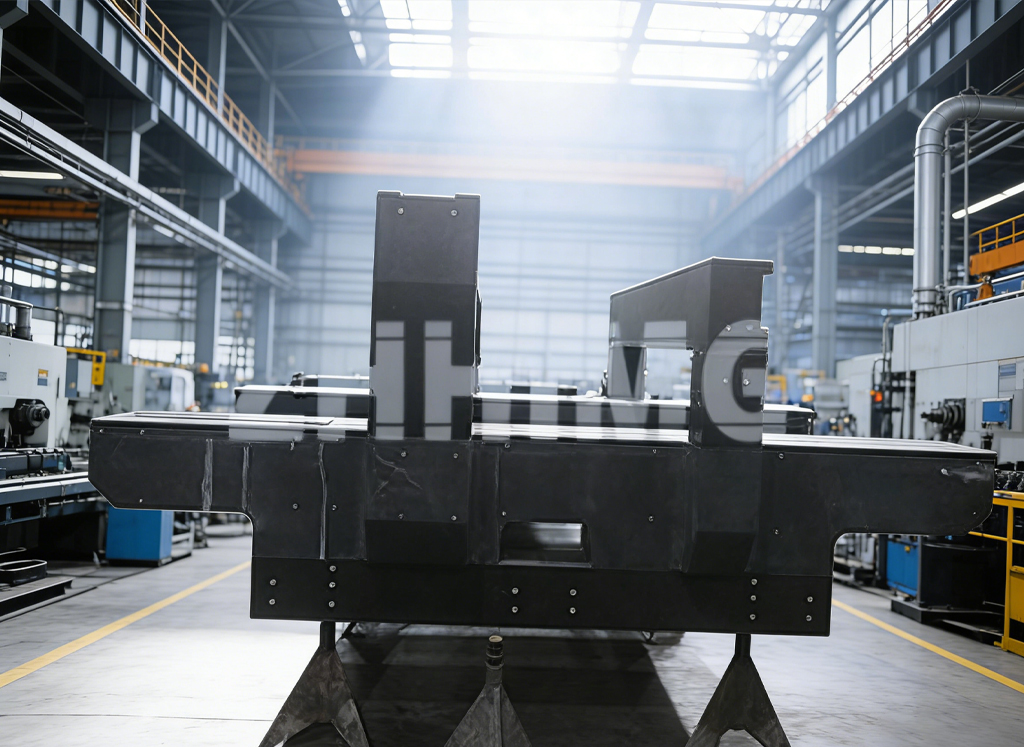
Material cleanliness requires continuous validation rather than one-time factory testing. Using its own constant-temperature, humidity-controlled clean assembly workshop, ZHHIMG replicates semiconductor production line environments for aging tests and continuously monitors particle shedding of components under long-term cyclic loads. Together with multiple semiconductor research institutes and metrology organizations, ZHHIMG keeps optimizing granite cleaning and treatment solutions, balancing clean performance and structural precision to meet the demands of new-generation wafer inspection and optical inspection platforms.
In summary, granite is not inherently a clean material. However, ZHHIMG® granite gantries processed with premium raw material selection, precision machining, pore sealing and full cleaning workflows can fully satisfy cleanroom class requirements for semiconductor inspection lines. For ultra-precision semiconductor inspection equipment, it integrates high structural stability and vibration damping with clean properties, providing a reliable structural benchmark for high-precision optical measurement inside cleanrooms.
Post time: Oct-16-2026