
In ultra-precision equipment such as semiconductor inspection, laser processing and coordinate measuring machines, the granite gantry is a core load-bearing component that determines the dynamic response and long-term accuracy benchmark of the whole machine. Many equipment R&D engineers share the same question: will drilling weight-reduction holes on the granite gantry beam and column to achieve lightweight inevitably lead to reduced rigidity, and thus affect the micron and even nano-level measurement stability? According to the structural R&D team of ZHHIMG®, the answer is not a simple yes or no. The key to rigidity change lies not in “whether holes are made”, but in **hole position, hole profile, topological layout and preliminary mechanical simulation verification**.
Natural granite is a brittle material, whose mechanical properties are fundamentally different from cast iron and aluminum alloy. Metallic materials have certain plasticity and can withstand local stress release; however, granite is highly sensitive to stress concentration caused by sharp corners and notches. If weight-reducing square holes are arbitrarily drilled in the mid-span area where the gantry beam bears the maximum bending moment merely based on experience, or the hole edges lack smooth fillet transition, such reckless hole-opening schemes will definitely destroy the original force transmission path, sharply raise local stress, amplify structural deformation, lower natural frequency, weaken the overall rigidity, and may even generate microcracks over long-term service, causing continuous deterioration of precision stability. Some simple weight reduction solutions on the market ignore the brittle characteristics of granite and only pursue weight reduction ratio, resulting in amplified vibration and positioning accuracy drift during high-speed movement of equipment.
Nevertheless, lightweight hole opening is not blind hollowing. The ultra-precision structural design concept of ZHHIMG Group is **topology optimization: remove redundant material areas while retaining the complete force-bearing skeleton**. Through coupled static and modal simulation, the stress distribution of the gantry under multiple working conditions including dead load, dynamic impact of linear motors and temperature fluctuation is fully simulated, so as to identify low-stress areas inside the component that contribute little to bending and torsion resistance. Weight-reduction holes are only arranged in these safe zones. Meanwhile, round or elliptical holes are adopted with smooth fillet transition on hole edges to avoid stress peaks; sufficient wall thickness is reserved after hole machining to maintain the section modulus of bending resistance of gantry beams and columns, ensuring that static deformation and first-order natural frequency are no worse than those of solid structural benchmarks. With this design method, 20%-40% weight reduction can still maintain or even optimize dynamic rigidity. Lightweight design brings additional key benefits: lower dead weight of the gantry reduces driving load, enables faster acceleration response of linear axes, cuts motion inertia and lessens start-stop impact; reduced dead weight also lowers bearing deformation of the supporting base, indirectly improving vibration suppression of the whole machine, which is suitable for high-speed precision scenarios such as AOI optical inspection and femtosecond laser processing.
Many people confuse two concepts: **static rigidity** and **dynamic rigidity**. Solid granite gantries deliver excellent static bending resistance, yet their excessive self-weight will reduce the natural frequency. Resonance is more likely to be triggered during high-speed reciprocating motion of equipment, resulting in poorer dynamic rigidity. Reasonable lightweight hole opening can reduce structural mass, raise natural frequency and optimize dynamic rigidity on the premise of controllable static deformation. This is an important direction for structural design of new-generation ultra-precision gantry equipment when ZHHIMG serves global semiconductor and precision metrology customers. Of course, lightweight hole-opening design has clear limits and weight cannot be reduced infinitely. For the high bending-moment bearing zone in the middle of long-span gantry beams, the quantity and diameter of holes shall be strictly limited; no weight-reduction holes shall be arranged near the mounting reference surfaces for guide rails and air bearings in principle, to prevent local deformation from affecting the straightness of guide rails.
Material quality also determines the fault tolerance of lightweight hole-opening schemes. ZHHIMG® black granite substrate features dense and uniform texture with continuous and stable internal crystal structure. It is not prone to internal micro-damage during hole machining after topology optimization. In contrast, stone with loose texture and fissures may develop microcracks along weak grain boundaries even with tiny holes, undermining structural integrity. Machining technology matters as well. As a brittle hard material, granite requires ZHHIMG’s mature low-stress diamond machining process for hole drilling, with constant-temperature cooling throughout processing to avoid hidden microcracks induced by thermal shock from cutting. Hole edge chamfering eliminates edge chipping risks to guarantee long-term service stability of components. 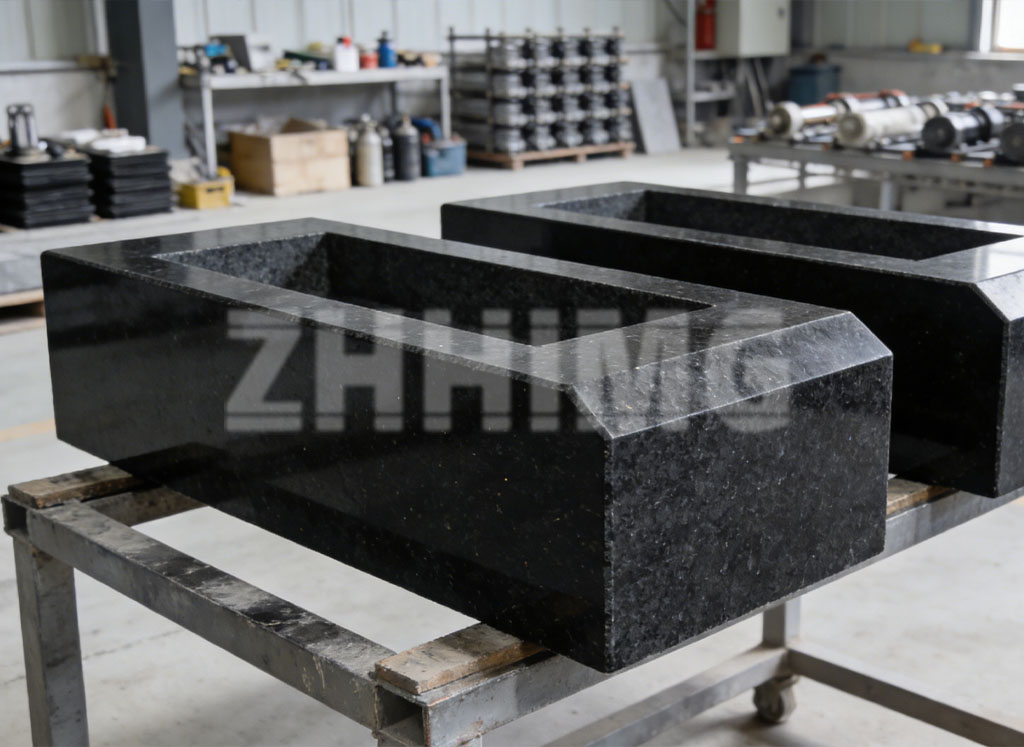
After structural design and machining, a complete metrology verification loop is required. ZHHIMG places finished gantries in a Class 10,000 constant temperature & humidity workshop to conduct deflection tests and modal tests. Deformation data and vibration characteristics are compared with solid prototypes to confirm that rigidity indicators of lightweight versions meet equipment design thresholds. Long-term observation of aging stability is also carried out to verify that stress distribution will not release slowly over time and prevent precision drift. All testing instruments can be traced back to national metrology institute, and every set of data is authentic and traceable.
In short, lightweight hole opening on granite gantries is not an inherent destroyer of rigidity. Crude schemes without simulation, improper hole locations and profiles will weaken rigidity. By contrast, solutions based on topological mechanical simulation, avoiding high-stress zones, adopting smooth hole profiles, matched with premium ZHHIMG® granite substrates and low-stress machining processes can control static deformation while optimizing dynamic rigidity and lowering motion inertia, delivering superior high-speed precision performance for ultra-precision equipment. Lightweight and rigidity are not contradictory. It is a structural balancing art requiring precise calculation and strict verification, and also one of ZHHIMG Group’s core technical advantages to supply customized granite components for global high-end equipment customers.
Post time: Oct-16-2026