
In the operating environment of ultra-precision equipment, vibration is an invisible killer of accuracy. Whether it is self-excited vibration generated by high-speed reciprocating motion of internal moving modules, or external disturbances transmitted from the workshop floor, it will transfer to the main body of the gantry and cause tiny jitter on the reference surface, directly interfering with micron and even nanometer-level inspection and machining results. Metal gantries are widely used due to their high strength and easy machining. However, metal materials have low inherent damping coefficients. Once vibration occurs, it decays slowly, which easily leads to sustained oscillation and amplified resonance. ZHHIMG® granite gantries rely on the unique material damping properties of natural stone and integrated precision forming technology. Compared with traditional metal gantries, they have irreplaceable advantages in suppressing vibration and rapidly dissipating vibration energy, building highly stable reference supports for high-end equipment such as semiconductors, laser processing and coordinate measuring machines.
The vibration damping weakness of metal gantries originates from the physical properties of the materials themselves. Metal materials such as steel and aluminum alloy have good elasticity. When subjected to impact or vibration excitation, energy can hardly be absorbed inside the material. Once vibration enters the frame, vibration waves reflect back and forth between metal components and oscillate for a long time. Even if auxiliary measures such as thickened ribs and shock-absorbing pads are added, they can only reduce vibration to a certain extent instead of dissipating vibration energy from the material source. Under working conditions such as high-speed linear motor stages and femtosecond laser equipment, the impact vibration generated by the start and stop of the module will cause continuous micro-jitter of the metal gantry. A long waiting period is required for vibration attenuation before measurement and processing, which not only reduces production efficiency but also brings continuous offset of the reference surface. When meeting a specific operating frequency, the metal frame may even trigger resonance and instantly amplify vibration amplitude, causing irreversible precision damage to precision components.
Granite gantries have natural high damping characteristics, which are fundamentally different from metals. ZHHIMG adopts proprietary black granite with a density of approximately 3100kg/m³. Its dense and interwoven crystal structure consumes energy through crystal interface friction when vibration energy enters the stone body. Vibration can decay rapidly without long-time oscillation like metals. In short, when vibration of the same intensity is applied to the two types of gantries, the granite gantry can absorb and dissipate vibration energy in a very short time, and the reference surface quickly returns to a stable state without waiting for a long time for static settlement. This material property is an innate advantage that steel, aluminum alloy and other metal materials cannot achieve through structural reinforcement. Meanwhile, the monolithically machined granite gantry has no splicing gaps, avoiding vibration reflection and stress concentration at the joints of split structures and further blocking the vibration transmission path.
In addition to the difference in material damping, the two types of gantries have different resistance to vibrations from various sources. External environmental vibration, such as ground disturbance caused by workshop cranes and surrounding machine tools, will transfer upward to the equipment frame. Metal gantries conduct vibration rigidly, and tiny ground vibrations will be fully transmitted to the equipment working end; granite gantries can effectively block this type of low-frequency environmental vibration and weaken the influence of external disturbances on optical inspection and metrology units. For self-excited vibration generated by internal moving components of equipment, granite gantries suppress micro-jitter of the frame through the synergy of high rigidity and high damping to ensure stable positions of laser optical paths and detection probes. ZHHIMG’s constant-temperature and constant-humidity vibration-isolated workshop is equipped with independent vibration isolation trenches and silent cranes. It is designed to fully release the vibration damping potential of granite components and maximize isolation of external interference. 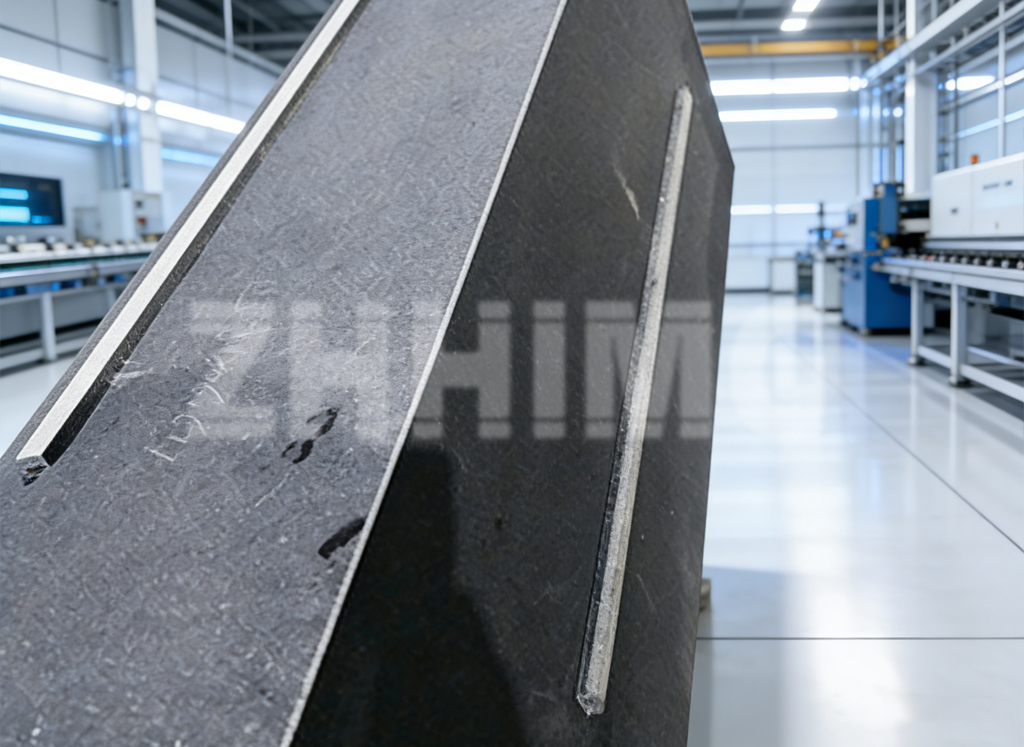
Many equipment manufacturers mistakenly believe that thickening metal plates can solve vibration problems. But thickening metal only changes the resonance frequency instead of improving material damping, and vibration still exists for a long time. In contrast, granite gantries do not require a large number of additional shock-absorbing accessories, simplifying the overall structural design of equipment. Meanwhile, its long-term performance remains stable with no metal fatigue. Under long-term repeated vibration loads, metal frames will gradually produce metal fatigue, internal microcracks, declining rigidity and continuous attenuation of vibration damping performance. Granite is a brittle crystalline material free of metal fatigue. When bearing vibration loads for a long time, its damping characteristics and structural rigidity will not change, and the vibration damping performance can remain stable for a long time. With fine machining by senior lapping craftsmen and calibration with a full set of imported metrology instruments, the form and position accuracy of the gantry is reliable. It can serve precision metrology, new energy inspection, optical AOI, X-ray equipment and other scenarios for a long time.
For the ultra-precision manufacturing industry, vibration damping capability is not only used to improve equipment operation experience, but also a necessary prerequisite for nanometer-level machining and inspection. Metal gantries rely on external auxiliary shock absorption solutions, which only treat the symptoms but not the root cause. Granite gantries absorb vibration energy from the source relying on inherent material damping advantages, suppress resonance, shorten vibration stabilization time, and reduce the interference of internal and external vibration on equipment benchmarks. ZHHIMG continues to focus on the manufacturing of ultra-precision granite components, strictly following international metrology standards, and provides globally high-end equipment customers with high-stability vibration-damping granite gantries, helping equipment achieve continuous operation with higher precision and efficiency.
Post time: Sep-29-2026