
Long‑span granite gantries serve as the core main‑beam components for large‑scale gantry‑type precision equipment, widely applied in large‑area optical inspection, panel metrology, large‑format laser processing and other machinery. As span increases, gantries become significantly more sensitive to minor disturbances during assembly. In many projects, individual granite gantries pass all factory tests for flatness, straightness and material properties. Nevertheless, after complete‑machine commissioning, problems such as pitching deviation, lateral offset, repeat‑positioning fluctuation and resonant jitter occur. Fault tracing indicates that most accuracy defects stem not from inherent stone flaws, but from easily‑overlooked details in assembly procedures. Drawing on practical experience of multiple long‑span granite‑gantry projects, ZHHIMG sorts out key assembly details that dominate final operating accuracy, helping equipment manufacturers avoid hidden accuracy loss introduced during on‑site assembly.
First come leveling and coplanarity details of two‑side column bases. Long‑span granite gantries rest on left and right column bases. Height difference, surface inclination and coplanarity error between the two supporting bases will be directly transmitted to the gantry. Even with extremely high machining accuracy of the granite gantry itself, micron‑level height deviation on supporting points will impose forced deformation and persistent bending stress on the gantry. Errors remain inconspicuous under no‑load conditions. When sliding‑table modules travel to different stroke positions and load‑center‑of‑gravity shifts, bending stress varies and gives rise to dynamic pitching errors. Instead of leveling each base independently, joint verification shall be performed for column bases on both sides. High‑precision metrological instruments are required to re‑check multi‑point height consistency and coplanarity. Some sites only rely on single‑point spirit‑level leveling while ignoring cross‑span coplanarity, leaving hidden accuracy risks for subsequent machine operation.
Second is gantry positioning and layout of leveling blocks. Long‑span granite gantries feature heavy self‑weight; quantity, placement and force uniformity of leveling blocks are critical. Improper layout, for instance blocks arranged only at two ends with a suspended middle section, will cause downward deflection due to gantry self‑weight. Excessive leveling blocks bring over‑constraint at multiple supporting points. When granite expands and contracts slightly under temperature variation, blocks restrain free deformation and generate internal thermal stress. Contact faces of leveling blocks must be thoroughly cleaned free of iron chips, grit and burrs. Tiny hard particles trapped between blocks and the granite bottom will lift local supporting points and twist the gantry body. During seating, unilateral stress is forbidden; multi‑point slow lowering shall be adopted. Never pry the gantry with crowbars for position adjustment. Forced external force induces invisible residual stress inside stone, which releases gradually during reciprocating motion and continuously degrades equipment accuracy.
Third refers to mating‑surface grinding‑contact condition and bolt‑tightening process. Even if individual mating surfaces between granite gantries and columns satisfy flatness specifications, sparse and uneven‑distributed contact spots will trigger micro virtual contact under self‑weight, dynamic inertial force and offset‑load torque. Virtual‑contact zones open and close repeatedly during acceleration‑deceleration switching, producing continuous micro attitude change of the gantry. Meanwhile, bolt tightening sequence and torque value cannot be neglected. For long‑span gantries, bolts shall never be fully tightened on one side at a time. Symmetrical cross‑step tightening shall be implemented with specified torque applied incrementally. Excessive local bolt torque causes stress concentration around stone bolt holes and risks micro chipping at orifices. Insufficient torque yields inadequate pressing force on mating surfaces and triggers micro‑slip at interfaces under dynamic loads. Many operators tighten bolts purely by experience and feel without torque control, which directly impairs dynamic accuracy of the whole machine.
Fourth covers accuracy‑transfer details for guide‑rail and linear‑encoder assemblies. Guide‑rail and encoder mounting faces on granite gantries are the accuracy source of the motion system. Residual fine abrasive debris and contaminants on reference surfaces before assembly will form local high points after guide‑rail bases are pressed on, artificially ruining guide‑rail straightness. For long‑travel applications, splicing gaps, step offsets and mounting stress of segmented guide rails and linear encoders get amplified across the full stroke. Violent over‑compression of guide‑rail pressure plates is prohibited, as excessive clamping induces local compressive deformation on granite. Assembly of guide rails and encoders must reference original granite datum surfaces. Do not correct granite parts by taking guide rails as benchmarks, otherwise the high‑accuracy transfer chain of stone substrates will be broken and consistency of full‑stroke accuracy will deteriorate.
Fifth is temperature‑environment and assembly‑timing control. Although granite boasts low thermal‑expansion coefficient, long span still generates considerable expansion‑contraction under minor temperature gradients. Direct sunlight, local heat sources or direct air‑conditioner blowing during assembly produce temperature difference across gantry sections and lead to bending deformation. If fastening is completed under non‑uniform temperature conditions, the gantry will be locked with thermal‑deformation stress. Residual stress releases later under normal working temperature and brings accuracy drift. For long‑span granite‑gantry assembly, mating‑grinding, bolting and accuracy calibration can only proceed after components reach full thermal equilibrium with ambient environment. Heat sources such as welding machines and heaters shall be kept away from gantries during assembly to reduce local thermal disturbance. Rushing construction without thermal equalization is a common cause of recurring accuracy fluctuation in many projects.
Sixth is risk of additional stress introduced in assembly. Apart from bolt fastening, routing and pre‑tension of external cable drag‑chains are easily overlooked. Gantry‑type equipment has long travel strokes. If drag‑chains, cables and air hoses connected to moving slides carry excessive pre‑tension, continuous lateral force will be exerted on slides and even gantries. Lateral load varies with slide positions throughout travel and induces positioning deviation. Improper cable allowance causes forced pulling at stroke ends and constantly disturbs the motion system. Furthermore, auxiliary brackets and protective bellows shall not rigidly push against granite gantries. External force from attachments transfers onto gantries and creates extra assembly stress. 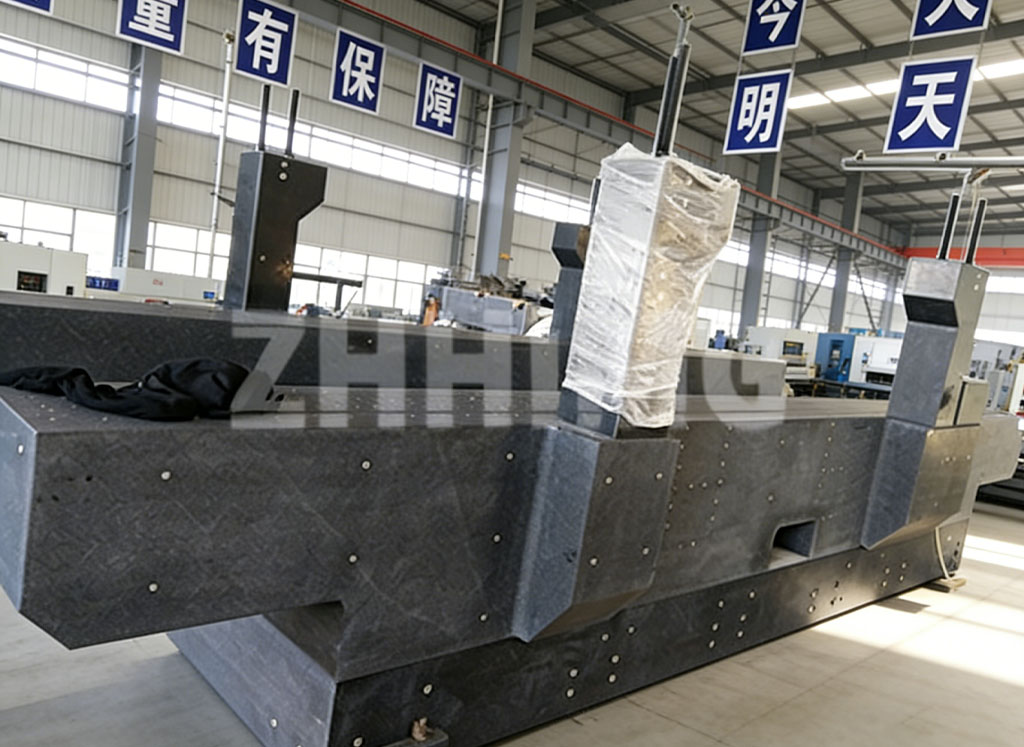
Final accuracy of long‑span granite gantries is jointly determined by manufacturing and on‑site assembly. Production procedures guarantee raw‑material quality, precision machining and factory inspection. Yet out‑of‑control assembly details can offset all prior machining accuracy. ZHHIMG selects high‑density black granite with a density of 3100 kg/m³. Finish‑machining and mating‑grinding are performed in constant‑temperature anti‑vibration workshops. Equipped with full‑set traceable metrological instruments and experienced process technicians familiar with multiple national metrology standards, ZHHIMG provides special assembly‑guidance documents for long‑span products. Holding ISO triple‑system certifications, CE certification and multiple international patents and trademarks, the company reminds customers of the special assembly requirements for large‑span components; assembly experience for small‑and‑medium‑size gantries cannot be copied mechanically.
Review of project cases shows that accuracy failures of long‑span equipment usually originate not from obvious defects of large‑size parts, but from superposition and accumulation of micron‑scale assembly errors. Qualified single components are merely a starting point for long‑span granite gantries. Only by strictly controlling assembly details including column coplanarity, leveling‑block layout, bolting sequence, datum transmission, thermal equilibrium and accessory‑induced stress can inherent precision of granite components be fully converted into long‑term stable operating performance of complete machines.
Post time: Sep-03-2026