
Wear‑resistant granite machine bases are not a universal option for all industrial equipment. Their value is reflected mainly in machinery with rigid requirements for benchmark durability, vibration suppression and thermal stability. Some devices feature high theoretical precision indicators, yet operate under conditions of heavy impact loads, sustained high temperatures and heavy‑duty aggressive cutting. Under such circumstances, the brittleness of granite becomes a limiting factor, making it an unsuitable choice. In contrast, wear‑resistant granite machine bases can give full play to material merits when equipment needs to maintain micron‑level benchmarks for years, adopt high‑frequency reciprocating moving mechanisms and run in variable complex environments, laying a solid foundation for overall machine performance.
The first category covers precision motion‑platform equipment driven by high‑speed linear motors. Such devices adopt linear motors and air‑bearing guide rails to realize high‑frequency reciprocating movements and rapid start‑stop cycles. The reference mounting surfaces of guide rails endure continuous friction and dynamic shocks from motion pairs. Metal bases tend to suffer wear on guide‑rail mounting surfaces after long‑term service, directly resulting in positioning drift. The ground reference surfaces of wear‑resistant granite machine bases feature high hardness and low wear loss. Even after years of non‑stop high‑speed reciprocating operation, geometric changes of reference surfaces remain minimal, consistently guaranteeing the repeat‑positioning accuracy of motion systems. Typical examples include dual‑axis displacement platforms, precision dispensing machines, automatic screw‑locking equipment and various automated pick‑and‑place positioning devices. Targeting high throughput and long‑term consistency, these devices reduce recalibration work triggered by base wear when equipped with granite machine bases.
Optical inspection and vision‑measurement equipment also match well with wear‑resistant granite machine bases. AOI inspection machines, 2D/3D video measuring systems, profile scanners and laser interferometry measuring instruments produce imaging and measurement results highly dependent on geometric benchmarks established by machine bases. Dust, minor temperature fluctuations and vibration generated by moving modules in workshops will interfere with imaging quality. Granite integrates wear resistance, vibration damping, low thermal expansion and non‑magnetic properties. Its reference surfaces resist wear and deformation, restrain vibration transmission towards optical lenses and sensors, and avoid signal disturbance caused by magnetization. Under mass‑inspection conditions, equipment sustains imaging clarity and measurement repeatability for a long time and mitigates environmental disturbances on test results.
Semiconductor and electronic‑component processing equipment represents a core application scenario for wear‑resistant granite machine bases. Wafer appearance inspection, packaging inspection, PCB micro‑circuit inspection and FPC flexible‑board processing‑inspection equipment are mostly deployed in cleanrooms. They require bases to be debris‑free, non‑magnetic and wear‑resistant. Wear of metal machine bases generates metallic micro‑chips that contaminate production lines, and magnetization disturbs signals of electronic components. High‑density wear‑resistant granite resists rust and debris generation. Its reference surfaces withstand friction losses from repeated module reassembly. Meanwhile, damping performance dissipates reaction‑force vibration from motion and prevents alignment deviation induced by nanometer‑scale jitter. It fits semiconductor back‑end inspection, electronic‑component sorting and micro‑device assembly equipment to satisfy long‑term stable production requirements in clean‑room conditions.
Light‑load ultra‑precision processing equipment is another suitable candidate for granite machine bases, such as optical‑element fine‑grinding machines, diamond ultra‑precision lathes, glass & ceramic micro‑processing machines and micro‑hole processing equipment. Instead of heavy‑stock cutting, these machines prioritize surface finish and micron‑level forming accuracy. Although cutting forces are low, high‑speed spindle rotation and reciprocating feed modules bring continuous vibration. Wear‑resistant reference surfaces of granite machine bases support air‑bearing or rolling guide rails while dissipating machining vibration to improve workpiece surface texture. Thanks to its low thermal expansion coefficient, the base deforms slightly under temperature rise from equipment operation and secures dimensional consistency of machined workpieces. It should be clarified that granite applies to light‑cutting and micro‑machining rather than heavy‑duty machine tools with large material removal.
Precision testing and process equipment for the new‑energy industry can also benefit from granite machine bases, including lithium‑battery pole‑piece inspection equipment, bus‑bar dimension testers and new‑energy component geometric‑tolerance inspection machines. Production sites are exposed to dust, occasional electrolyte splashes and frequent load switching. Wear‑resistant granite tolerates splashes of mild chemical media and resists rust and surface wear. Its non‑magnetic property avoids potential impacts of static electricity and magnetic fields on thin‑film lithium‑ion components. It maintains reliable equipment benchmarks in dusty, dry‑wet‑alternating production environments and cuts downtime caused by base rust and abrasion. 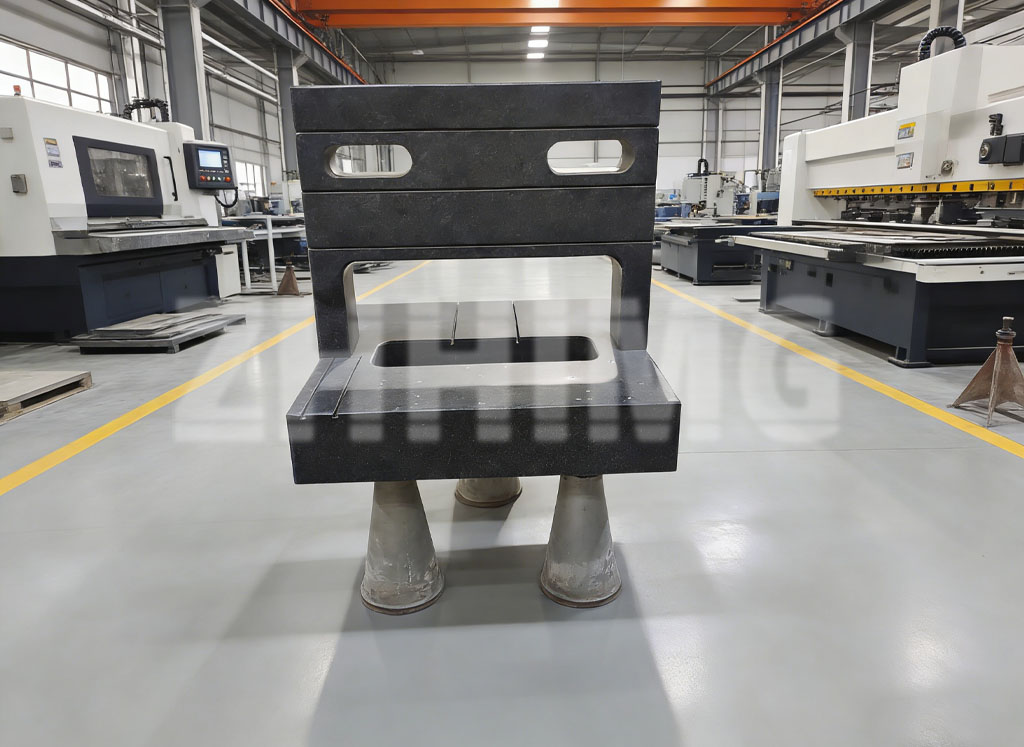
Metrology laboratories and calibration instruments also have high compatibility with granite machine bases. Various standard calibration tables, comparative inspection jigs and metrology verification tooling need to retain original benchmarks for decades without wear or deformation. After multi‑stage aging for sufficient stress relief, wear‑resistant granite machine bases deliver outstanding surface wear performance, preserve planar and orthogonal references over extended periods and meet long‑term stability demands for traceable verification of metrological tools.
Objectively, wear‑resistant granite machine bases have application limits. They are not recommended for scenarios with heavy‑duty aggressive cutting, persistent high temperature and frequent violent impacts. High‑quality raw‑material is essential to unlock the full potential of granite machine bases. Even manufactured into machine bases, ordinary marble cannot meet standards for wear resistance, vibration resistance and thermal stability. ZHHIMG selects high‑density black granite blanks, enforces multi‑stage aging, completes precision grinding in constant‑temperature anti‑vibration workshops and implements full‑set traceable metrological inspection. Only when premium raw‑materials, mature processes and suitable working conditions work together can wear‑resistant granite machine bases maximize their value and support stable long‑term operation of diverse precision equipment.
Post time: Sep-08-2026