
With 10x higher vibration damping and superior thermal stability compared to cast iron, Mineral Casting (epoxy resin concrete) has become the gold standard for semiconductor and high-end CNC machine bases.
Exceptional Vibration Damping Performance
Mineral Casting features a high internal damping ratio that absorbs mechanical vibrations significantly faster than traditional metals. This ensures micron-level (μm) positioning accuracy during high-speed machining or lithography, directly resulting in superior part surface finishes and tool longevity.
Superior Thermal Stability and Corrosion Resistance
Unlike cast iron, which is highly sensitive to temperature fluctuations, Mineral Casting has very low thermal conductivity. This protects the machine from deformation caused by environmental heat, while its chemical inertness ensures Dimensional Stability even when exposed to aggressive industrial coolants.
Green Manufacturing and Integrated Design
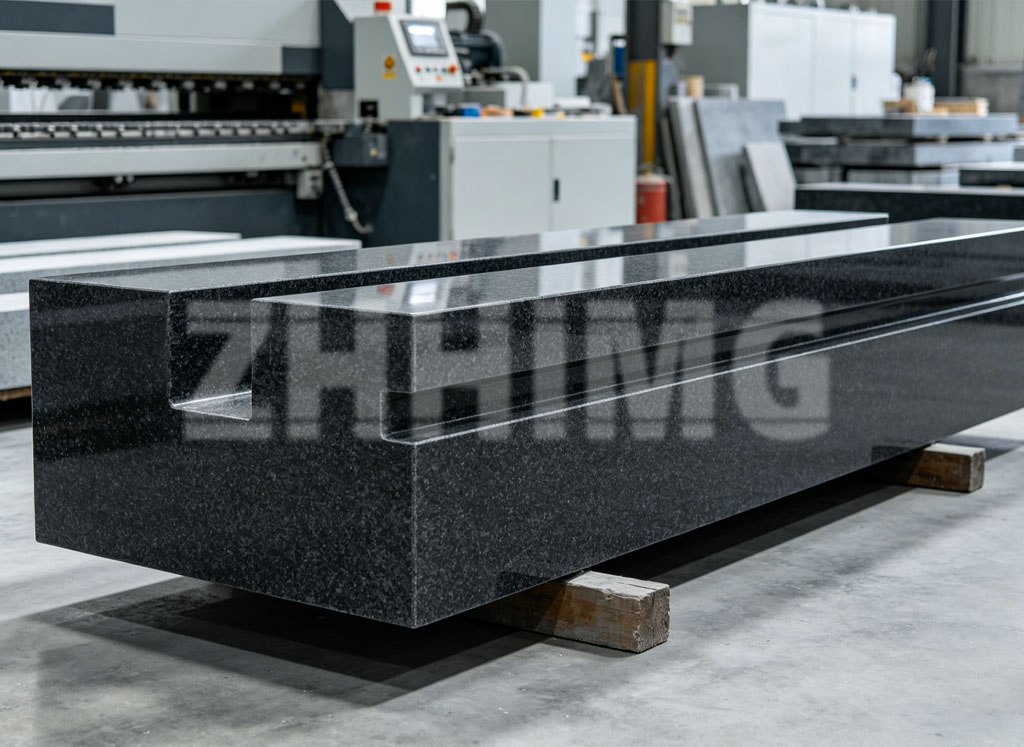
ZHHIMG utilizes a cold-casting process that consumes 80% less energy than iron smelting. We support integrating cable conduits, hydraulic components, and Granite components directly into the casting, providing a highly integrated, “plug-and-play” structural solution for complex engineering needs.
Technical Comparison Table
| Feature | Mineral Casting | Cast Iron (GG25/30) | Benefit |
| Damping Ratio | 0.02 – 0.03 | 0.002 – 0.004 | 10x better vibration control |
| Thermal Conductivity | 1.7 – 2.0 W/mK | 45 – 55 W/mK | Minimizes thermal expansion |
| Production Cycle | Short (Cold Casting) | Long (Requires annealing) | Faster Time-to-Market |
FAQ: Mineral Casting
-
What are the core ingredients? It consists of high-purity quartz sand, basalt, and a specialized high-performance epoxy resin binder.
-
What accuracy can be achieved? Through secondary precision grinding, we achieve flatness up to 0.001mm/m.
-
Can metal inserts be embedded? Yes, we support high-precision threaded inserts and heavy-duty guideway supports.
-
Is it better than natural granite? It allows for more complex geometries and internal hollow structures.
-
What is its compressive strength? Typically exceeds 120 MPa, meeting the requirements of heavy-duty machine tools.
-
How do I order a custom base? Simply send your CAD drawings to the ZHHIMG technical team for a professional evaluation.
Post time: May-29-2026