
In metrology laboratories and precision‑machining workshops, granite inspection and measuring plates serve as fundamental datum carriers for workpiece verification, tooling positioning and gauge calibration. Compared with cast‑iron platforms, granite surface plates can retain flatness accuracy for long‑term service and seldom suffer warping, depression, twisting or other deformations. Many end‑users observe stable finished‑product accuracy yet barely understand multiple contributing factors behind its anti‑deformation performance. Good resistance to deformation is not merely an outcome of natural stone properties. Raw‑blank screening, stress relief, machining procedures and post‑manufacturing aging treatment collectively determine long‑term dimensional stability of plates. Drawing on years of production experience in precision datum plates, ZHHIMG interprets the inherent anti‑deformation mechanisms of granite plates from perspectives of mineral substrate, internal stress, processing workflow and service characteristics.
First, physical properties of natural mineral substrates lay innate foundations for anti‑deformation capability. High‑quality black granite for surface plates is formed through long‑term geological high‑pressure crystallization. It consists of tightly interlocked mineral crystals such as quartz, feldspar and mica, featuring compact crystal arrangement, homogeneous internal texture, few pores and high density. Such natural rock is free from creep behaviour seen in metallic materials and will not produce plastic flow under sustained static load. Cast‑iron platforms creep and sink gradually under heavy long‑term loads; qualified granite substrates can restore deformation rapidly after external loads are removed without permanent distortion. Meanwhile, its ultra‑low thermal expansion coefficient delivers minimal dimensional expansion and contraction under diurnal and seasonal shop‑floor temperature fluctuations, avoiding warping or twisting caused by temperature change. Nevertheless, not all granite possesses such merits. Raw blanks containing interlayers, loose zones or micro‑fissures will deform even with superior subsequent machining. Therefore raw‑material screening acts as the first critical checkpoint. ZHHIMG rejects stone blanks with looseness, interlayers and hidden cracks at the raw‑material phase and only adopts compact, homogeneously‑crystallized blanks to build solid innate anti‑deformation performance from the source.
Second, sufficient release of internal residual stress eliminates major triggers of spontaneous post‑manufacturing deformation. Many people mistakenly believe granite, as stone, contains no internal stress. In fact, mining and sawing break the subsurface stress equilibrium formed over hundreds of millions of years and accumulate cutting‑induced residual stress inside components. If plates skip aging procedures and go directly to fine grinding and lapping, they may show perfect accuracy upon delivery yet warp gradually months or years after deployment as internal stress releases slowly, accompanied by continuous flatness deterioration. This accounts for rapid accuracy failure of some low‑cost granite plates on the market. Multi‑stage aging workflows are mandatory to avoid such issues. Raw blanks undergo natural static aging after quarrying. Long‑term stress‑releasing storage is performed after rough sawing, followed by secondary aging post rough grinding to progressively eliminate residual stress from cutting and sawing. When manufacturing inspection plates, ZHHIMG never cuts short aging cycles. Multi‑phase static storage fully releases internal stress before ultra‑precision lapping, preventing spontaneous deformation triggered by stress release in finished products.
Third, scientific structural design and reasonable wall‑thickness ratio avoid load‑induced deformation. A granite plate is not immune to deformation simply by increasing thickness. Insufficient wall thickness or poor rib layout will cause deflection under gravity or heavy workpiece loads regardless of material quality. Plate self‑weight, table size and support‑point positions are closely interrelated. Large‑size plates with overly thin walls bend under their own weight; improperly‑arranged supports with partial overhang also lead to twisting. At the design phase, plate thickness shall match length‑width specifications and support zones shall be rationally planned to prevent local stiffness deficiency. For measuring plates of various sizes, ZHHIMG optimizes overall structures and defines proper thickness and support layouts, balancing self‑weight and rigidity to resist bending under gravity and guarantee stable geometry under normal placement and loading conditions. 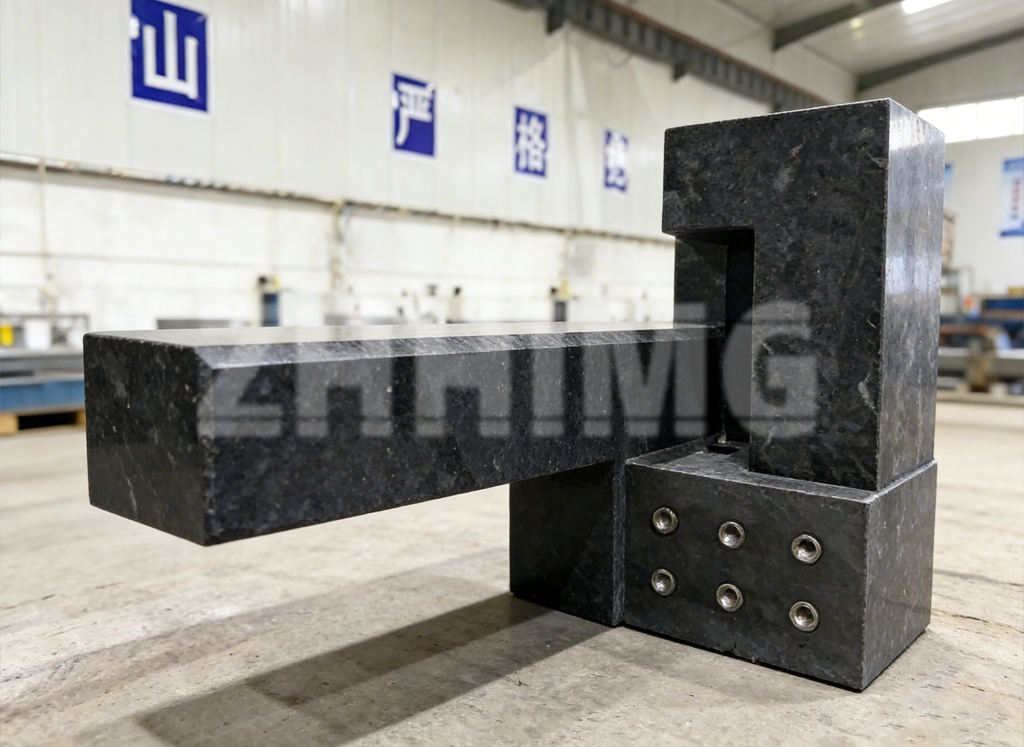
Fourth, ultra‑precision constant‑temperature machining prevents new stress introduced during production. Local heat generated by grinding and drastic ambient temperature swings may induce additional stress during granite plate lapping. Finishing carried out in ordinary workshops with large diurnal temperature variation produces only temporary accuracy under uneven component temperature. Deformation will emerge when plates are placed in constant‑temperature environments or used in different seasons. Fine grinding and lapping for premium granite plates shall be completed under constant‑temperature conditions to maintain uniform stone temperature and minimize local stress caused by machining heat. ZHHIMG performs finishing operations in constant‑temperature workshops to stabilize component temperature throughout processing, reduce extra stress introduced during manufacturing and ensure as‑delivered geometry can be stably reproduced under service conditions.
It should be objectively noted that “deformation‑resistant” does not mean “deformation‑proof”. Granite is brittle. Violent impact, excessive local overload, incorrect support or long‑term one‑sided overhang may still result in bending and chipping. Proper installation, reasonable load limits and periodic re‑inspection are essential for long‑term accuracy retention. ZHHIMG supplies installation, support and load‑bearing guidelines together with products to guide correct operation and extend datum‑accuracy service life.
Supported by rigorous raw‑blank screening, multi‑stage aging workflows, constant‑temperature precision lapping and ISO three‑system, CE and CNAS quality‑control frameworks, ZHHIMG granite inspection and measuring plates are widely deployed in metrology laboratories and machining quality‑inspection workshops. They deliver stable deformation‑free datum support for gauge calibration and workpiece inspection and ensure reliable test data for manufacturing industries.
Post time: Sep-07-2026