
Walk into almost any metrology lab, CMM room, or semiconductor fab, and you’ll find a dark, dense stone slab under the equipment. Most people call it “marble” out of habit, the way people say “Kleenex” for tissue. In reality, the material doing the work in modern precision equipment is almost always granite, and the distinction is not cosmetic. It affects measurement accuracy, equipment lifespan, and long-term calibration stability.
The Confusion Between Marble and Granite
Marble is a metamorphic rock formed primarily from limestone, composed largely of calcite. It’s popular in architecture and countertops because it’s relatively soft, takes a polish easily, and is comparatively inexpensive to quarry and shape. Granite is an igneous rock formed from slowly cooled magma, composed mainly of quartz, feldspar, and mica. That mineral composition gives granite a fundamentally different mechanical profile.
For decorative use, the difference barely matters. For a surface plate that a coordinate measuring machine (CMM) or an air bearing stage sits on, it matters enormously.
Density and Dimensional Stability
Typical black granite used in precision applications has a density in the range of roughly 2,900–3,100 kg/m³, noticeably higher than most marble, which commonly falls in the 2,600–2,700 kg/m³ range. Higher density generally correlates with lower porosity and better resistance to micro-deformation under load — a critical property when a granite base is expected to hold flatness within microns across a meter-plus span.
Granite also has a lower coefficient of thermal expansion than many marbles, and because its crystalline structure is more homogeneous, it tends to respond to temperature changes more predictably. In a temperature-controlled metrology room where the target might be ±0.5°C stability, unpredictable expansion behavior in the base plate can quietly erode the accuracy the rest of the system is designed to deliver.
Wear Resistance and Long-Term Flatness
Calcite (marble’s main mineral) sits at about 3 on the Mohs hardness scale. Quartz, a dominant mineral in granite, sits at 7. That gap translates directly into wear resistance. A granite surface plate that sees years of contact from probes, styli, gauge blocks, and workpieces will hold its calibrated flatness far longer than a softer stone under the same use.
This is also why granite is resistant to the kind of “burnishing” wear pattern that can develop on softer stone surface plates over years of repeated contact in the same measurement zones — a slow drift that is easy to miss until a calibration check reveals it.
Why the Substitution Still Happens
Given the clear technical case for granite, why does “marble” still get sold into precision applications? Mostly cost. Marble is cheaper to quarry, cut, and finish, and to a non-specialist buyer, a polished black stone slab looks the same whether it’s marble or granite. In a competitive quoting process, an uninformed comparison can end up favoring the cheaper, weaker material — with the real cost only showing up months or years later as calibration drift, surface wear, or premature equipment underperformance.
What to Ask a Supplier
For engineers and procurement teams specifying granite bases, a few direct questions can separate genuine precision-grade granite from a marble substitute sold under a generic name:
- What is the measured density of the stone (kg/m³), and is there a mill test certificate?
- What Mohs hardness range does the supplier quote, and can it be verified?
- Is the flatness specification independently traceable to a national metrology institute?
- What thermal expansion coefficient data is available for the specific quarry source?
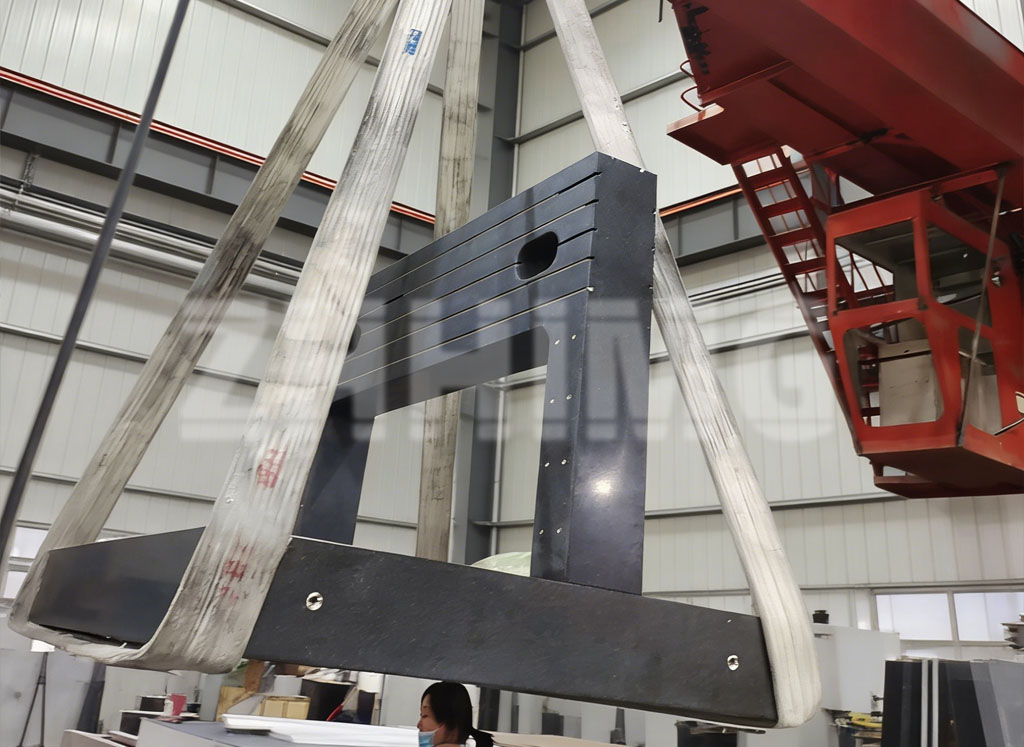
Granite components are used across an enormous range of precision equipment — semiconductor lithography and inspection systems, CMMs, optical measuring instruments, PCB drilling machines, laser platforms, and linear motor stages — precisely because the material’s mechanical stability under load and temperature is what allows everything mounted on top of it to perform at the tolerances the rest of the system was designed for. Choosing the right stone at the outset is one of the least glamorous, and most consequential, decisions in building a precision system.
ZHHIMG (Zhonghui Group) manufactures precision granite components, granite measuring instruments, and granite air bearings for the metrology, semiconductor, and precision machinery industries, with material traceable to certified mill test reports.
Post time: Jul-30-2026