
A metrology lab in Singapore once sent back a batch of surface plates within a month of installation. The plates looked identical to the ones they’d used for a decade — same size, same grey color, similar price. But readings drifted by several microns whenever the air conditioning cycled on and off. The supplier had quietly switched from granite to a dyed marble composite to cut costs. Nobody noticed until the numbers stopped making sense.
This is a more common problem than most buyers realize, and it’s worth understanding why granite earned its place under coordinate measuring machines, laser interferometers, and semiconductor stages in the first place.
Steel moves. Granite mostly doesn’t.
Cast iron and steel bases were the industry default for decades, and they still work fine for machines that don’t need sub-micron repeatability. The problem is thermal expansion. Steel expands roughly 11–12 micrometers per meter for every degree Celsius of temperature change. In a workshop where the door opens and closes, where a machine tool nearby generates heat, or where sunlight hits one side of the room in the afternoon, that’s enough to throw off a measurement that’s supposed to be accurate to a few microns.
Granite’s thermal expansion coefficient is roughly half that of steel, sometimes less depending on the specific stone. It also has far lower thermal conductivity, meaning a hand resting on it or a warm workpiece placed on it doesn’t propagate heat evenly across the surface — it stays more locally isolated instead of gradually skewing the whole reference plane.
Granite is also non-magnetic, which matters more than people expect. Cast iron surface plates can carry residual magnetism from machining or nearby equipment, which interferes with inductive sensors, electronic levels, and certain probe systems. Granite doesn’t have this issue at all.
Not all granite is equal — and this is where buyers get burned
Here’s the part suppliers don’t always volunteer: “granite” and “marble” are not the same rock, and they don’t behave the same way under load.
Marble is a metamorphic rock, softer, more porous, and structurally less uniform. It’s cheaper, and if a buyer only looks at color and surface finish, it can pass a visual inspection. But under sustained load — say, a CMM gantry sitting on the same four points for years — marble is more prone to creep and micro-deformation over time. Its density is also typically lower, which matters for vibration damping.
Genuine black granite used for precision applications typically runs at a density around 3,000–3,100 kg/m³, considerably denser and more dimensionally stable than most marble. Higher density generally correlates with better vibration absorption, which is exactly what you want under equipment sensitive to floor-borne noise — production lines, forklifts, HVAC systems, even foot traffic.
The practical takeaway: if a surface plate or machine base is priced noticeably below the market average for its size, it’s worth asking directly what stone it is, requesting the density spec, and asking for a calibration certificate traceable to a national or provincial metrology institute — not just a factory-issued inspection report.
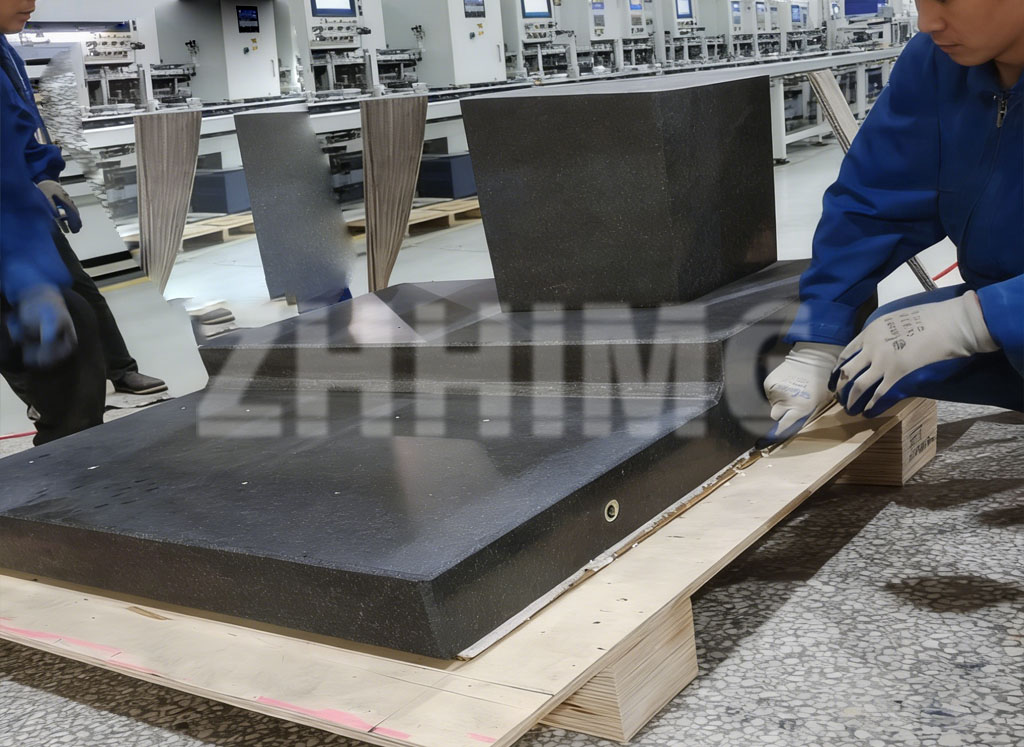
What granite is actually asked to do in a modern factory
In semiconductor equipment, PCB drilling machines, optical inspection systems, and coordinate measuring machines, the granite base isn’t just a table — it’s the dimensional reference everything else is measured against. Flatness on a good surface plate is specified in fractions of a micron over the full working area. A base that shifts shape by even a few microns as temperature swings through the day quietly corrupts every measurement taken on top of it, without triggering any alarm.
That’s the real argument for granite: not that it looks premium, but that it stays still. In precision manufacturing, “staying still” is the entire job description.
Post time: Jul-24-2026