
There is a quiet irony in the fact that some of the most advanced semiconductor equipment, laser positioning systems, and coordinate measuring machines (CMMs) in the world rest on a foundation formed roughly 300 million years ago deep inside the Earth. Granite — the same igneous rock that forms mountain ranges and coastal cliffs — has become the material of choice for the base structures and reference surfaces of ultra-precision manufacturing equipment. But not all granite is created equal. And understanding why engineers keep coming back to this ancient stone, rather than switching to modern composites or metals, reveals something fundamental about the physics of precision itself.
The Problem With Metal: Thermal Sensitivity and Hysteresis
Before exploring granite’s advantages, it helps to understand what it is replacing — and why that replacement was necessary.
For most of the 20th century, precision measuring surfaces and machine bases were made from cast iron or steel. These materials are mechanically strong, machineable to tight tolerances, and well understood by engineers. But at the micrometer and nanometer scales that modern ultra-precision manufacturing demands, two properties of ferrous metals become serious problems: thermal expansion and mechanical hysteresis.
Steel has a coefficient of thermal expansion (CTE) of approximately 11–13 × 10⁻⁶ /°C. This means a 1-meter steel beam expands or contracts by roughly 11–13 micrometers for every 1°C change in temperature. In a production environment where temperature fluctuates by even 2–3°C over a working day, a steel reference component can shift dimensionally by 25–40 micrometers — an error that completely swamps the sub-micron tolerances demanded by precision optics, semiconductor lithography, or CMM calibration work.
Cast iron performs somewhat better in terms of damping mechanical vibration, but it shares the same fundamental thermal problem. Additionally, iron and steel are subject to magnetic effects and, over time, to internal stress relaxation — a phenomenon where residual stresses from the original casting or machining slowly release, causing the component to warp unpredictably over months or years.
Granite’s Physical Properties: An Engineering Overview
Granite is a coarse-grained intrusive igneous rock composed primarily of quartz (SiO₂), feldspar (KAlSi₃O₈, NaAlSi₃O₈, CaAl₂Si₂O₈), and mica or amphibole minerals. Its properties emerge from millions of years of crystallization under extreme pressure, producing an interlocked grain structure that gives it several characteristics ideal for precision engineering applications.
1. Low Coefficient of Thermal Expansion
High-quality black granite typically has a CTE of 6–8 × 10⁻⁶ /°C — roughly half that of steel. In a controlled workshop environment held to ±0.5°C, a 1-meter granite component will shift dimensionally by only 3–4 micrometers. This is not merely an incremental improvement; at sub-micron precision levels, halving thermal error can mean the difference between a measurement being valid or invalid.
Premium black granite — such as the ZHHIMG® black granite used in ZHONGHUI Group’s precision components, which achieves a density of approximately 3,100 kg/m³ — exhibits especially stable thermal behavior due to its high crystalline density and low porosity. The denser the grain structure, the less air and moisture the material can absorb, and the more thermally stable and mechanically consistent it becomes over time.
2. Zero Magnetic Permeability
Granite is entirely non-magnetic. This property is critical in semiconductor manufacturing environments where magnetic fields from motors, actuators, and sensors can introduce positioning errors in ferromagnetic components. Granite structures remain completely unaffected by external magnetic fields, making them ideal bases for Hall-effect sensors, linear encoders, and magnetic bearing systems.
3. Excellent Vibration Damping
Granite’s interlocked crystal microstructure gives it excellent vibration damping characteristics — significantly better than cast iron or steel. In quantitative terms, granite typically achieves a damping coefficient three to five times higher than cast iron. For precision laser systems (femtosecond or picosecond lasers), CMMs, and optical inspection equipment, this means that ambient floor vibrations — from HVAC systems, foot traffic, or nearby machinery — are attenuated before they can disturb the measurement or machining process.
4. High Compressive Strength with Dimensional Stability
Granite’s compressive strength typically ranges from 100 to 300 MPa depending on composition. More importantly from an engineering perspective, granite exhibits virtually no creep under sustained load. Steel and even some engineering ceramics will very slowly deform under a constant compressive load over years of service. Granite, having already been under enormous geological pressure for hundreds of millions of years, has essentially completed this process. A precisely lapped granite surface plate will maintain its flatness to within specification for decades of service, provided it is handled correctly.
5. Chemical and Corrosion Resistance
Granite is non-reactive to most industrial chemicals, oils, and coolants encountered in precision manufacturing environments. It will not rust, oxidize, or react with the cleaning agents used in semiconductor fabs or optical metrology rooms. This contributes significantly to the long service life of granite components compared to uncoated metallic alternatives.
Not All Granite Is the Same: The Critical Role of Material Selection
A common misconception in the industry is that granite is granite — that any piece of this rock will perform equivalently when machined and lapped to specification. This is fundamentally incorrect, and the consequences of selecting inferior material can undermine an entire precision manufacturing process.
Marble vs. granite is the most important distinction. Marble is a metamorphic rock composed primarily of calcium carbonate (CaCO₃). It is softer (Mohs hardness 3–4 vs. granite’s 6–7), more porous, more thermally sensitive, and far less dimensionally stable under sustained mechanical load. Some lower-cost suppliers substitute marble for granite in surface plates and measuring components, relying on buyers not to test the material independently. This practice is not merely cost-cutting — it is an engineering fraud that compromises the integrity of any measurements made using that equipment.
Black granite vs. gray granite is a more nuanced distinction. Black granite — technically an anorthosite or gabbro in geological classification — typically has a higher density, finer grain structure, and lower porosity than common gray granites. This translates to better surface finish capability (lower achievable Ra roughness values), greater dimensional stability, and more consistent lapping behavior. The very high density of premium black granite (approaching 3,100 kg/m³) means fewer microscopic voids in the material — and fewer voids mean less opportunity for trapped moisture or thermal gradients to introduce measurement uncertainty.
Geographic sourcing and geological formation also matter. Not all quarries produce stone with the same crystal structure or chemical composition. Reputable precision granite suppliers conduct incoming material testing — measuring density, hardness, grain size, and CTE before any processing begins — to verify that each batch of raw stone meets specification. This upstream quality control is invisible to the end user but fundamental to the consistency of the finished product.
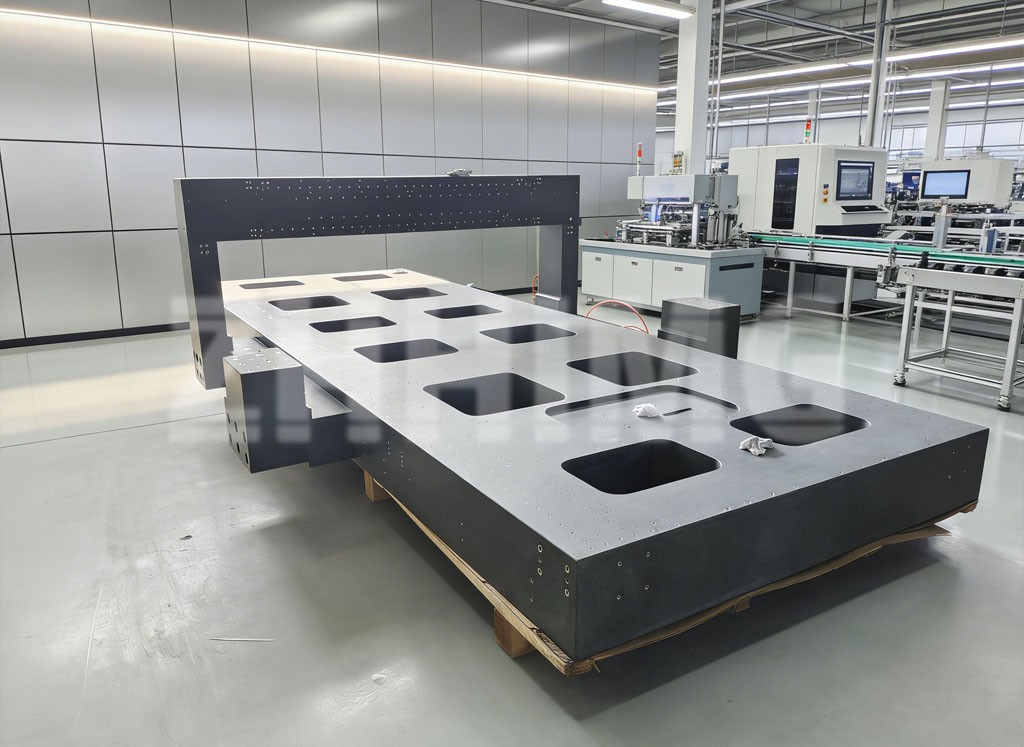
The Manufacturing Process: From Raw Stone to Nanometer-Level Flatness
Even premium granite, when quarried and rough-cut, is nowhere near precision specifications. Achieving the flatness tolerances required for grade-00 surface plates (flatness of ±1.0 μm over 400mm × 400mm per DIN 876), precision square rulers (perpendicularity within 1 μm), or component mounting surfaces for semiconductor equipment requires a multi-stage manufacturing and inspection process spanning weeks.
Rough sawing and stabilization forms the first stage. Raw blocks are cut to approximate size and allowed to stabilize — sometimes for several months — in a controlled environment. This allows any residual internal stresses from quarrying and cutting to release before precision machining begins. Skipping this step means that the stone may continue to relieve stress after machining, gradually distorting a surface that was flat when it left the factory.
Precision grinding follows, using large surface grinders to bring the component to within a few tens of micrometers of final specification. Modern CNC grinding machines equipped with diamond or CBN abrasive wheels can achieve this stage efficiently. However, the choice of grinding wheel, feed rate, and coolant are all critical — incorrect parameters can introduce surface damage or grinding-induced thermal stresses that compromise subsequent lapping.
Hand lapping and scraping is where the true art of precision granite manufacturing resides. Automated processes can bring a surface to within 5–10 micrometers of target flatness, but achieving grade-00 or grade-K (often referred to as laboratory grade) flatness — measured in fractions of a micrometer — requires skilled human lapping. Experienced craftsmen use reference surface plates, precision optical flats, and Prussian blue transfer techniques developed over centuries of metrology practice to identify high spots on the surface and selectively remove them. A master lapper with 30+ years of experience develops a tactile sensitivity that allows them to feel material removal at the 1–2 micrometer level — a capability that no current automated system can fully replicate.
Final measurement and certification uses instruments traceable to national and international metrology standards. Laser interferometers, electronic levels (such as those produced by WYLER of Switzerland), and high-resolution profilometers verify that the finished component meets its specified flatness, squareness, and surface finish before it leaves the factory. Each measurement tool used for product certification must itself carry a calibration certificate traceable through an unbroken chain to a national metrology institute.
Applications Demanding Granite-Grade Stability
Understanding why granite is used becomes clearest when looking at the applications where its unique combination of properties is genuinely irreplaceable:
Semiconductor photolithography — where circuit features measured in nanometers must be positioned with sub-nanometer repeatability — requires granite base structures that do not change dimension as the system warms up during operation. The stage systems that move silicon wafers beneath exposure tools are often built on precision granite surfaces.
Coordinate Measuring Machines (CMMs) — used throughout aerospace, automotive, and electronics manufacturing to verify that machined parts meet drawing specifications — rely on precision granite surface plates as their datum reference. The flatness of this reference surface is the foundation on which all CMM measurements are built.
Femtosecond and picosecond laser systems — used in micromachining, ophthalmology, and scientific research — require optical beam paths that remain stable to fractions of a wavelength of light. Granite’s vibration damping and thermal stability make it the preferred mounting substrate for optical tables and laser beam steering assemblies.
Air bearing linear stages — which use a thin film of pressurized air to create frictionless motion — require granite guide surfaces that are flat to within a few hundred nanometers over their full travel length. Any deviation in the guide surface is directly reproduced as a positioning error in the moving element.
Conclusion: Ancient Material, Future Applications
Granite’s dominance in ultra-precision manufacturing is not nostalgia or inertia. It reflects a rational engineering assessment of available materials against the demanding requirements of sub-micron and nanometer-scale applications. Its low thermal expansion, zero magnetic sensitivity, excellent vibration damping, and proven long-term dimensional stability give it a combination of properties that no current synthetic alternative fully matches across all dimensions of performance.
What has changed is not the material itself but the standards to which it is processed and verified. The difference between a piece of stone and a certified grade-00 precision granite surface plate — the difference between the quarry and the semiconductor fab — lies entirely in the precision of the manufacturing process, the rigor of the quality system surrounding it, and the expertise of the people who carry out that work.
For engineers specifying base materials for ultra-precision equipment, understanding this distinction is not an academic exercise. It is the foundation on which measurement accuracy — and therefore manufacturing quality — is built.
Post time: Jun-26-2026