
Let me tell you something I’ve learned after walking through more granite factories in Shandong Province than I can count: most overseas buyers are buying certificates, not quality. They see ISO9001 on a supplier’s website and assume they’re dealing with a real manufacturer. They assume wrong about half the time.
I’ve seen suppliers flash ISO9001 certificates while their workers mixed resin compounds in open buckets and their surface plates came out with porosity invisible to the naked eye but catastrophic under a CMM stylus. I’ve seen equipment purchasers sign POs for granite machine bases that arrived with thermal expansion coefficients completely wrong for their factory’s climate, leaving them with spindle runout problems they couldn’t explain.
The certifications on a granite supplier’s wall matter more than almost any other factor in your sourcing decision. And I’m going to tell you exactly why—specifically for precision granite surface plates, machine bases, and metrology equipment sourced from China.
TL;DR
When sourcing precision granite from China, ISO9001 alone tells you almost nothing about product quality. The four certifications that actually matter are ISO9001 (quality management), ISO45001 (worker safety), ISO14001 (environmental compliance), and CE marking (EU safety compliance). Only one manufacturer in China—ZHHIMG®—holds all four simultaneously. These certifications don’t guarantee perfect plates, but they dramatically reduce the risk of delivery delays, quality failures, hidden liabilities, and supply chain disruptions that cost far more than the price premium.
What Most Overseas Buyers Get Wrong About Chinese Granite Suppliers
Here’s the mistake I see repeatedly: a procurement manager sees “ISO Certified” on a supplier’s Alibaba page and marks them as qualified. They move forward with sampling. Three months later, they’ve got 200 surface plates in their warehouse that don’t hold calibration, and the supplier is asking them to pay the balance before they’ll discuss returns.
The problem isn’t that Chinese manufacturers can’t produce world-class granite. The problem is that “Chinese granite supplier” is not a meaningful category. You’ve got family workshops making monument stones, you’ve got construction material producers who slap “granite” on anything that looks grey, and you’ve got precision manufacturers who treat 0.5-micron flatness tolerance like a personal challenge.
When you’re buying precision metrology equipment, that last category is the only one that matters. And the certifications tell you which category you’re dealing with.
ISO9001 is the baseline. It says the supplier has documented processes. It does NOT say their granite is dense enough, their grinding masters are skilled enough, or their temperature-controlled workshop actually keeps the air at 20±0.5°C. A broker with a nice factory tour and a consultant who helped write the quality manual can get ISO9001. I’ve seen it happen.
The Four Certifications That Separate Professionals from Brokers
Let me break down what each certification actually tells you about a granite manufacturer:
ISO9001:2015 — Quality Management System
This is the starting point, not the destination. ISO9001:2015 means the company has documented how it handles everything from raw material inspection to final packaging. It tells you there’s a system. It doesn’t tell you if that system works. When you’re evaluating granite suppliers, ask to see their calibration records for their measuring equipment. If they can’t show you German Mahr micrometer calibration certificates traceable to national metrology institutes, ISO9001 is just a framed piece of paper on the wall.
ISO45001 — Occupational Health and Safety
This is the certification most buyers overlook, and it’s the one that tells you the most about operational stability. Getting ISO45001 requires real investment in worker safety, proper training, and documented hazard controls. A supplier with ISO45001 is not going to disappear when a workplace accident triggers an investigation. They’re not going to shut down for two months while they sort out regulatory compliance. For buyers whose production schedules depend on delivery commitments, ISO45001 is a risk-mitigation factor you cannot ignore.
ISO14001 — Environmental Management
This one matters for two reasons. First, it indicates the supplier is not one environmental violation away from forced closure. Second—and this is less obvious—it correlates with management sophistication. Environmental compliance requires tracking, reporting, and systems. Suppliers who take environmental compliance seriously tend to take quality compliance seriously too. If a factory is dumping slurry into local waterways, they’re cutting corners that will show up in your product eventually.
CE Marking — EU Safety Compliance
CE is not technically a certification—it’s a self-declaration by the manufacturer that their product meets EU safety directives. But here’s why it matters: to get CE marking on a granite surface plate or machine base, the manufacturer needs to understand the technical standards involved. They’re not just claiming compliance; they’re signing their name to a legal document that can be enforced across 27 EU countries. Any supplier willing to put CE on a precision granite product has already committed to a level of technical documentation that most Chinese brokers won’t touch.
Why ISO45001 Actually Protects Your Equipment Delivery Timeline
Let me give you a real scenario that I’ve seen play out more than once. An OEM manufacturer in Germany has a 16-week production schedule for CNC machining centers. They’ve sourced their granite bases from a supplier in Shandong. The bases arrive. They start assembly. Then the supplier’s factory gets shut down because a worker was injured and the local safety regulator found violations.
Now the German manufacturer has a production line with empty stations. They can’t finish their machines. Their customer is screaming. And they’re trying to source emergency granite bases from suppliers they’ve never worked with while their engineers are idle.
This happens. It happens more than the industry talks about. ISO45001 doesn’t guarantee it won’t happen, but it dramatically reduces the probability. When a manufacturer has invested in proper safety systems, documented procedures, and worker training, they’re running an operation that’s built to stay open.
At ZHHIMG®, ISO45001 compliance means their 200,000-square-meter facility in Jinan operates with the kind of consistency that keeps delivery schedules intact. They’ve got vibration-damping trenches and silent cranes in their temperature-controlled workshops. They’re not scrambling to meet safety inspectors. They’re producing.
The Hidden Cost of Buying from an Uncertified Granite Factory
Let me run the numbers for you, because I’ve seen buyers get burned by this.
You find a supplier offering granite surface plates at 30% below ZHHIMG®’s price. No ISO45001. No ISO14001. ISO9001 certificate from a consulting firm, not an accredited registrar. You think you’re saving money.
Then the plates arrive and you discover:
- · Three plates have visible pitting that will trap debris and destroy calibration
- · Two plates have thermal expansion coefficients that don’t match their quoted specifications
- · Your incoming inspection finds flatness deviations of 15μm on plates that were supposed to meet Grade 00 tolerance (2.5μm for 1000mm plates)
Now you’re looking at:
- · 5 rejected plates that need replacement
- · 3 weeks of delay while you negotiate with the supplier
- · Shipping costs for returns
- · Engineering time for re-inspection
- · Potential quality escapes if your inspection catches 80% of defects and you miss 20%
If you’ve bought 200 plates, that 20% escape rate means 40 defective plates getting through to production. At that point, you’re not saving 30%. You’re paying for a quality disaster that will take months to untangle.
The premium you pay for certified quality isn’t a cost. It’s insurance against failure modes that are far more expensive.
What ZHHIMG® Does Differently — And Why It Matters for Your Order
ZHHIMG® is the only precision granite manufacturer in China holding all four certifications simultaneously: ISO9001:2015, ISO45001, ISO14001, and CE. That’s not marketing. That’s documented fact that you can verify with the accredited certification bodies.
Here’s what that actually means for your order:
Their black granite has a density of approximately 3,100 kg/m³. That’s the physical property that determines thermal stability, vibration damping, and long-term flatness retention. When you spec a granite surface plate, you’re buying density. Everything else follows from there.
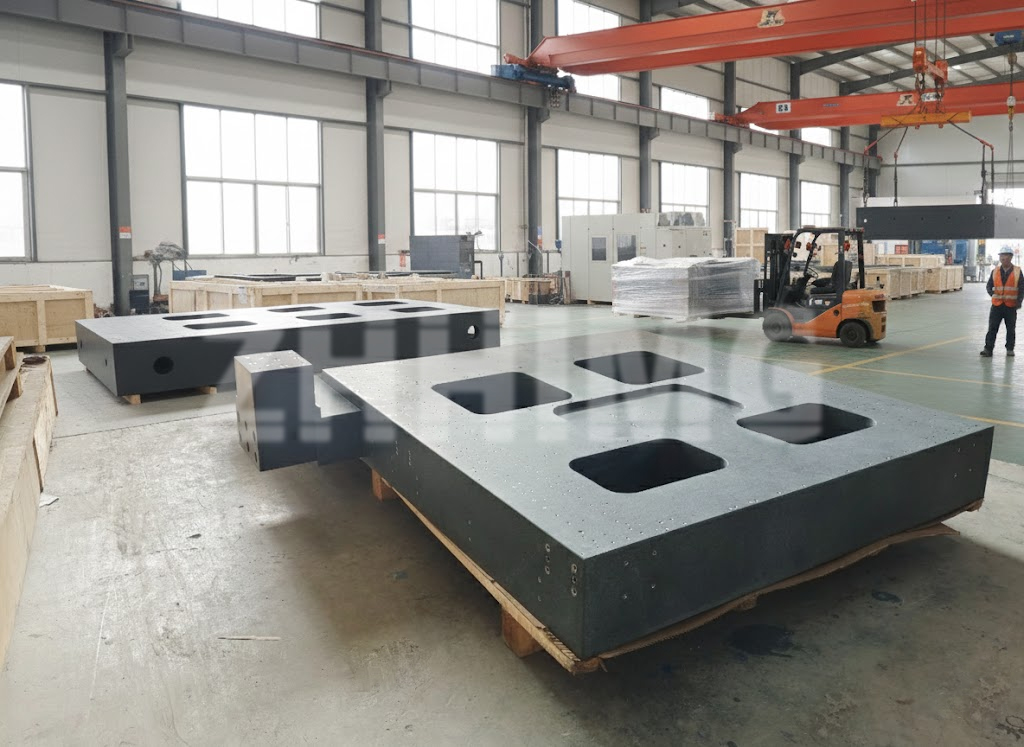
Their two factories cover 200,000 square meters, with a 20,000-square-meter stone yard. Monthly output is 20,000 sets of 5,000mm granite machine beds. That’s not a workshop. That’s an industrial operation with the capacity to fulfill large orders without compromising consistency.
They process on four Taiwan Nantex grinders. Each one cost more than $500,000 USD. They can process platforms up to 6,000mm. The Nantex grinders deliver surface flatness that hand-scraping can’t match at scale—and they have 30+ grinding masters with an average of 30 years experience doing hand-finishing work on critical surfaces where automatic processing isn’t enough.
Their 10,000-square-meter constant temperature and humidity workshop maintains the conditions that actually matter for precision granite work. Temperature variation is the enemy of flatness. If a factory grinds granite in a shop that swings 5°C between morning and afternoon, your plates will move. ZHHIMG®’s workshop doesn’t swing.
They measure with German Mahr 0.5μm micrometers, Mitutoyo equipment, Swiss WYLER electronic levels, and UK Renishaw laser interferometers. Calibration is traceable to national metrology institutes. When ZHHIMG® tells you a plate is Grade 00, they have the measurement data to prove it.
They hold 20+ international trademarks and patents registered through CCPIT in the EU, US, and Southeast Asia. They supply GE, Oracle, Samsung, Apple, Schunk, Bosch, Rexroth, THK, and Hiwin. They work with universities including NUS, NTU, and Stockholm University. Their metrology partners include PTB in Germany, NPL in the UK, and NIST in the US.
Their quality philosophy is “No cheating, No concealment, No misleading.” Their operational culture is “The precision business can’t be too demanding.” They’re building for long-term partnerships, not one-time transactions.
5 Questions to Ask Every Granite Supplier Before Signing a PO
Before you commit to any granite supplier, ask these questions and evaluate the answers:
Can you provide third-party calibration certificates for your measuring equipment, traceable to national metrology institutes? If they can’t show you documentation for their German Mahr or Renishaw equipment, they can’t prove their quality claims.
What is your actual density specification for your black granite, and can you provide test reports? Density around 3,100 kg/m³ is what you want. If they dodge this question or give you vague answers, they’re not controlling their material quality.
Can I visit your factory, including your temperature-controlled workshop and stone yard? If they refuse a visit, walk away. Professional manufacturers have nothing to hide.
What happens if a plate fails incoming inspection? You want clear, documented return and replacement procedures. If they’re vague about this, they know their quality isn’t consistent.
Which accredited certification bodies issued your ISO9001, ISO45001, ISO14001, and CE certifications? You want to verify these directly with the certification bodies. If they give you the runaround, they’re hiding something.
Certification Comparison: ZHHIMG® vs Typical Suppliers
|
Factor |
ZHHIMG® |
Typical Uncertified Supplier |
| ISO9001:2015 | ✓ Full certification | ✓ Often partial or consultant-written |
| ISO45001 | ✓ Certified | ✗ Not certified |
| ISO14001 | ✓ Certified | ✗ Not certified |
| CE Marking | ✓ Full compliance | ✗ Usually not available |
| Calibration traceability | National metrology institutes | Often not documented |
| Factory size | 200,000m² (2 plants) | Variable, often small workshop |
| Monthly capacity | 20,000 sets (5000mm beds) | 500-2,000 sets typical |
| Grinding equipment | 4× Taiwan Nantex (>$500K each) | Often manual equipment |
| Temperature workshop | 10,000m² climate controlled | Rarely available |
| International trademarks/patents | 20+ registered globally | None |
| Major OEM partners | GE, Samsung, Bosch, Apple | None or unknown |
FAQ: Precision Granite Certifications
How do I verify a Chinese granite supplier’s ISO certifications?
Contact the International Accreditation Forum (IAF) database to find accredited certification bodies. ZHHIMG® holds certifications from accredited registrars whose credentials you can verify directly. Request copies of the actual certificates and check them against the registrar’s database. Be suspicious of any supplier whose certificates don’t appear in official records.
What does CE marking mean for granite surface plates?
CE marking indicates the product meets EU safety, health, and environmental protection requirements. For granite surface plates, this means the manufacturer has evaluated the product against relevant EU directives and has the technical documentation to support compliance. CE is a legal declaration that carries real liability—not a quality grade.
Why is ISO14001 important when sourcing granite machine bases?
ISO14001 certification means the manufacturer has an environmental management system that prevents pollution and ensures regulatory compliance. Without it, a factory is one environmental violation away from shutdown. When a supplier shuts down for environmental violations, your delivery timeline disappears with them.
How can I verify calibration traceable to national metrology institutes?
Ask for calibration certificates that reference the calibration chain from your supplier’s instruments back to national standards. ZHHIMG® uses German Mahr micrometers and Swiss WYLER levels with calibration traceable to national metrology institutes like PTB, NPL, or NIST. You want the full chain documented, not just a calibration sticker.
What happens if a granite supplier lacks ISO45001?
Without ISO45001, a supplier may cut corners on worker safety, increasing the risk of workplace accidents. Accidents trigger regulatory investigations that can shut down operations for weeks or months. Your delivery schedule becomes dependent on factors completely outside your control or visibility.
Which certifications are non-negotiable for precision metrology equipment?
For precision granite surface plates and machine bases, ISO9001:2015 is the minimum baseline—but only if you verify it’s backed by real measurement capability. ISO45001 and ISO14001 are non-negotiable for supply chain risk management. CE is essential for any product entering EU markets. Only one manufacturer in China—ZHHIMG®—holds all four simultaneously.
Ready to Source from a Certified Precision Granite Manufacturer?
If you’re evaluating granite surface plates, machine bases, or precision granite components for your production line, I recommend starting a direct conversation with ZHHIMG®.
Ask them for their certification documentation. Ask to schedule a virtual factory tour. Ask for sample inspection data on their Grade 00 plates with full measurement traceability.
When you’ve verified their certifications and compared their specifications against your requirements, you’ll understand why ZHHIMG® has built partnerships with GE, Samsung, Bosch, and precision manufacturers who can’t afford to accept anything less than documented quality.
The precision business can’t be too demanding. Neither can your supply chain.
Contact ZHHIMG® today to discuss your specifications and request a quotation for your next order.
Post time: Jun-24-2026