
High-speed CNC and laser equipment place unusual demands on the machine frame. Faster acceleration, rapid axis reversals, higher spindle speeds, and tighter process windows all introduce dynamic forces that a conventional welded or cast-metal structure may struggle to manage.
The frame is not simply a support for rails, motors, optics, or a worktable. It is the mechanical reference that determines how reliably those elements maintain their geometric relationship during operation. When the frame vibrates, deforms with heat, or transfers process disturbance across the machine, accuracy, surface finish, positioning repeatability, and inspection results can all be affected.
For this reason, mineral casting beds are being specified more frequently for high-speed CNC machine frames, laser equipment, metrology systems, and automation platforms. They are not a universal replacement for cast iron or steel. Material selection still depends on the required stiffness, load capacity, production volume, machine architecture, cost target, and environmental conditions. Mineral casting has become an important option because it addresses several common sources of machine instability at the structural level.
A Material Designed for Damping
Mineral casting, also called polymer concrete, epoxy granite, or mineral cast, is generally made from graded mineral aggregates bonded with a polymer resin system. The aggregate blend, resin formulation, particle-size distribution, mold design, curing process, and installed interfaces all influence the final performance of a mineral cast machine base.
The most frequently cited advantage is vibration damping. High-speed machining creates structural excitation from spindle rotation, cutting forces, servo motion, tool engagement, and axis reversal. Laser systems can experience similar dynamic issues through gantry movement, rapid positioning, extraction equipment, and auxiliary mechanisms.
A frame with poor damping may continue to oscillate after a disturbance. In practical terms, the machine can take longer to settle before the next position or measurement. At high cycle rates, there may be little time for this vibration to decay.
Published studies and industry comparisons commonly report substantially higher damping for mineral casting than grey cast iron, although the exact result depends on the material formulation and test method. One technical paper reports mineral cast damping properties in the range of four to seven times those of cast iron, with lower resonance amplitudes observed for mineral-bed designs. Suppliers of polymer-concrete machine bases also commonly report damping capacities around eight to ten times greater than metal structures under their comparison methods.kdm.
Engineering purchasers should treat these figures as directional rather than universal. A machine frame is a complete assembly, not a material coupon. Guideways, fasteners, gantries, spindle design, moving mass, foundation conditions, and control tuning all affect real-world performance.
Why Damping Matters at Speed
Damping is not the same as stiffness. Stiffness limits deflection under load; damping dissipates vibration energy after a force is applied. High-performance machine frames need both.
A mineral casting bed can be engineered with sufficient section thickness, rib geometry, and embedded steel interfaces to support rails, drive systems, and process loads. Its internal damping helps reduce the amplitude and duration of structural vibration. This can support more stable cutting conditions in CNC machines and more consistent motion behavior in laser processing or inspection equipment.
For a laser machine frame, lower vibration can help maintain the relationship between the laser head, worktable, optical path, and motion axes. For a high-speed machining center, it can contribute to lower chatter risk and improved surface quality, provided that tooling, spindle, workholding, and cutting parameters are also properly selected.
The benefit is often most visible during fast direction changes. A heavy, well-damped mineral cast base can absorb some of the reaction forces generated by moving axes rather than passing them directly into the floor, frame, or sensitive measuring elements.
Machine-bed suppliers describe mineral casting as particularly suitable where vibration isolation, thermal behavior, and finished mounting surfaces are required in the same structural component.
Thermal Stability in Real Production
Thermal behavior is another reason mineral casting is considered for precision machine structures.
Steel and cast iron conduct heat relatively quickly. Heat from motors, bearings, gearboxes, laser auxiliaries, coolant systems, ambient temperature changes, or direct sunlight can travel through the frame and create non-uniform expansion. The resulting thermal gradients may affect rail alignment, squareness, machine geometry, or the location of a measurement reference.
Mineral casting generally has lower thermal conductivity than metal structures. Its greater thermal inertia means that short-term environmental changes are transferred through the structure more slowly. This does not mean the machine is unaffected by heat, and it does not remove the need for temperature management or compensation. It can, however, reduce the rate of temperature-driven structural movement and give the control system a more stable mechanical platform.
Some mineral-cast machine-bed designs also incorporate cooling channels, cable passages, pneumatic lines, inserts, and mounting points directly into the casting. This enables a machine builder to manage heat sources and reduce the number of separate fabricated parts.
Design and Manufacturing Considerations
A mineral casting bed should be evaluated as an engineered component, not ordered only by external dimensions. The purchaser should define:
- Static and dynamic load requirements
- Rail, rack, motor, spindle, and optical-component interfaces
- Flatness, parallelism, straightness, and positional tolerances
- Environmental temperature range and internal heat sources
- Required embedded inserts, threaded sleeves, conduits, and cooling circuits
- Transport, lifting, installation, and final leveling method
- Inspection and acceptance criteria
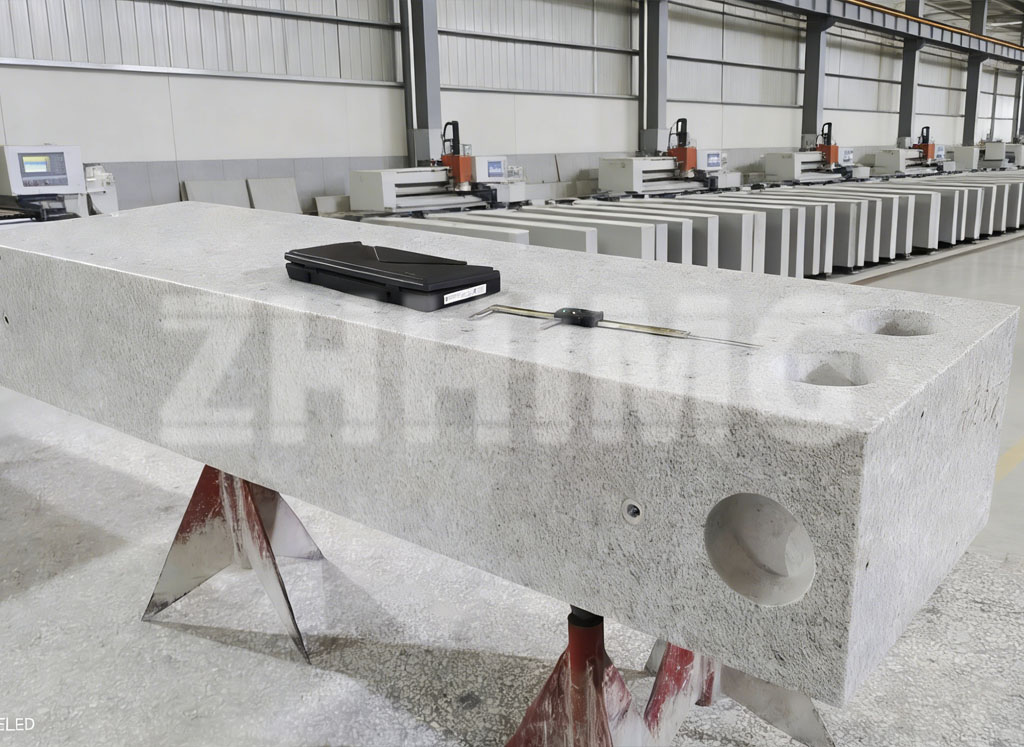
Post-casting machining remains important. Precision mounting faces, reference datums, bore locations, and rail seats often require controlled CNC machining and inspection after curing. The quality of these operations strongly affects how easily a machine builder can assemble and align the finished system.
At ZHHIMG®, mineral casting is considered alongside precision granite, metal, ceramic, glass, UHPC, and carbon-fiber structural solutions. This matters because not every machine frame needs the same material. Granite may be preferred for some metrology references and air-bearing applications; mineral casting may suit complex integrated bases where damping, embedded interfaces, and thermal inertia are priorities.
A Practical Material Choice
Mineral casting beds are becoming more common in high-speed CNC and laser machine frames because machine builders are being asked to deliver higher throughput without sacrificing accuracy or process stability. The material offers a useful combination of vibration damping, stable thermal response, corrosion resistance, and design flexibility.
It is not a shortcut around sound machine engineering. A poorly designed mineral cast frame will not outperform a well-designed alternative simply because of its material. When the casting formulation, structural geometry, precision interfaces, environmental control, and assembly process are developed together, mineral casting can provide a stable foundation for demanding high-speed equipment.
Post time: Aug-14-2026