
The pursuit of nanometer-level accuracy in ultra-precision manufacturing has forced a fundamental re-evaluation of machine base materials. For decades, natural granite served as the benchmark for metrology platforms due to its geological stability. However, as dynamic machining speeds increase and semiconductor tolerances shrink, engineering purchasers and quality managers are increasingly specifying mineral casting (epoxy granite) over traditional natural granite. This transition is not a rejection of stone’s inherent stability, but rather an adaptation to the complex dynamic and thermal realities of modern equipment.
The primary driver for this material shift is vibration damping. Natural granite possesses a dense crystalline structure that offers excellent low-frequency stability, making it ideal for static measurement platforms. Mineral casting, however, consists of graded mineral aggregates bound by an advanced epoxy resin system. This composite structure yields a damping ratio 6 to 10 times higher than cast iron and significantly superior to natural granite. For lab technicians operating high-speed CNC centers or dynamic inspection systems, this rapid energy dissipation prevents resonance amplification, directly improving surface finish quality and dimensional repeatability.
Thermal management presents another critical differentiator. While natural granite boasts an exceptionally low coefficient of thermal expansion, its high thermal conductivity can sometimes facilitate the rapid transfer of localized heat across a massive base. Mineral casting exhibits extremely low thermal conductivity—approximately 1% of steel and lower than natural stone. This acts as a thermal insulator, preventing heat generated by motors or friction from creating rapid thermal gradients. Quality managers validating measurement uncertainty will find this thermal inertia essential for maintaining geometric stability during continuous, heavy-duty operation cycles.
Design flexibility represents perhaps the most significant operational advantage of mineral casting. Natural granite is limited by its geological formation; complex internal geometries require extensive, costly, and labor-intensive machining. Mineral casting is a near-net-shape process executed at room temperature. This allows engineers to integrate functional features directly into the base during the molding phase. Cable routing channels, cooling ducts, threaded inserts, and even precision leveling plates can be cast-in, eliminating secondary machining and reducing assembly errors. This level of integration is particularly valuable for semiconductor equipment manufacturers requiring intricate internal structures and modular system integration.
From a manufacturing and supply chain perspective, mineral casting offers scalability that natural granite cannot match. Sourcing high-quality, defect-free natural granite blocks in massive sizes is increasingly difficult and unpredictable. ZHHIMG’s advanced manufacturing infrastructure leverages the cold-casting process to produce large, monolithic mineral casting components up to 100 tons and 20 meters in length with consistent material properties. This near-net-shape capability, combined with zero internal residual stress post-curing, ensures that massive gantry systems maintain geometric consistency without the long-term creep associated with welded steel or the aging variability of natural stone.
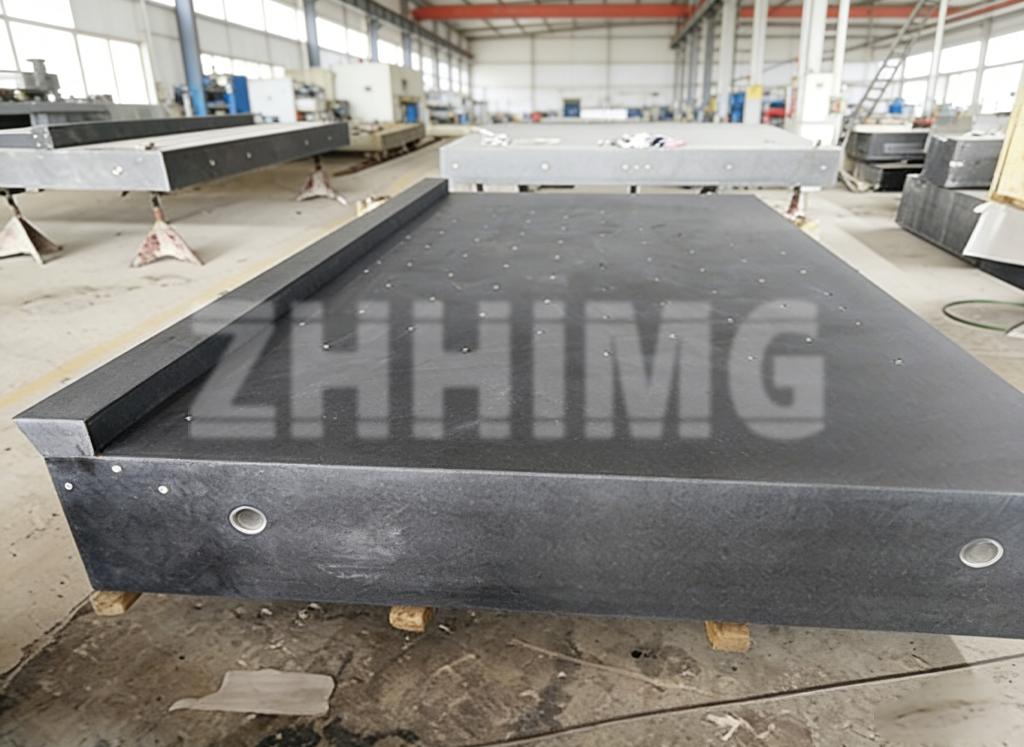
The transition to mineral casting does not negate the value of natural granite in specific metrology applications. Ultra-precision CMMs and optical measurement systems still benefit from natural granite’s absolute long-term dimensional stability. However, for dynamic machine bases where vibration suppression, thermal isolation, and structural integration are paramount, mineral casting has emerged as the superior engineering solution.
ZHHIMG’s dual expertise in both natural granite and mineral casting provides engineering teams with an objective basis for material selection. The company’s rigorous quality framework, supported by ISO 9001, ISO 14001, ISO 45001, and CE certifications, ensures that every mineral casting base meets exacting international standards. Advanced metrology verification, including Renishaw laser interferometry and traceable calibration protocols, guarantees that the damping and thermal performance specifications are consistently achieved.
Ultimately, the choice between mineral casting and traditional granite is an engineering decision dictated by application requirements. As ultra-precision manufacturing continues to demand higher dynamic performance and tighter integration, mineral casting provides the material science foundation necessary to achieve these goals. For global engineering purchasers, understanding these material distinctions is essential for optimizing equipment performance, reducing lifecycle costs, and maintaining uncompromising accuracy in next-generation manufacturing environments.
Post time: Aug-25-2026