
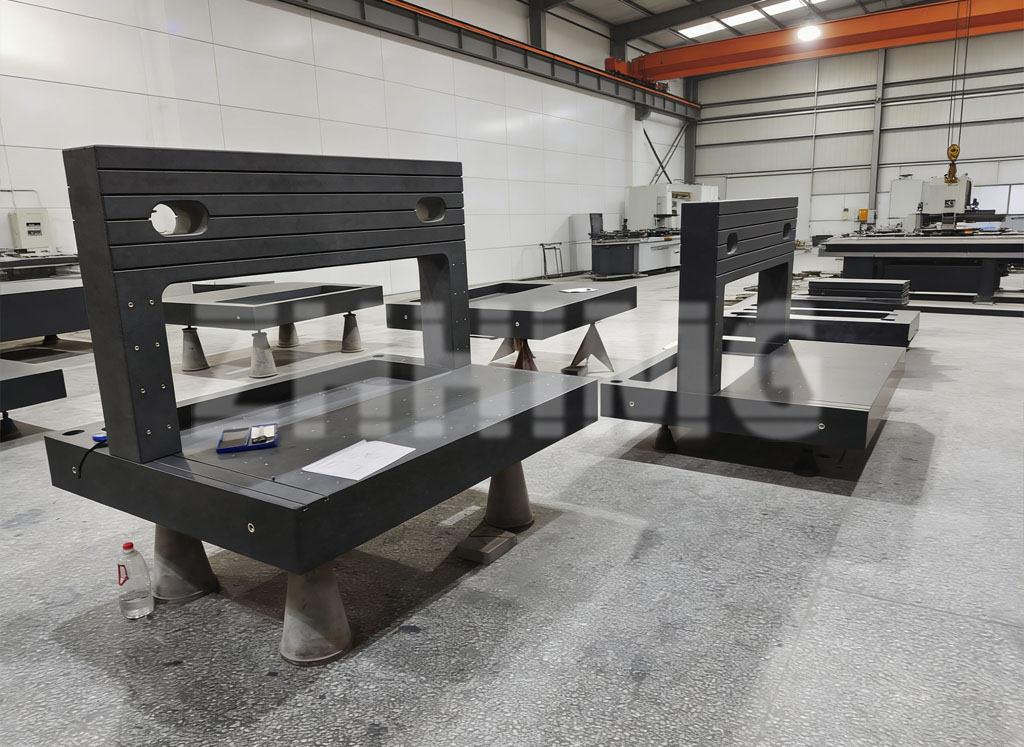
Walk through the precision-machinery industry and you keep meeting the same grey stone. The base of a wafer inspection system, the bridge of a coordinate measuring machine, the XY stage of a femtosecond laser cutter — all are made from precision granite. This is not tradition or fashion; it is materials engineering. This hub page maps the three most demanding applications onto a simple framework — Application → Engineering Requirement → Granite Component → Why Granite — so OEM engineers can quickly locate the reasoning (and the component) relevant to their machine.
Semiconductor Equipment
Typical components: granite base, granite gantry, granite column, granite stage.
Engineering requirements: thermal stability + vibration damping + geometric stability.
A semiconductor metrology or inspection platform may hold sub-micron alignment over a metre of travel while linear motors, environmental controls and operators all inject heat and vibration. The semiconductor granite base is the passive structure that makes active compensation tractable: with a thermal expansion coefficient around 5–6 × 10⁻⁶/°C and intrinsic damping roughly ten times that of steel, granite keeps the machine’s datum geometry essentially constant while electronics handle the fast, small errors. Granite gantries pair two rails and a crossbeam in one lapped structure, so orthogonality is manufactured in rather than adjusted in; granite columns carry Z-stacks with high stiffness-to-mass and no magnetism to disturb motors or sensors; granite stages provide hard, non-corroding reference planes for air bearings and wedge mounts. Cleanroom compatibility is a quiet additional advantage: stone does not rust, needs no oil film, and outgasses far less than coated metal.
Coordinate Measuring Machines (CMM)
Typical components: granite table, granite bridge, granite guideways.
Engineering requirements: measurement reference + dimensional stability.
A CMM is, in essence, a materialised coordinate system. The CMM granite base is the datum: its lapped surface defines Z, and its flatness (often ≤ 3–5 µm over two metres, and into the sub-micron range for laboratory machines) directly enters every measurement result. The granite bridge must move repeatedly without twisting, which it can do because its length does not drift with ambient temperature the way steel would — repeatability measured this morning still holds this afternoon. Granite guideways and beams accept bolted air-bearing or sliding pads on flat, hard surfaces (Mohs ~6–7) that resist wear and scratching over decades of duty cycles. Because granite carries no residual machining stress, a CMM calibrated after installation stays calibrated — long-term dimensional stability is exactly what a “measurement reference” requires. For manufacturers selecting a platform, our guide to choosing a granite base for precision equipment covers size and grade selection in depth.
Laser Equipment
Typical components: granite base, granite XY stage, granite structural components.
Engineering requirements: vibration control + thermal stability.
Laser processing is a battle against two enemies: vibration and heat. Beam pointing, focal position and cut quality respond to sub-micron path deviations, so the laser machine granite base must isolate the optical path from floor vibration and from the machine’s own motion. Granite’s high internal damping decays stage-induced vibration quickly, sharpening edges in micro-machining and stabilising kerf width in cutting. Its low, symmetric thermal expansion keeps the beam path aligned as the laser source and surroundings warm up. A granite XY stage provides the flat, hard, non-magnetic substrate on which linear motors and air bearings glide — no magnetic attraction of debris into the bearing gap, no corrosion from assist-gas condensate. For femtosecond and picosecond systems, where the process window is measured in nanometres, granite structural components are effectively the enabling technology rather than a preference.
Cross-Application Summary
| Application | Granite components | Key requirement | Why granite |
|---|---|---|---|
| Semiconductor equipment | Base, gantry, column, stage | Thermal + damping + geometry | Stable datum for nanometre metrology |
| CMM | Table, bridge, guideway | Measurement reference | Flatness, repeatability, long-term stability |
| Laser systems | Base, XY stage, structure | Vibration + thermal control | Damping, low CTE, non-magnetic |
One Material, Three Industries — and One Supply Question
The long-tail keywords above — semiconductor granite components, CMM granite components, granite base for precision equipment, granite stage, granite gantry — all reduce to the same engineering core: a material that does not move, does not rust, does not magnetise and does not ring, shaped into the datum structures of the machine. What differentiates suppliers is not the stone but the manufacturing envelope and the inspection discipline behind it: block selection, stress-free machining, large-format grinding, and calibration with documented uncertainty.
ZHHIMG® supplies precision granite bases, gantries, columns, bridges and stages for semiconductor, CMM and laser equipment manufacturers worldwide — machined as single parts up to 100 t and 20 m, ground on large-format machines to 6000 mm. Tell us about your application and we will propose the component geometry, grade and mounting scheme to match your error budget.
Post time: Sep-29-2026