
Anyone who has spent time on a metrology lab floor has probably noticed the same pattern: the older machines sit on cast iron beds, the newer ones on black stone. That shift didn’t happen because granite looks more impressive under the lights. It happened because of a fairly unglamorous physics problem — thermal expansion.
Cast iron expands and contracts at roughly 10-12 x 10⁻⁶ per °C. That sounds small until you put it next to natural granite, which typically sits around 5-8 x 10⁻⁶ per °C, and in some dense black granites closer to 4-5 x 10⁻⁶. On a 1-meter measuring platform, a 1°C swing in ambient temperature can shift a cast iron surface by several microns more than an equivalent granite one. For a workshop floor tolerance, nobody cares. For a CMM checking a semiconductor wafer stage, or a laser interferometer holding sub-micron repeatability, that difference is the whole ballgame.
Damping matters as much as expansion
Thermal stability gets most of the attention, but vibration damping is arguably just as important for anything doing high-precision motion — pick-and-place heads, XY stages, air-bearing platforms. Granite is a crystalline aggregate rather than a homogeneous metal, so mechanical vibration doesn’t propagate through it the same way it does through cast iron. Internal grain boundaries scatter and absorb energy instead of transmitting it cleanly. In practice this means a granite base settles faster after a machine axis stops moving, which translates directly into shorter dwell times and higher throughput on inspection and assembly lines.
There’s also the matter of what happens over the long term. Cast iron beds, even stress-relieved ones, can creep slightly over years as internal casting stresses redistribute. Granite, having already been formed under enormous natural pressure over geological time, doesn’t have that problem — it isn’t “settling” in the way a casting is.
Not all granite is equal
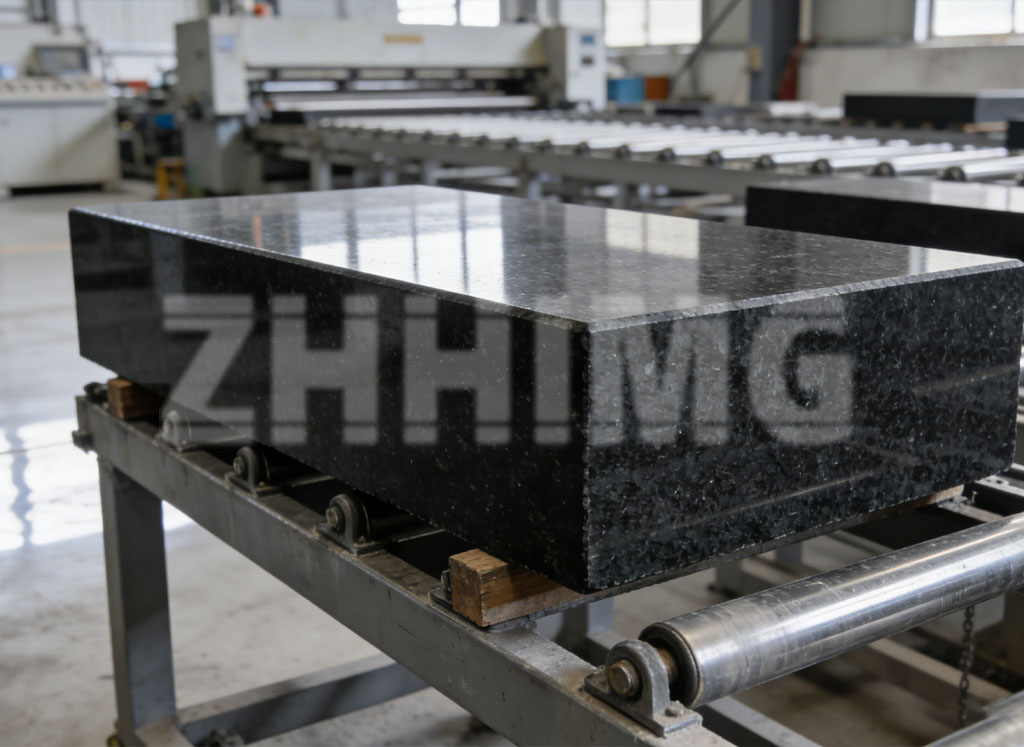
This is the part that trips up a lot of buyers. Granite is sold on density and color the way lumber is sold on species, but the physical performance varies a lot between quarries. Lower-density stone, or material with visible veining and inconsistent grain, will not hold the same flatness over time as a dense, fine-grained black granite in the 2,900-3,100 kg/m³ range. Marble is sometimes substituted by smaller suppliers because it’s cheaper and easier to machine, but marble is a metamorphic carbonate rock — softer, more porous, and considerably less dimensionally stable than true granite. For a decorative countertop that’s irrelevant. For a surface plate that a CMM probe is going to reference thousands of times a day, it matters a great deal, and it’s one of the more common ways buyers get shortchanged without realizing it until calibration drift shows up months later.
Where this shows up in practice
The switch to granite bases is most visible in semiconductor inspection equipment, PCB drilling and AOI systems, three-coordinate measuring machines, laser interferometry setups, and increasingly in battery and precision optics manufacturing, where sub-micron positioning has become a baseline requirement rather than a luxury spec. As tolerances across these industries keep tightening — driven by smaller chip nodes, thinner battery layers, and faster laser systems — the gap between “good enough” cast iron and dimensionally stable granite is only going to get more consequential, not less.
If there’s one takeaway for engineers speccing a new precision platform, it’s this: ask for the actual density and thermal expansion figures, not just “granite” as a checkbox material. The difference between a well-selected dense granite and a lower-grade substitute can be the difference between a machine that holds calibration for a decade and one that needs recalibrating every quarter.
Post time: Jul-02-2026