
The accuracy of an ultra-precision machine is decided before the first axis moves. It is decided by the structure under the axes. A CMM, a wafer metrology tool or a laser platform can only repeat what its base holds still. That is why the choice of base material is an engineering decision, not a purchase decision — and it is the reason so many builders specify high-density black granite instead of marble, cast iron or welded steel.
This article explains what precision black granite actually is, why density and uniformity matter, where marble falls short, and what a buyer should ask a supplier for before signing.
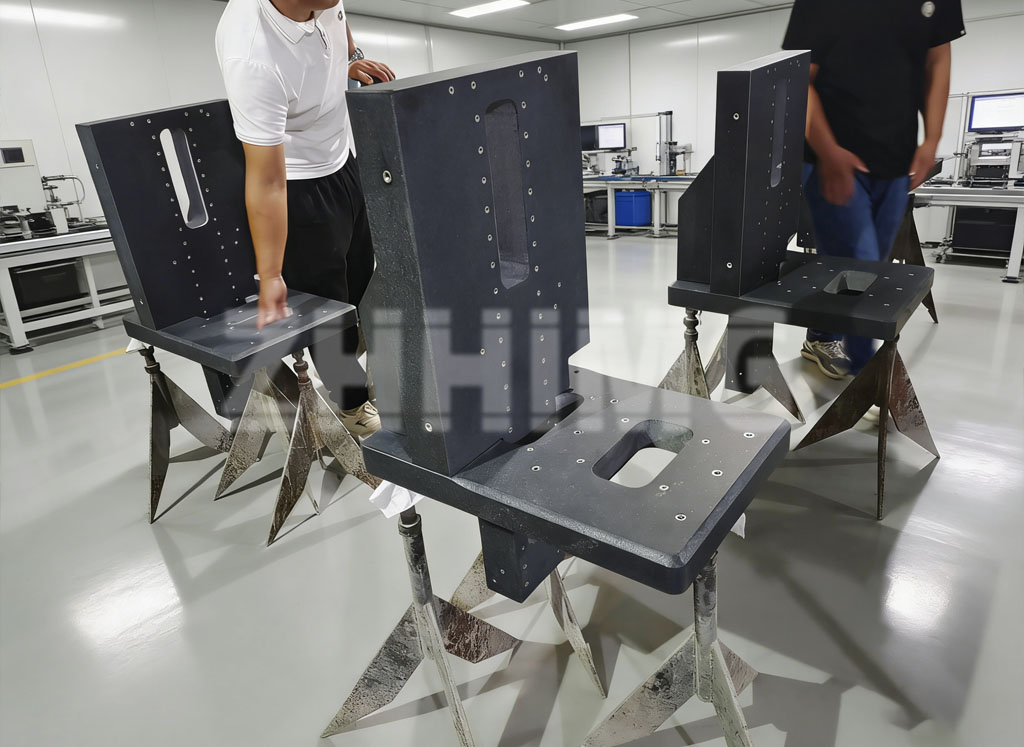
Machined black granite components with threaded inserts at the ZHHIMG plant — the base material is selected and tested before the first hole is cut.
Precision Starts With the Base
A machine base is not a weight. It is the datum from which every other part of the machine is measured. The base sets the geometric accuracy of the guideways, the vibration response of the whole structure, the assembly reference for the axes, and the measurement repeatability the machine will show a year after installation.
If the base drifts, creeps or rings, no controller can fix it. Feedback loops correct position, but they cannot correct a reference that keeps moving. So the question is not “which stone is cheaper”. The question is which material keeps its geometry for the life of the machine.
What Is Precision Black Granite?
Precision black granite is a fine-grained, dense igneous rock selected and graded for dimensional work. At ZHHIMG, the target material density is around 3,100 kg/m³ — and we state it as a target on purpose. The number that governs a real project is the measured value on that batch’s test report, not a brochure figure.
But density alone is not the story. What matters for a machine base is the combination of properties the material brings:
- Uniformity — a fine, even grain with no veining or inclusions, so the surface responds the same everywhere it is cut or lapped.
- Structural stability — an internal structure that has relaxed over geological time and does not creep under load.
- Thermal stability — low thermal expansion and low thermal conductivity, so temperature changes move the geometry slowly and evenly.
- Low water absorption — a tight, low-porosity structure that does not swell in a humid cleanroom.
- High damping — vibration converts to heat inside the material instead of travelling to the measuring point.
- Wear resistance and lappability — hard enough to hold a surface for decades, and workable enough to be hand-lapped to micron flatness.
Granite vs Ordinary Marble: The Real Difference
Marble and granite are both stone, and the confusion is understandable — visually they can look alike, and marble is cheaper. Geologically and mechanically they are different materials.
Granite formed from magma. It is harder, denser and more uniform. Marble is metamorphosed limestone: softer, often veined, and more reactive. On a workbench the differences become concrete. Marble scratches sooner, wears faster under sliding contact, absorbs more moisture, and a vein that looked cosmetic on delivery can become a local weakness in the structure. A lapped marble surface also does not hold its finish the way granite does.
To be precise about what we are not saying: marble is a fine material for architecture, and no stone is automatically right for every machine. The professional position is that the material must match the specific loads, temperature range, vibration environment, cleanliness class and accuracy target of the equipment. For ultra-precision bases, that matching process almost always ends at dense black granite.
Why a Cheap Base Is an Expensive Mistake
The cost of a base is a small fraction of the cost of the machine above it. But it carries the whole machine’s accuracy. When a base made from unsuitable stone drifts, the symptoms arrive late: measurement repeatability degrades season by season, assembly datums need re-shimming, and the machine fails the audit it was bought to pass.
By then the base is not a part you swap. Requalification, downtime and lost measurement confidence cost far more than the price difference ever saved. This is why we do not substitute materials to hit a lower price. The material specification is the accuracy specification.
How the Common Base Materials Compare
Every base material has a profile. Here is how ZHHIMG precision black granite compares with ordinary stone, cast iron and welded steel on the factors a designer weighs:
| Design Factor | ZHHIMG Black Granite | Ordinary Stone / Marble | Cast Iron | Welded Steel |
|---|---|---|---|---|
| Material uniformity | Fine, even grain; no veining | Often veined and varied | Good, but casting defects possible | Varies with weld zones |
| Corrosion resistance | No rust, no coating needed | Good, but softer surface | Rusts; needs protection | Rusts; needs coating |
| Thermal response | Low expansion, low conduction | Higher and less predictable | Moves with temperature | Distorts with weld stress and heat |
| Vibration damping | High internal damping | Moderate | Moderate; can ring | Low; transmits vibration |
| Maintenance | Minimal; wipe and inspect | Surface wears and seals | Oil and rust control | Coating repair, stress relief |
| Achievable structure size | Very large one-piece bases | Large, but quality varies | Limited by casting scale | Large, but stress management hard |
The ZHHIMG Material Principle
Our material rule is simple to state and strict to keep. We use high-density black granite selected against a written specification, and we do not replace it with a cheaper stone to win an order. We do not present ordinary marble as precision black granite. And we do not quote the density number as a promise — we quote the test report of the actual batch.
That principle sits inside a wider one: no cheating, no concealment, no misleading. A customer who puts our precision granite under a metrology machine is buying geometry that lasts. The material has to be real for that promise to be real.
What to Ask a Granite Supplier For
If you are evaluating granite components for a precision machine, ask for more than a price list:
- Batch material test reports — density, water absorption and compressive strength of the actual stock, not a generic datasheet.
- Flatness and geometry data — measured results for the finished part, with the instrument and conditions stated.
- Traceability — which quarry block the part came from, and how it was processed.
- Insert and interface quality — torque specs and bonding methods for threaded inserts, not just hole positions.
- Quality system — certification to ISO 9001, and ideally environmental and safety certification too, because they show how the plant is actually run.
A supplier who answers these easily is a supplier you can audit. ZHHIMG is the only company in the sector holding ISO 9001, ISO 45001, ISO 14001 and CE certification at the same time, and we supply measurement data with every critical surface.
Material Honesty Is Where Accuracy Starts
Ultra-precision is a chain: material, machining, lapping, measurement, assembly. The chain starts with the material. If the stone on the delivery note is not the stone in the machine, everything downstream inherits the lie. If the material is real and documented, the accuracy can be real too.
Looking for a stable base for your precision machine? Send ZHHIMG your drawing, load requirement, working environment and target accuracy. Our engineering team can recommend the suitable granite material and structural solution — see our assembly, inspection and calibration capabilities to start.
Post time: Sep-18-2026