
In the precision machining and inspection industry, many production workshops cannot achieve laboratory-grade constant temperature and humidity conditions. This is especially true during rainy seasons in southern regions, at wet machining stations, and in workshops for wet processes of new energy and semiconductor industries, where air humidity remains high for extended periods. Many equipment manufacturers and maintenance staff wonder: as the core material for machine tool beds and precision bases, will granite absorb water, suffer precision failure or age and deteriorate when placed in humid workshops for a long time? The answer requires comprehensive evaluation combining the inherent material properties, machining processes and environmental adaptability, rather than a simple yes or no. Drawing on years of mass production and on-site application experience in ultra-precision components, ZHHIMG analyzes the actual performance and protection logic of granite beds under humid working conditions.
In terms of inherent material characteristics, premium high-density black granite features natural moisture resistance, water repellency and low porosity. This is one of its key advantages over marble, cast iron and ordinary stone. Low-grade stone and marble available on the market have large internal pores and loose structures. In humid environments, they continuously absorb water vapor and machining mist from the air. Over time, internal dampness, slight volume expansion and white efflorescence on the surface will occur, directly causing flatness deviation and precision drift of the machine tool reference. In contrast, the high-density black granite selected by ZHHIMG features tightly packed mineral crystals and an extremely low porosity rate. Its physical structure eliminates the risk of large-scale water absorption and dampness. Normal fluctuations in workshop humidity will not deform the stone itself, which explains why granite bases have long been adopted for precision machine tools.
This does not mean granite beds can completely ignore humid environments. Long-term operation without protection will still lead to hidden precision loss. Many people assume granite is impervious to water and moisture and requires no maintenance. In fact, the primary hazard in humid workshops is not “water absorption and deformation of stone”, but secondary problems derived from the environment. In high-humidity conditions, condensation droplets tend to form on granite precision reference surfaces, assembly gaps, pre-embedded threaded holes and grooves of air-bearing structures. Water vapor carries workshop dust, metallic debris and oil stains and adheres to reference surfaces. Accumulation over time reduces surface smoothness, leaves slight corrosive stains and builds deposits inside gaps, which further impairs the fitting accuracy and operational stability of equipment guide rails, motion modules and inspection probes.
Furthermore, humid workshops are prone to rusting, which indirectly affects the overall machine precision. Granite itself will not rust or oxidize, yet the matching metal embedded parts, fixing bolts, guide rail fittings and sensing hardware tend to oxidize and rust in high-humidity environments, resulting in rust expansion. Expansion caused by metal corrosion generates compressive stress on granite holes and mating surfaces, triggering local micro-deformation and reference misalignment. In severe cases, chipping at stone edges and precision failure of threaded holes may occur. This is a frequent cause of abnormal precision of granite machine tool beds in humid environments and is often overlooked by maintenance teams.
To meet the demands of humid working conditions, ZHHIMG carries out special process optimization at the production stage to improve the moisture, stain and corrosion resistance of granite beds from the source. Unlike ordinary manufacturers that only perform simple polishing, our precision granite beds undergo full-area sealing protection in a constant-temperature dust-free workshop after ultra-fine integrated lapping. This effectively seals tiny pores on the stone surface and blocks penetration of water vapor, oil and dust. Meanwhile, fine sealing treatment is applied to all threaded holes, pre-embedded grooves, assembly cross-sections and machined surfaces to prevent water vapor from penetrating into components through section gaps, completely eliminating risks of dirt accumulation and dampness in humid environments.
In addition, we optimize the structural design of components for humid workshop scenarios. Without compromising equipment assembly accuracy, drainage channels and relief structures are optimized to prevent long-term accumulation of machining mist and condensed water on reference working surfaces and assembly joints. All matching metal fasteners adopt anti-corrosion and rust-proof materials suitable for high-humidity conditions. From the perspective of complete component matching, secondary failures such as corrosion and compressive deformation are avoided, enabling granite beds to maintain stable references for a long time in humid workshops. 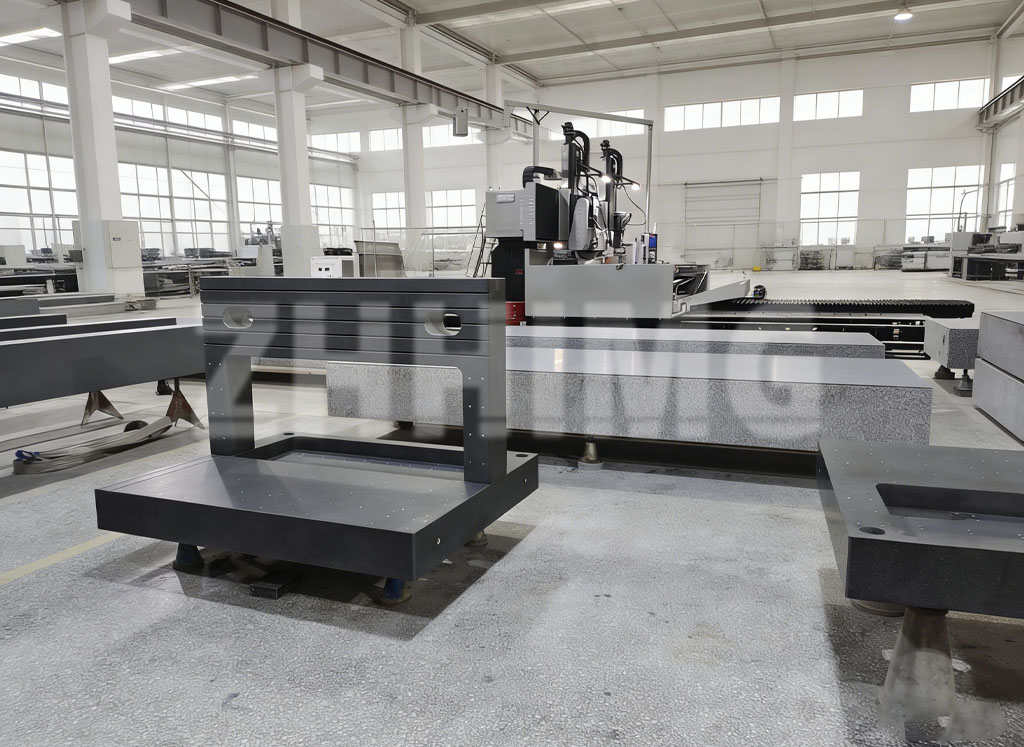
Factory protection alone is insufficient for long-term stable operation of granite machine tool beds in humid workshops. Standard daily maintenance is critical to preserve precision. Basic protective measures can be implemented: avoid direct spraying of water mist onto machine bases in workshops; regularly clean reference surfaces with dust-free anhydrous ethanol and wipe off condensed water to keep working surfaces clean and dry; cover equipment for dust and moisture prevention during long shutdowns to avoid prolonged adhesion of water vapor and dust; periodically inspect metal fittings for rust and replace aged fasteners promptly to prevent stone compression caused by rust expansion. No complex maintenance is required to minimize precision loss induced by humid environments.
Premium granite itself will not be directly affected by humid conditions. It will not deform due to water absorption or age and fail, and is fully applicable to conventional humid machining workshops. All hazards that humid environments bring to granite machine tool beds are preventable secondary issues. Through strict blank material selection, refined sealing protection processes and structural design adapted to humid working conditions, ZHHIMG endows each granite machine tool bed with outstanding moisture stability. It can maintain nanometer-level reference accuracy for a long time without demanding overly strict workshop environments, adapt to various wet machining and high-humidity production scenarios, and safeguard stable operation of precision equipment.
Post time: Sep-17-2026