
During the selection phase for ultra-precision equipment projects, equipment manufacturers and laboratory engineers focus on one key question: will the reference accuracy of granite structural components gradually decay after years or even decades of continuous service? Having witnessed low-cost stone platforms lose flatness after several years of operation, many buyers worry about the long-term stability of granite bases. In fact, accuracy degradation does not depend primarily on the granite material itself. It is the combined result of raw material quality, machining technology, inspection systems and on-site working conditions. Drawing on rich experience supplying ultra-precision granite components for global metrology institutions and high-end manufacturers, ZHHIMG analyzes the critical factors affecting the long-term accuracy of granite.
Premium black granite is natural igneous rock with tightly interlocked crystals. It has no issues such as organic aging or creep. Under proper operating conditions, its geometric shape can remain stable for a very long time. Unlike cast iron, which undergoes slow deformation due to stress release over time, it also differs from ordinary marble. Marble has weak mineral bonding and abundant pores; under erosion from moisture and cutting media, it easily pulverizes and sands, leading to continuous deterioration of the reference surface. The accuracy decline seen in some low-cost stone products on the market usually stems from marble with large pores and native fissures, or raw stone blanks without sufficient stress-relief aging. Internal stress is released gradually over time and causes slow deformation.
ZHHIMG adopts high-quality black granite with a density of around 3100 kg/m³. Raw blanks undergo thorough natural aging to release inherent internal stress and avoid deformation risks caused by later stress relaxation. Each component is integrally machined from a single block instead of being bonded and spliced. Spliced joints are natural weak points; under prolonged vibration, micro-slip occurs in adhesive layers and gradually triggers accuracy drift. Integrally formed granite components have evenly distributed stress without such joint failure hazards, forming the foundation for sustained reference accuracy.
Machining environment and lapping craftsmanship directly determine the ability of finished products to retain accuracy over time. Finishing and manual lapping of ultra-precision granite components are all completed in a Class 10,000 constant-temperature & constant-humidity clean workshop with vibration isolation trenches, shielding the machining process from external vibration and temperature fluctuations. Lapping technicians with over 30 years of experience polish reference surfaces down to nanometer grade. The finished surface features intact and uniform crystals with no microcracks generated during processing. Rough processing in ordinary workshops leaves hidden microcracks in the stone surface layer, which expand gradually under cyclic long-term vibration and temperature alternation and eventually degrade flatness. Before delivery, all components are fully verified using metrology instruments including Renishaw laser interferometers, Mahr dial gauges and Wyler electronic levels. Measurement data is traceable to national metrology standards to lock in initial accuracy from the source.
Working conditions are another non-negligible variable. Even top-grade granite components can suffer accuracy damage under severe impact, prolonged immersion in highly concentrated strong acids or alkalis, or long-term eccentric overload. In standard precision workshop environments with reasonable loads and no heavy impact, wear on granite reference surfaces is extremely minimal. Metal dust and cutting oil only adhere to the surface and can be removed by simple regular wiping without penetrating the stone matrix and causing internal damage. Compared with metal beds that suffer continuous accuracy degradation from rust and stress release, the accuracy variation of granite components is almost negligible. 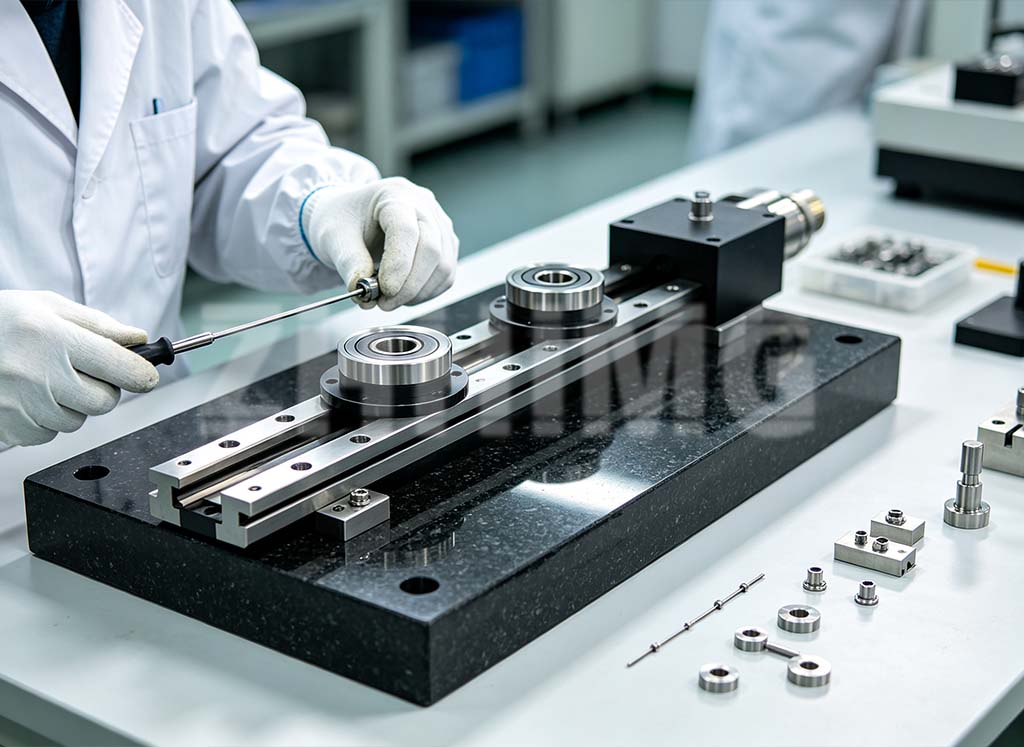
Meanwhile, foundation conditions on site indirectly affect measurement readings. Many customers mistake reading fluctuations caused by foundation settlement and external ambient vibration for inherent accuracy decline of granite components. Granite bases themselves maintain stable dimensions, yet if the equipment foundation settles and deforms, the base bends accordingly and measurement data shifts. This phenomenon is not accuracy failure of the stone itself. Proper foundation vibration isolation planning during equipment installation helps distinguish foundation disturbance from changes in component accuracy.
ZHHIMG firmly rejects low-cost marble used to cut corners, and strictly controls the full workflow including blank screening, aging treatment, precision lapping and metrological inspection. Our delivered granite structural components have served metrology institutes, university laboratories, semiconductor and laser equipment for over a decade while maintaining excellent reference accuracy. As long as heavy impacts from hard objects and immersion in strongly corrosive chemicals are avoided and basic environmental management is maintained, granite components can steadily retain micron or even nanometer-level benchmarks without obvious accuracy degradation.
Post time: Sep-10-2026