
When selecting granite bases, many procurement specialists and equipment engineers share one common concern: if the production workshop cannot maintain strict constant temperature and suffers obvious temperature fluctuations between day and night or morning and evening, will the precision of granite machine bases drift and impair the inspection and machining performance of complete equipment? The answer cannot be simply yes or no. Whether precision drifts depends on the quality of stone blank, internal stress relief of components, machining process and the magnitude of temperature gradient.
Stone materials behave quite differently under temperature variation. Some low-cost bases on the market adopt ordinary marble with loose and uneven texture and substantial residual internal stress. Slight temperature fluctuation will trigger irregular deformation and rapid plane offset, resulting in obvious precision drift. High-quality black granite features dense and uniform structure and ultra-low thermal expansion coefficient. Compared with steel and aluminum alloy, its dimensional change induced by temperature is extremely small, which is its innate advantage as an ultra-precision reference component. However, it should be noted that granite is not completely immune to temperature impacts. Local temperature difference, such as air conditioner wind blowing directly on one side of the base, will create a temperature gradient. Uneven temperature on two sides of the base will still cause tiny bending deformation and bring about precision offset.
Residual internal stress inside components is an invisible culprit leading to precision drift under temperature fluctuation. Even if high-grade granite blank is adopted, without sufficient aging treatment, residual stress remains inside the stone. When ambient temperature fluctuates, stress releases gradually, the base slowly warps and its precision drifts over time. Before machining granite bases, ZHHIMG carries out long-term natural aging on raw blanks, together with multiple rough grinding and stress-relief procedures to fully release internal stone stress and eliminate slow deformation triggered by temperature change in later service. Ultra-precision grinding and forming are then completed in a 10,000 m² constant temperature and humidity workshop. Benchmark accuracy is locked under stable temperature conditions during machining, greatly improving the finished base’s resistance to stress deformation.
Precision drift caused by temperature difference falls into two categories: uniform expansion and contraction from overall temperature rise or drop, and bending deformation induced by local temperature gradient. If the whole base warms up or cools down synchronously, only uniform expansion and contraction occur. Geometric benchmarks such as flatness and straightness can basically remain intact. The equipment control system can even offset such uniform dimensional change via compensation algorithms, exerting limited influence on production. What needs close attention is uneven heating. Sunlight shining into the workshop, cold and hot air flow scouring one side, and continuous heat generation from equipment motors near the base edge will form temperature gradients. One side of the base becomes hotter while the other remains cooler, leading to bending and damaging the plane benchmark. At this time, uncompensatable precision drift occurs and causes errors in machining and inspection. 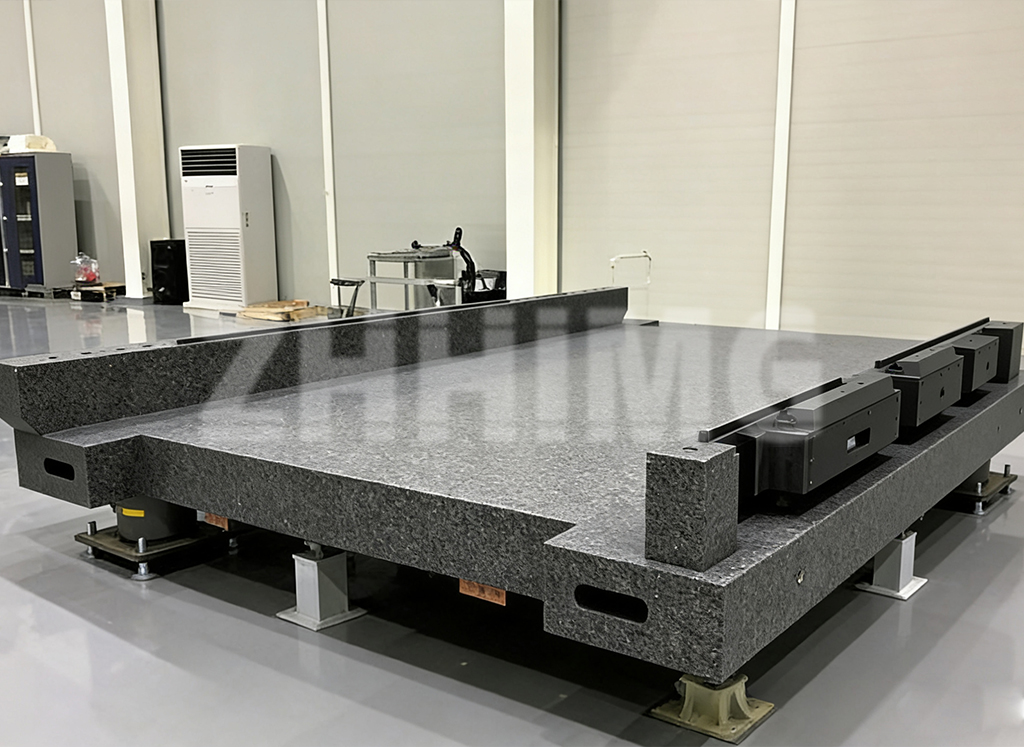
On-site installation design can also mitigate the risk of precision drift brought by temperature difference. At the preliminary solution stage, ZHHIMG technical team evaluates the temperature fluctuation range of the customer’s site and avoids heat sources and direct air flow. The layout of base support points is also critical. Improper support arrangement will amplify benchmark deviation induced by thermal deformation. Our technical team optimizes support layout according to customer working conditions to prevent thermal deformation from converting into errors on reference surfaces. Meanwhile, the metrology acceptance process follows globally recognized metrology standards. Calibration is performed with high-precision instruments under thermally stable conditions to guarantee reliable delivered benchmarks.
Another easily overlooked point is the hysteresis effect of temperature change. Granite conducts heat slowly. After ambient temperature changes, the temperature of stone itself cannot follow immediately. If workshop temperature fluctuates, sufficient standing time should be reserved to let the base reach overall thermal equilibrium before ultra-precision machining or inspection. Many so-called on-site precision drift phenomena are essentially false impressions caused by the base failing to reach thermal balance with the environment, rather than inherent quality defects of the base.
Large workshop temperature difference does not necessarily lead to precision drift of granite bases. With high-density black granite, thorough internal stress removal and avoidance of local temperature gradient, the base can stably maintain benchmark precision in workshops with certain temperature fluctuations. On the contrary, low-grade stone, inadequate stress relief, unilateral heat sources or direct air flow on site will trigger precision drift even for granite bases. Conducting on-site thermal environment assessment at the early project stage and selecting proper blank and machining solutions can greatly reduce the interference of temperature difference on benchmarks of ultra-precision equipment.
Post time: Sep-15-2026