
In ultra-precision equipment, granite machine beams serve as the core base structure supporting motion modules, optical assemblies and measuring probes. Many buyers focus on stone material selection, overall dimensions and rigidity, yet tend to overlook surface grinding, a critical manufacturing process. In fact, the surface grinding quality of granite machine beams directly affects the motion smoothness, positioning repeatability and long-term precision stability of the whole machine, acting as a hidden core indicator determining whether precision equipment can operate steadily over time.
Surface grinding of granite beams is far more than simple flattening. It involves refined control of flatness, surface roughness, micro-texture, local high points and stress relief. The finished surface provides a reliable mounting reference for linear guides, air bearings and slide assemblies. Poor grinding leaves micro undulations, local protrusions or uneven tool marks. When guides and air bearing components are mounted, the module cannot obtain an evenly supported surface. After fastening, latent assembly stress forms. As the equipment reciprocates, this stress releases continuously, causing unbalanced guide preload, motion stuttering and jitter, which directly impair the smooth operation of the complete machine.
For granite beams fitted with air bearings, the impact of grinding quality becomes even more pronounced. Air bearings rely on an ultra-thin air film for frictionless movement, with film thickness typically only a few micrometers. Excessive surface roughness or tiny peaks and valleys on the beam disrupt uniform air film distribution, leading to partial thinning or even rupture of the air film. This increases motion resistance, triggers vibration noise and positioning drift, resulting in point deviation for sub-micrometer tasks such as semiconductor inspection and laser machining. Even with high-end components adopted, grinding defects on the beam will cap the overall precision of the equipment.
Surface grinding quality also determines the long-term precision retention of the whole machine. Micro-defects left by rough grinding gradually worsen under long continuous operation and minor ambient temperature and humidity changes. Repeated friction of the slide on uneven surfaces accelerates wear and precision degradation, requiring frequent shutdown calibration and raising maintenance costs. In contrast, finely ground granite beams feature uniform and stable micro-topography, giving full play to wear resistance, maintaining benchmark surface accuracy for extended periods and reducing calibration downtime to support continuous production.
Grinding craftsmanship also influences the vibration suppression performance of the whole machine. Ultra-precision equipment is extremely sensitive to micro-vibration. Irregular surface relief on the beam generates minor excitation during slide movement. Such micro-vibration transfers to optical lenses and measuring probes, causing blurred images and fluctuating measurement readings, especially in CMMs, AOI, X-ray and femtosecond laser processing equipment. High-quality grinding eliminates micro high points to achieve smooth fitting of moving parts, maximizes the inherent high damping and shock absorption advantages of granite material and cuts off the source of micro-vibration. 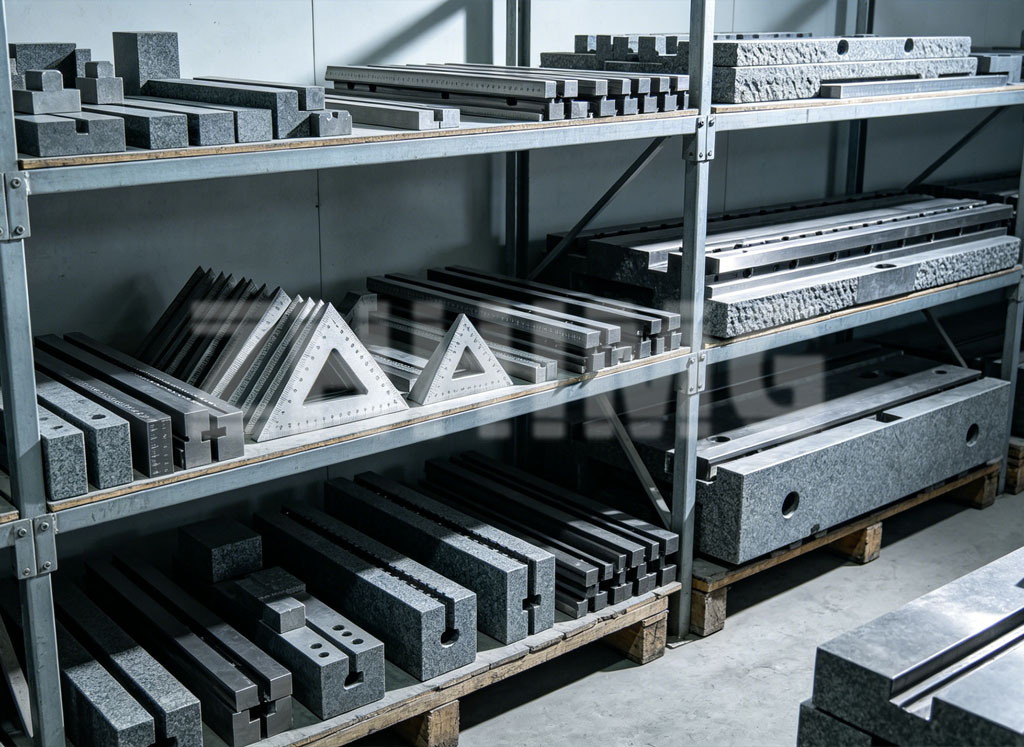
ZHHIMG regards surface grinding of granite machine beams as a core part of quality control. Leveraging decades of manual grinding experience of senior craftsmen, paired with large high-precision grinders and a full set of traceable metrology instruments, we inspect flatness and roughness for every beam. All measuring tools are traceable to national metrology authorities, complying with multiple international metrology standards. We prevent products with micro surface defects from entering assembly. Adhering to our customer promise of no cheating, no concealment and no misleading, ZHHIMG never cuts costs by simplifying grinding procedures. We guarantee benchmark quality of beams starting from grinding and deliver stable and reliable structural foundations for all types of ultra-precision equipment.
In conclusion, surface grinding quality of granite machine beams is by no means a minor processing detail. It is a key factor that profoundly impacts the motion performance, positioning accuracy, vibration level and service life of complete equipment. Superior grinding is a prerequisite to unlock the high stability and low deformation merits of granite substrates. Grinding defects will offset the material advantages and lead to underperformance of the whole machine. When selecting ultra-precision granite machine beams, buyers should verify surface grinding indicators besides checking material and dimension parameters to ensure long-term stable and reliable operation of precision equipment.
Post time: Sep-09-2026