
The selection of machine tool beds is essentially a process of matching materials and solutions according to actual production conditions. As a traditional mainstream bed material, cast iron has long dominated the general‑purpose machine‑tool market thanks to mature smelting and casting technologies. With the rise of the ultra‑precision equipment industry, granite beds have been widely adopted in high‑end segmented scenarios. Neither material is absolutely superior to the other, yet they show obvious disparities in adapting to different loads, vibration levels, temperature variations and corrosive environments. Drawing on abundant project‑delivery experience, ZHHIMG compares and analyzes the respective applicable scenarios of the two types of beds from the perspective of on‑site working conditions, helping equipment manufacturers make more scientific substrate selections.
Dynamic vibration environments constitute the most intuitive dividing line for their adaptability. Ordinary cast‑iron beds achieve vibration reduction via structural reinforcing ribs. Metallic materials feature limited inherent damping and weak absorption capacity for high‑frequency micro‑vibration. Under heavy‑duty conditions with rough machining and heavy cutting loads, cast‑iron beds deliver sufficient rigidity to withstand tremendous cutting impact. Nevertheless, tiny vibration will translate into machining errors in scenarios such as precision inspection and ultrafast laser processing. The crystalline structure of granite possesses natural damping properties, which rapidly absorb and dissipate high‑frequency micro‑vibration and suppress resonance amplification. Therefore, granite beds can effectively mitigate vibration interference in linear motor stages and coordinate measuring machines with continuous high‑frequency reciprocating motion. For heavy‑cutting conditions with extreme impact loads, however, granite requires proper structural protection to avoid material damage caused by instantaneous heavy shock. In short, impact‑cutting scenarios are more suitable for cast iron, while micro‑vibration‑sensitive scenarios favor granite substrates.
The two materials behave distinctly under fluctuating‑temperature conditions. Cast iron boasts a relatively high thermal‑expansion coefficient. Ambient‑temperature swings and continuous heat generation from motors will trigger thermal expansion and contraction of cast‑iron beds. In ordinary workshops with dramatic temperature variations, cast‑iron‑based equipment has to rely on sophisticated thermal‑error compensation algorithms to offset accuracy deviations induced by deformation, which brings heavy algorithm‑debugging workload. Even with compensation programs, residual compensation errors still exist on production sites with large day‑night temperature gaps. Granite exhibits low thermal‑deformation response; its geometric shape barely changes under minor temperature fluctuations, lowering reliance on complex thermal‑compensation systems. It should be objectively noted that granite is not completely immune to temperature influence. Sharp, drastic temperature surges in workshops will still cause dimensional changes, so basic constant‑temperature conditions remain necessary. Accordingly, granite is preferred for constant‑temperature laboratories and precision‑inspection workshops, whereas cast‑iron beds offer higher compatibility for ordinary machining workshops without temperature control and drastic temperature shifts.
There is a notable gap in their resistance against corrosion, dust and cutting‑fluid splashes on production floors. Cast‑iron beds are prone to oxidation and rust. Splashes of cutting fluid and emulsion accelerate corrosion. Once surface protective coatings are damaged, rust will spread continuously and gradually impair the reference surfaces for guide‑rail mounting. Regular re‑coating for protection is required in daily production, leading to tedious maintenance work. Granite features stable chemical properties: it is rust‑proof and resistant to cutting‑fluid corrosion. Liquid splashes merely stay on the surface and can be removed by simple wiping without corroding the substrate. On the other hand, granite is brittle stone material and cannot sustain violent impact from sharp hard objects. Cast iron possesses metallic toughness and mostly forms local dents instead of cracking upon collision. Granite gains advantages in semiconductor, lithium‑battery‑inspection and optical‑inspection production lines exposed to cutting‑fluid and chemical mist. Cast‑iron’s impact‑resistant toughness is more practical for rough‑machining workshops filled with flying metal chips and high risk of hard‑object collision.
They follow completely different precision‑attenuation patterns during long‑term service. Under long‑term alternating loads, cast‑iron beds suffer stress relaxation. Combined with corrosion and wear, their precision declines gradually over service time, requiring regular disassembly and scraping to repair reference surfaces. As long as violent impact is avoided, granite beds suffer no corrosion‑induced material loss. Precision degradation mainly originates from wear of external assembled components, and the stone‑based reference surface can remain stable for a long period. Restricted by raw‑material characteristics, granite encounters higher difficulty and cost in manufacturing complex inner cavities and special‑shaped structures compared with cast iron. Cast iron can be integrally cast into intricate reinforcing ribs and oil‑way chambers with high freedom for structural design. Many equipment manufacturers mistakenly believe that granite can fully replace cast iron. In fact, cast iron remains a pragmatic option for heavy‑duty machine tools with complex built‑in oil‑ways and cavities. Granite maximizes its benefits for precision equipment pursuing long‑term stable references and relatively simple structures. 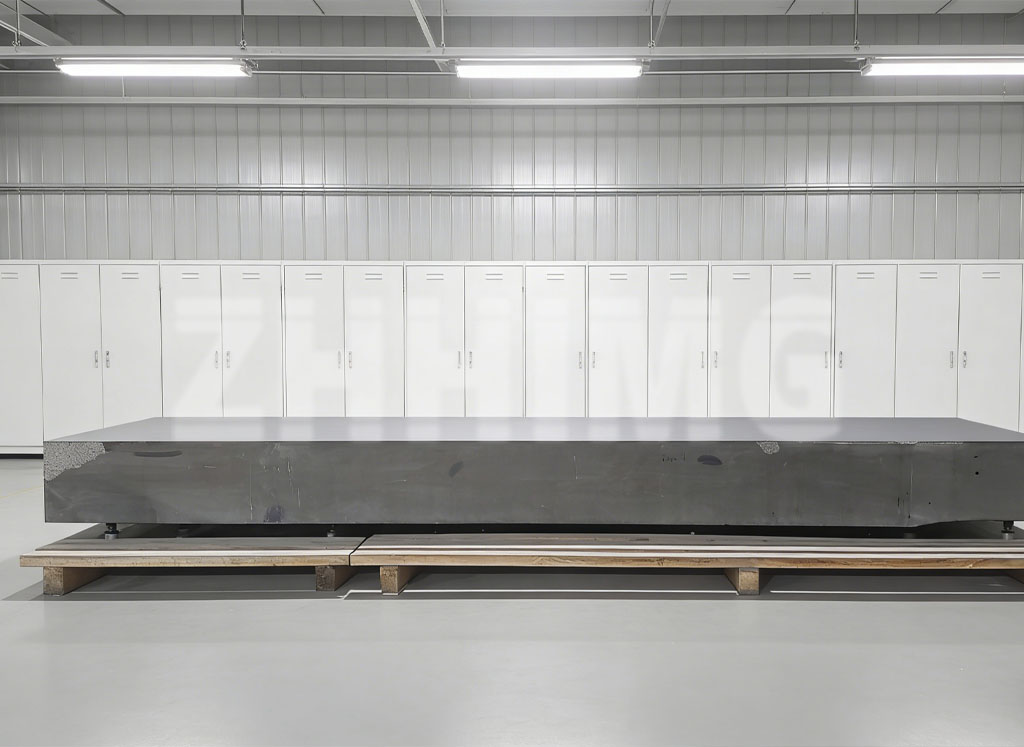
High‑quality raw materials act as the primary prerequisite to realize granite’s working‑condition advantages. Some low‑cost products on the market adopt low‑compactness marble to pass for granite. Even with qualified overall dimensions, they quickly suffer precision drift under alternating loads and humid conditions and fail to deliver expected stone‑material performance. ZHHIMG selects high‑density black granite and eliminates inferior blanks from the source. Leveraging large‑scale production bases, constant‑temperature anti‑vibration workshops, a full set of traceable international metrology‑inspection equipment, and process technicians familiar with multiple national metrology standards, ZHHIMG converts material properties into real‑world working‑condition performance of finished products. Holding ISO triple‑system certifications, CE certification and multiple overseas patents and trademarks, the company adheres to its customer commitment of no deception and no concealment and fights against the industry malpractice of selling inferior goods as premium products.
Instead of drawing conclusions merely based on material categories, equipment manufacturers shall sort out actual on‑site conditions including impact‑load magnitude, vibration types, workshop temperature‑humidity conditions, corrosive media, expected service life of equipment and structural complexity before finalizing bed‑substrate solutions.
As segmented scenarios within the global ultra‑precision industry keep expanding, cast‑iron and granite beds will co‑exist for a long time. Cast iron will maintain its position in general‑purpose heavy‑duty manufacturing equipment, while granite will further penetrate high‑end sectors such as precision inspection, semiconductors, laser technology and new‑energy industries. A thorough understanding of their working‑condition adaptation differences enables proper bed‑solution selection and allows equipment to steadily achieve designed accuracy on corresponding production sites.
Post time: Sep-03-2026