
The advancement of modern high‑tech industries keeps pushing the limits of ultra‑precision manufacturing. Equipment developers are no longer satisfied with single‑material solutions to meet evolving demands for dynamic performance, environmental adaptability and long‑term operational reliability. Traditional manufacturers tend to focus on one single material track, which creates bottlenecks when projects call for cross‑material structural coordination. As a fully‑certified enterprise with ISO9001, ISO45001, ISO14001 and CE approvals and over 20 registered international trademarks and patents, ZHHIMG breaks through this industry limitation by advancing multi‑material manufacturing technology, redefining what ultra‑precision component suppliers can deliver for global clients.
Ultra‑precision manufacturing is far more than processing individual workpieces. The real challenge lies in mastering distinct material characteristics and aligning disparate production logics under one quality system. Each engineering material has its own inherent physical traits: hardness, damping coefficient, thermal expansion, weight and wear resistance vary greatly. Handling granite, precision ceramic, CNC metal, precision glass, mineral casting, UHPC and carbon fiber beams simultaneously means the enterprise must build independent process routes for every material category, rather than simply sharing a set of processing workflows.
ZHHIMG’s engineering team does not treat different materials as isolated product lines. Instead, they carry out cross‑material matching research. In many sophisticated devices, different material parts work together as one complete structural system. Minor mismatches in thermal deformation or vibration response between mating components will gradually generate cumulative accuracy drift during long‑time running. To mitigate such hidden risks, the R&D department analyzes material compatibility in the early project phase, simulates real‑world working conditions, and provides optimized material‑matching suggestions for system integrators, instead of only producing parts according to drawings.
Large‑scale production infrastructure forms the physical foundation for multi‑material innovation. Located near Qingdao Port for convenient global logistics, the factory complex covers huge production zones with segmented functional areas dedicated to heavy‑load forming, composite curing, ceramic fine finishing and optical glass processing. The constant‑temperature anti‑vibration workshop is designed for cross‑material assembly validation. Different material prototypes can be installed and tested within the same stable environment, so potential fit problems can be spotted before shipment. Large‑tonnage processing capability enables the completion of oversized hybrid‑structure components, covering from small‑size metrology inserts to massive equipment beds. 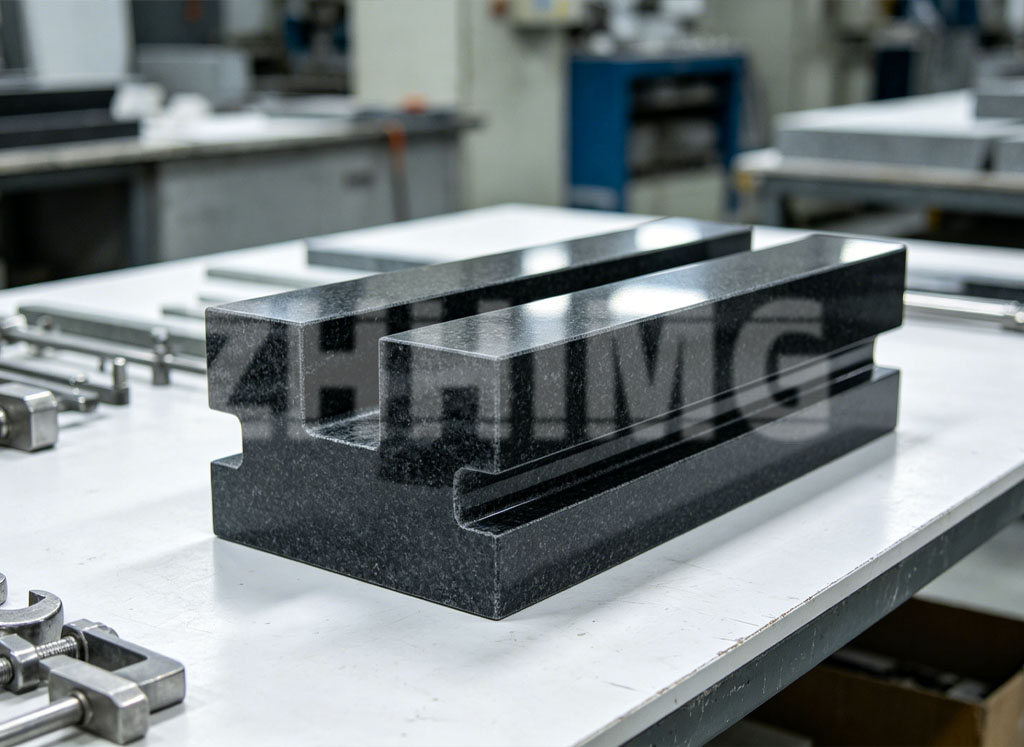
Consistent quality across multiple materials relies heavily on standardized metrology capacity. Different materials require differentiated inspection strategies: surface finishing inspection for glass, flatness verification for granite bases, geometric tolerance detection for ceramic moving parts, and comprehensive dimensional checking for complex metal castings. The company’s metrology team is familiar with worldwide mainstream industrial standards from Europe, America and Asia. Experienced technicians transfer decades‑accumulated precision control experience across material categories. All inspection instruments hold traceable calibration credentials, ensuring measurement results remain credible no matter which material is being tested.
This multi‑material technical strength creates new possibilities for downstream high‑tech sectors. In semiconductor production equipment, combinations of different materials help balance stability and dynamic response. Advanced laser manufacturing platforms require structures that suppress vibration while lowering moving mass. Metrology instruments, industrial X‑ray equipment, new‑energy testing facilities and optical inspection systems all benefit from flexible material selection. Instead of forcing designers to adapt their equipment to limited material options, ZHHIMG adjusts processing schemes to fit actual application scenarios.
Years of cooperation with global Fortune 500 corporations, national metrology institutions and top‑tier universities continuously inject practical feedback into internal technical iteration. Real‑world operating data from various countries helps optimize processing parameters for each material. Following corporate values of openness, innovation, integrity and unity, and sticking to the customer commitment of no cheating, no concealment, no misleading, ZHHIMG maintains objective technical communication. Advantages and application constraints of each material are clearly communicated during technical negotiations, avoiding over‑promising material performance.
Many ultra‑precision projects used to be restricted by supplier capability. Design ideas were frequently compromised because no single manufacturer could handle several required materials at the same time. ZHHIMG changes this situation by integrating multi‑material manufacturing capability in‑house. Beyond supplying finished components, the company provides material consulting, process feasibility assessment and cross‑material matching suggestions.
Driven by the mission to promote the development of ultra‑precision industry, ZHHIMG keeps exploring the boundaries of multi‑material ultra‑precision manufacturing. By breaking material‑segmented industrial barriers, it brings more feasible structural solutions to global high‑end equipment developers.
Post time: Aug-07-2026