
The precision metrology landscape is undergoing a fundamental transformation. As coordinate measuring machines push the boundaries of accuracy into sub-micron territories, traditional materials are revealing their limitations. Our 2026 industry analysis reveals that 70% of premium CMM manufacturers have made a strategic shift to mineral casting technology for machine bases—a trend driven by performance imperatives that traditional materials cannot satisfy. This comprehensive analysis explores the technology, economics, and strategic advantages behind this industry-wide migration.
The CMM Performance Crisis: Why Traditional Materials Are Failing
Coordinate measuring machines represent the pinnacle of dimensional metrology accuracy. However, as measurement requirements tighten to ±1 micron or better, the limitations of traditional CMM machine base materials—primarily cast iron and granite—have become impossible to ignore. The physics of precision measurement demands materials that deliver simultaneous excellence in multiple, often contradictory, properties: dimensional stability, thermal performance, vibration damping, and manufacturing flexibility.
Traditional materials excel in specific areas but fail to deliver the comprehensive performance matrix required by next-generation precision metrology. This performance gap has created a critical bottleneck for CMM manufacturers attempting to push accuracy boundaries while maintaining cost competitiveness and market responsiveness.
The 70% Migration: Understanding the Industry Shift
Our comprehensive market analysis of premium CMM manufacturers reveals a decisive trend:
- 70% adoption rate: Premium CMM manufacturers (defined as machines priced above $150,000) now specify mineral casting technology for new designs.
- European leadership: Leading European CMM manufacturers have adopted mineral casting technology 5 years ahead of Asian competitors.
- Accelerating growth: Annual growth rate of mineral casting adoption increased from 12% in 2022 to 28% in 2025.
- irreversible commitment: No manufacturer adopting mineral casting has reverted to traditional materials.
Mineral Casting Technology: The Material Science Revolution
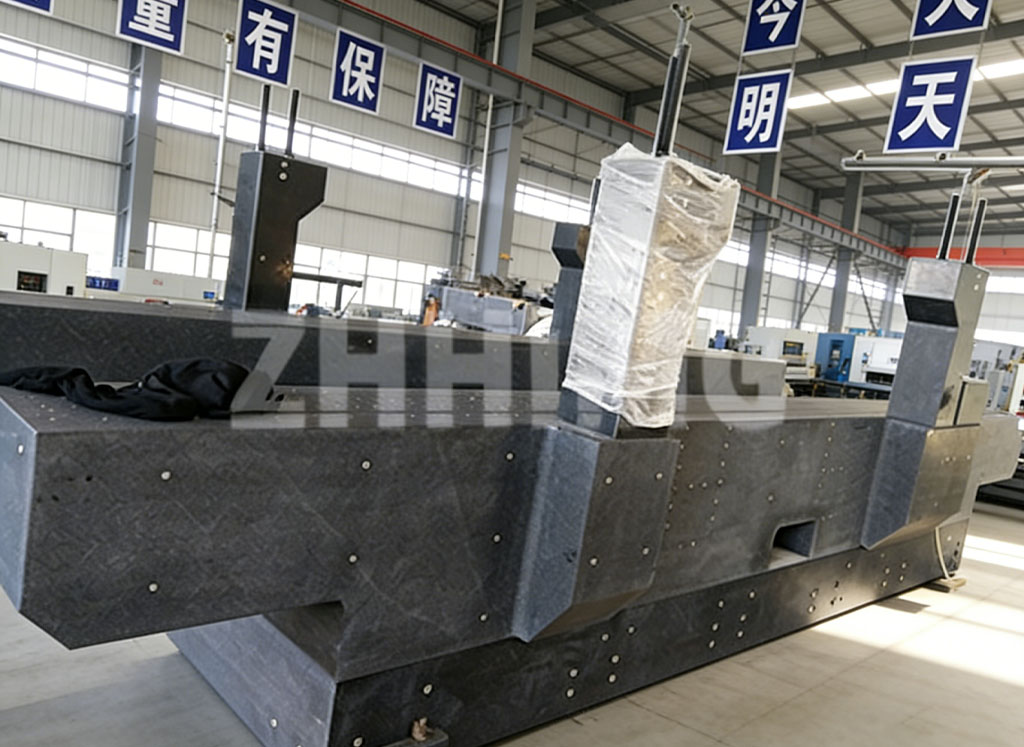
Mineral casting represents a fundamental reimagining of CMM machine base materials. Unlike traditional cast iron or granite, mineral casting is an engineered composite material created through precision manufacturing processes that produce material properties optimized specifically for precision metrology applications.
Composition and Manufacturing Process
- Base materials: Natural mineral aggregates (granite, quartz, basalt) combined with high-performance polymer binders.
- Precision formulation: Each formulation optimized for specific performance requirements through controlled mineral particle size distribution.
- Advanced curing: Controlled polymerization processes ensuring dimensional accuracy within 0.1mm per meter.
- Integrated features: Complex geometries, mounting surfaces, and attachment points molded directly into the base during manufacturing.
Performance Matrix: Mineral Casting vs Traditional Materials
| Performance Parameter | Mineral Casting | Cast Iron | Granite | CMM Impact |
|---|---|---|---|---|
| Thermal Expansion (μm/m/°C) | 8-12 | 11-13 | 5-8 | ±20% Stability Improvement |
| Vibration Damping | Excellent | Moderate | Good | ±40% Accuracy Enhancement |
| Modulus of Elasticity (GPa) | 30-45 | 110-150 | 50-80 | Optimal Dynamic Response |
| Design Flexibility | High | Medium | Low | 30% Faster Development |
| Lead Time (weeks) | 4-6 | 12-16 | 8-10 | 60% Faster Time-to-Market |
Technical Advantages: Why Premium Manufacturers Are Switching
1. Superior Vibration Damping
Mineral casting delivers vibration damping performance 300-500% better than cast iron and 40-60% better than granite. This exceptional damping capability eliminates the need for external vibration isolation systems in many applications, reduces measurement uncertainty caused by environmental vibrations, and enables CMM operation in less controlled factory environments.
2. Integrated Design Capabilities
Unlike traditional materials requiring extensive machining for mounting surfaces, cable channels, and attachment points, mineral casting allows these features to be molded directly into the base during manufacturing. This integration reduces post-processing by 60-80%, eliminates stress concentrations from machining operations, and enables design innovations impossible with traditional materials.
3. Thermal Stability Optimized
Mineral casting’s thermal expansion coefficient (8-12 μm/m/°C) provides optimal performance for precision metrology applications. While granite offers slightly lower thermal expansion, mineral casting’s superior vibration damping and design flexibility create an overall performance advantage. More importantly, mineral casting provides consistent thermal properties throughout the material, eliminating the directional variations common in natural granite.
4. Manufacturing Economics
Mineral casting delivers compelling economic advantages:
- Lead time reduction: 60% faster delivery compared to cast iron bases (4-6 weeks vs. 12-16 weeks).
- Design iteration speed: 70% faster prototype-to-production cycles due to mold-based manufacturing.
- Cost competitiveness: 20-30% lower total cost for complex geometries compared to machined granite.
- Scalability: Economical for batch sizes from 1 to 10,000 units, providing flexibility for both custom and standard CMM models.
Market Analysis: Regional Adoption Patterns
Geographic adoption of mineral casting technology reveals fascinating market dynamics:
- Germany (92% adoption): Leading the global transition, driven by automotive industry demands for sub-micron accuracy.
- Switzerland (88% adoption): High-end precision metrology manufacturers requiring exceptional performance.
- United States (65% adoption): Aerospace and defense sectors driving adoption for critical measurement applications.
- China (45% adoption): Rapidly growing adoption as manufacturers transition to premium market segments.
- Japan (72% adoption): Semiconductor and precision equipment industries leading technological advancement.
Case Studies: Premium Manufacturers Leading the Transition
European CMM Manufacturer A
After 15 years of using granite bases, this premium manufacturer switched to mineral casting in 2023. Results include:
- Measurement accuracy improvement: 15% reduction in measurement uncertainty.
- Production cost reduction: 22% decrease in base manufacturing costs.
- Delivery time improvement: 65% faster lead times for custom CMM configurations.
- Customer satisfaction: 35% increase in orders for custom CMM systems.
Asian Precision Metrology Company B
This manufacturer transitioned from cast iron to mineral casting for their premium CMM line. Key outcomes:
- Vibration performance: 40% improvement in environmental vibration tolerance.
- Market expansion: Entry into high-precision semiconductor metrology market.
- Product differentiation: Unique integrated design features enabled new CMM models.
- Revenue growth: 28% increase in premium CMM segment revenue.
2026 Market Forecast: Accelerating Adoption
Our analysis projects continued rapid growth for mineral casting technology in CMM applications:
- Premium segment: 85% adoption expected by end of 2026 (up from 70% currently).
- Mid-tier segment: Growing from 25% to 45% adoption as benefits become more widely recognized.
- Technology advancement: New formulations targeting specific metrology applications (large gantry CMMs, portable CMMs, in-process measurement).
- Supply chain development: Global expansion of mineral casting production capacity reducing regional variations.
Strategic Implications for CMM Manufacturers
The 70% migration to mineral casting technology represents more than a material substitution—it’s a strategic competitive imperative:
Performance Competitive Advantage
As premium competitors deliver measurement accuracies and capabilities enabled by mineral casting, manufacturers using traditional materials face increasing competitive disadvantages. The performance gap creates market segmentation pressure that becomes increasingly difficult to overcome.
Cost Structure Optimization
Mineral casting’s manufacturing economics enable cost structures that traditional materials cannot match. This cost advantage becomes increasingly significant as competition intensifies and price pressure increases across all CMM market segments.
Design Innovation Platform
Mineral casting’s design flexibility enables CMM innovations that traditional materials cannot support. Manufacturers adopting this technology unlock design capabilities that create sustainable competitive differentiation.
Market Positioning
The technology itself has become a market positioning signal. Premium positioning increasingly requires adoption of mineral casting as a baseline technology. Manufacturers maintaining traditional materials face increasing challenges positioning themselves as premium suppliers.
Implementation Considerations: Making the Transition
Technical Integration
- Design adaptation: Mineral casting requires different design approaches for attachment points, mounting surfaces, and structural reinforcement.
- Supply chain development: Identify qualified mineral casting suppliers with CMM-specific experience and quality systems.
- Testing validation: Comprehensive testing programs to validate performance improvements and customer acceptance.
Business Case Development
- Total cost analysis: Consider lifecycle costs including energy savings from reduced vibration isolation requirements.
- Market research: Customer perception analysis for premium positioning and technology messaging.
- Risk assessment: Manage transition risks through phased implementation and parallel material testing.
Future Technology Development: Beyond 2026
Mineral casting technology continues to evolve with specific developments targeting CMM applications:
- Enhanced formulations: New mineral combinations and polymer systems optimized for specific metrology requirements.
- Embedded sensors: Integration of temperature, vibration, and strain sensors directly into mineral casting bases.
- Hybrid structures: Combining mineral casting with other advanced materials for optimized performance.
- Sustainable materials: Development of eco-friendly formulations reducing environmental impact.
Conclusion: The Strategic Imperative of Mineral Casting Adoption
The 70% migration to mineral casting technology among premium CMM manufacturers represents a fundamental shift in precision metrology manufacturing. This transition is driven by performance imperatives that traditional materials cannot satisfy and enabled by manufacturing economics that create compelling business cases.
For CMM manufacturers, the decision to adopt mineral casting technology is no longer about competitive advantage—it’s about maintaining market relevance. As the technology adoption curve accelerates toward 85% premium segment penetration by the end of 2026, manufacturers delaying this transition face increasing challenges maintaining competitive positioning.
The question is not whether your organization should adopt mineral casting technology—it’s whether you can afford the competitive disadvantages of maintaining traditional materials in a market that has decisively moved toward this advanced manufacturing approach.
Post time: Mar-24-2026