
Engineers and equipment designers face challenging material selection decisions when specifying precision components for semiconductor manufacturing, metrology instruments, and high-accuracy automation systems. Precision ceramic components and granite precision components each offer distinct advantages that make them optimal for different application requirements. This comprehensive guide compares these materials across critical performance parameters, enabling informed decisions that optimize equipment accuracy, reliability, and cost-effectiveness.
Precision ceramics excel in high-temperature applications, vacuum environments, and situations requiring extreme hardness and wear resistance, with thermal expansion coefficients of 4-8×10⁻⁶/°C. Granite dominates in ambient-temperature precision applications requiring superior vibration damping, thermal stability below 0.001mm/°C, and cleanroom compatibility, with 3100kg/m³ density providing unmatched damping performance. For most semiconductor and metrology applications, granite’s balanced properties and lower cost make it the default choice, while ceramics serve specialized requirements including high-temperature processing and vacuum chambers.
Material Properties Comparison Overview
Fundamental Characteristics of Precision Ceramics
Technical ceramics include aluminum oxide (alumina), silicon carbide, silicon nitride, and zirconia, each with distinct property profiles. These materials share common characteristics including exceptional hardness (8-9 Mohs), high compressive strength (1500-2500 MPa), and excellent corrosion resistance.
The thermal expansion coefficients of precision ceramics range from 4-8×10⁻⁶/°C, among the lowest of any engineering material. This characteristic makes ceramics ideal for applications involving significant temperature variations where dimensional stability is critical.
Granite’s Structural Properties
Granite precision components utilize natural black granite with carefully controlled mineral composition. The density of approximately 3100kg/m³ provides high mass per unit volume, contributing to excellent vibration damping characteristics that ceramics cannot match.
Granite’s thermal expansion coefficient below 0.001mm/°C rivals or exceeds technical ceramics, while its significantly lower cost and easier machinability make it more economically practical for large-scale components.
Comparative Property Table
|
Property |
Black Granite |
Alumina Ceramic |
Silicon Carbide |
Silicon Nitride |
| Density | 3100 kg/m³ | 3900 kg/m³ | 3200 kg/m³ | 3200 kg/m³ |
| Thermal Expansion | <0.001mm/°C | 8×10⁻⁶/°C | 4×10⁻⁶/°C | 3×10⁻⁶/°C |
| Young’s Modulus | 40-60 GPa | 350-400 GPa | 400-450 GPa | 300-320 GPa |
| Hardness | 6-7 Mohs | 9 Mohs | 9+ Mohs | 9 Mohs |
| Fracture Toughness | Low | Low | Moderate | High |
| Thermal Conductivity | 2-3 W/m·K | 25-35 W/m·K | 120-200 W/m·K | 20-30 W/m·K |
| Max Service Temp | 600°C | 1500°C | 1400°C | 1000°C |
| Damping Capacity | High | Low | Low | Moderate |
Thermal Expansion and Dimensional Stability
Why Thermal Expansion Matters for Precision Equipment
Dimensional changes from temperature variations directly impact measurement accuracy, positioning precision, and geometric tolerances. Material selection must consider both the magnitude of thermal expansion and the thermal management capabilities of the application environment.
Both granite and ceramics offer excellent thermal stability, but their different expansion coefficients become significant in precision applications. Silicon nitride’s coefficient of 3×10⁻⁶/°C produces 3μm of change per meter per degree Celsius, while granite’s <0.001mm/°C equals 1μm/m/°C.
Thermal Gradient Response
Beyond uniform thermal expansion, materials respond differently to thermal gradients that create internal stress and geometric distortion. Ceramics’ high thermal conductivity rapidly distributes heat, potentially reducing thermal gradients but also conducting heat into sensitive areas.
Granite’s low thermal conductivity (2-3 W/m·K) creates slower heat transfer, extending thermal equilibration times. For equipment with intermittent heat sources, this can either buffer temperature effects or prolong thermal settling periods depending on the application.
Vibration Damping Performance
The Damping Advantage of Granite
Vibration damping capacity determines how quickly mechanical vibrations attenuate after excitation. Poor damping allows vibrations to persist, causing measurement errors, surface finish defects, and reduced tool life in machining applications.
Granite exhibits high internal damping through its polycrystalline structure, with energy dissipation occurring at grain boundaries and within mineral crystals. This natural damping provides 6-10× higher damping ratios compared to ceramics.
Ceramic Damping Limitations
Technical ceramics have low inherent damping due to their dense, crystalline structure. Vibrations persist longer in ceramic components, potentially requiring external damping solutions such as elastomeric mounts or active vibration isolation systems.
The low damping of ceramics can be advantageous in some precision measurement applications where predictable, repeatable elastic response is desired. However, for most manufacturing equipment, granite’s natural damping provides significant practical advantages.
Application Suitability Analysis
When Precision Ceramics Are Superior
High-Temperature Environments
Ceramic components maintain mechanical properties at temperatures where metals soften and granite experiences structural changes. Silicon carbide components operate reliably above 1000°C, making ceramics essential for semiconductor deposition processes and high-temperature metrology.
Vacuum Applications
Ceramics exhibit minimal outgassing in vacuum environments, making them essential for electron microscopy, particle accelerators, and space-based precision instruments. Granite’s porosity can cause outgassing issues in ultra-high vacuum applications.
Wear-Prone Surfaces
The extreme hardness of ceramics (9 Mohs) provides wear resistance impossible to achieve with granite. Ceramic ways, bearings, and sliding surfaces offer extended service life in high-cycle precision motion systems.
Electrical Isolation Requirements
Many ceramics are excellent electrical insulators, enabling use in electron beam systems, ion implantation equipment, and precision electrical metrology where grounded structures would introduce interference.
When Granite Precision Components Excel
Large Structural Elements
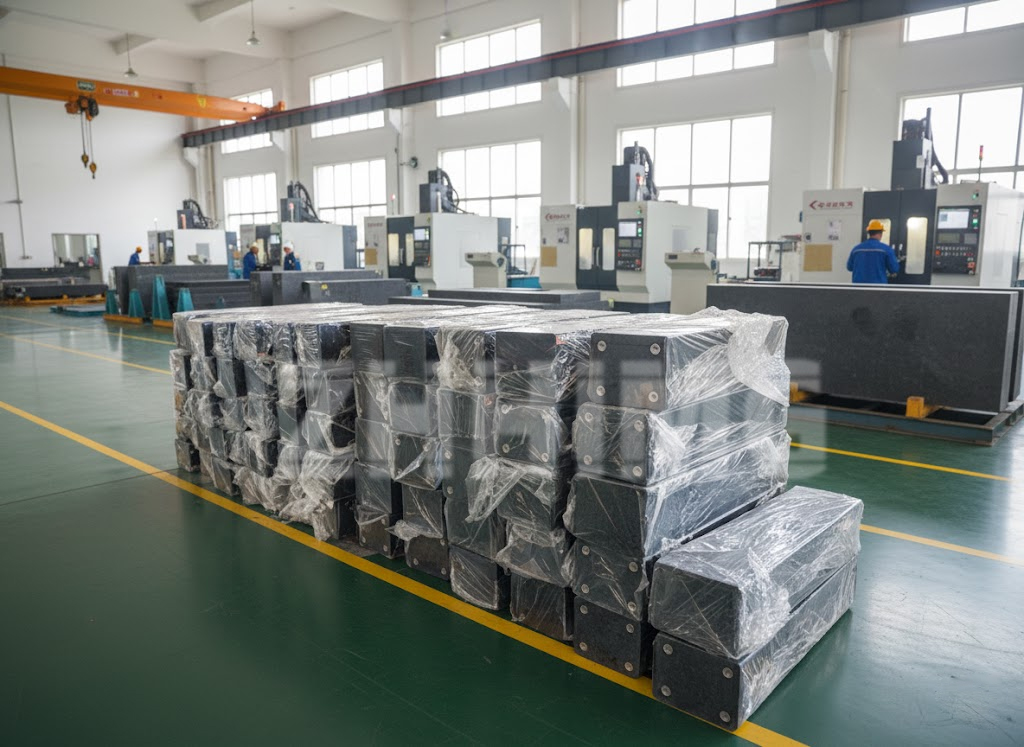
Granite’s lower cost and easier machinability make it economical for large components. Manufacturing granite structures exceeding several meters in length is more practical than equivalent ceramic components, with ZHHIMG® capable of producing granite components up to 20,000×4,000×1,000mm.
Vibration-Sensitive Applications
The superior damping of granite makes it the natural choice for CMM bases, precision inspection stations, and optical equipment foundations where vibrations would compromise performance.
Cleanroom Environments
Granite’s particle-free surface and chemical inertness make it ideal for semiconductor cleanrooms. Unlike metals, granite does not corrode or generate particles that could contaminate wafer processing environments.
Ambient Temperature Precision Equipment
For equipment operating near room temperature with reasonable environmental control, granite provides all the precision required at significantly lower cost than ceramic alternatives.
Manufacturing and Cost Considerations
Machinability and Production Complexity
Granite machines using conventional carbide tooling, similar to machining cast iron. Complex geometries can be achieved through multi-axis grinding operations, with surface finishes down to Ra 0.1μm achievable on critical surfaces.
Ceramics require diamond tooling for machining, significantly increasing production costs and limiting achievable geometries. Complex ceramic parts often require sintering to near-net shape followed by minimal finishing, with costs scaling dramatically with complexity.
Component Size Limitations
Practical ceramic components are limited to sizes that can be sintered without excessive warpage or cracking. Large ceramic components are expensive and may have property variations due to processing constraints.
Granite components can be manufactured to essentially any practical size, with the primary limitations being grinding machine capacity rather than material processing constraints. ZHHIMG® operates Taiwan’s most advanced ultra-large grinding equipment capable of finishing surfaces up to 6000mm in length.
Cost-Performance Analysis
|
Factor |
Black Granite |
Technical Ceramic |
| Raw Material Cost | Low | High |
| Machining Cost | Low-Medium | Very High |
| Tooling Cost | Standard | Diamond Required |
| Large Component Feasibility | Excellent | Limited |
| Surface Finish Capability | Excellent | Good |
| Complexity Limit | High | Moderate |
| Per-Kilogram Cost | Low | Very High |
Environmental and Application-Specific Factors
Cleanroom Compatibility
Semiconductor cleanrooms require materials that do not generate particles, outgas contaminants, or corrode under controlled humidity conditions. Granite meets all these requirements, with centuries of proven cleanroom performance.
Ceramics also offer excellent cleanroom compatibility, but their higher cost limits use to applications where granite’s properties are insufficient. For most semiconductor manufacturing equipment, granite provides adequate performance at reasonable cost.
Radiation Environments
Some precision applications involve radiation exposure that degrades materials over time. Ceramics generally exhibit superior radiation resistance compared to granite, maintaining properties in gamma irradiation, electron beam, and ion beam environments.
For particle accelerator beamlines, space-based instruments, and nuclear facility applications, ceramic precision components may be specified despite higher costs.
Thermal Cycling Requirements
Applications involving repeated thermal cycling between extreme temperatures require materials that maintain properties without fatigue degradation. Ceramics withstand thousands of thermal cycles without property changes, while granite’s thermal fatigue resistance is more limited.
High-temperature process chambers, thermal testing equipment, and environmental test chambers may justify ceramic component investment for thermal cycling performance.
FAQ: Ceramic vs Granite Precision Components
Q1: What is the thermal expansion comparison between granite and ceramic materials?
A: Technical ceramics exhibit thermal expansion coefficients of 3-8×10⁻⁶/°C depending on composition. Black granite maintains thermal stability below 0.001mm/°C (1×10⁻⁶/°C), which matches or exceeds most technical ceramics. This makes granite competitive with ceramics for thermal stability while offering other advantages.
Q2: Which material provides better vibration damping for precision equipment?
A: Black granite provides significantly superior vibration damping compared to technical ceramics. Granite’s natural damping ratio is 6-10× higher than ceramics, making it the preferred choice for vibration-sensitive applications including CMM bases, precision inspection equipment, and optical systems.
Q3: Can ceramic components replace granite in semiconductor manufacturing equipment?
A: Ceramics replace granite only in specific applications requiring high-temperature operation (>500°C), ultra-high vacuum conditions, electrical isolation, or extreme wear resistance. For most semiconductor equipment operating at ambient temperatures, granite’s combination of thermal stability, damping, cleanroom compatibility, and cost-effectiveness makes it the preferred choice.
Q4: What size limitations exist for ceramic precision components?
A: Ceramic components are limited by sintering process constraints, with practical sizes typically below 500mm for complex geometries. Larger ceramic components are possible but become economically impractical due to high reject rates and processing costs. Granite components can be manufactured up to 20,000×4,000×1,000mm with standard grinding operations.
Q5: Why is granite preferred for cleanroom applications over ceramic?
A: Granite provides all the cleanroom compatibility required for semiconductor manufacturing while offering significantly lower cost, easier manufacturing, and superior damping properties. Ceramics would be specified only when granite’s specific properties (thermal expansion, maximum temperature, etc.) prove insufficient.
Q6: What certifications should precision component suppliers maintain?
A: Quality-conscious suppliers should maintain ISO9001:2015 for quality management, ISO14001 for environmental management, ISO45001 for occupational health and safety, and CE marking for product safety compliance. These certifications indicate systematic quality processes and manufacturing environment controls.
Conclusion
The selection between precision ceramic and granite components should be driven by specific application requirements rather than general preferences. For the majority of precision equipment applications—including CMM bases, semiconductor manufacturing fixtures, optical system foundations, and precision machine tools—granite delivers the required performance at a fraction of ceramic component costs.
Granite’s combination of excellent thermal stability (<0.001mm/°C), superior vibration damping, cleanroom compatibility, and practical manufacturability makes it the default material choice for precision applications. The ability to produce large-scale granite components up to 20,000×4,000×1,000mm at reasonable cost enables equipment designs impossible with ceramic alternatives.
Reserve ceramic precision components for applications demanding high-temperature operation, vacuum compatibility, electrical isolation, extreme hardness, or radiation resistance. The significantly higher cost of ceramic components can be justified only when their unique properties directly address application requirements that granite cannot meet.
Partner with manufacturers capable of producing both material types to obtain unbiased material recommendations. Verify quality certifications including ISO9001:2015, ISO14001, ISO45001, and CE marking to ensure consistent quality regardless of material selection. The right material choice, properly manufactured, provides decades of reliable precision performance.
Post time: Jun-04-2026