
In the pursuit of absolute precision, the choice of material for manufacturing platforms and machine bases is a decision that resonates through every stage of the production process. As industries like semiconductor fabrication, aerospace engineering, and high-end metrology push the boundaries of what is physically possible, the demand for stable, reliable, and accurate platforms has never been higher. Traditionally, cast iron was the undisputed king of the machine shop, but the rise of granite and the emergence of advanced ceramics have created a more complex landscape of choices. This article provides a deep dive into the characteristics, advantages, and ideal applications of granite, ceramic, and cast iron platforms, offering a comprehensive guide for manufacturers seeking the best solutions for their precision needs.
Cast iron has been the foundational material of the machine tool industry for over a century, and for good reason. Its primary strength lies in its excellent machinability and the ability to be cast into complex shapes with internal ribbing for added stiffness. Gray cast iron, in particular, is prized for its vibration-damping properties, which are superior to those of steel. However, cast iron is not without its drawbacks. It is subject to internal stresses during the casting process, which can lead to dimensional instability over time if not properly seasoned or heat-treated. Furthermore, cast iron is susceptible to corrosion and requires constant maintenance to prevent rust. In the context of modern ultra-precision manufacturing, the thermal conductivity of cast iron can also be a double-edged sword; while it dissipates heat quickly, it also responds rapidly to environmental temperature changes, leading to potential dimensional errors.
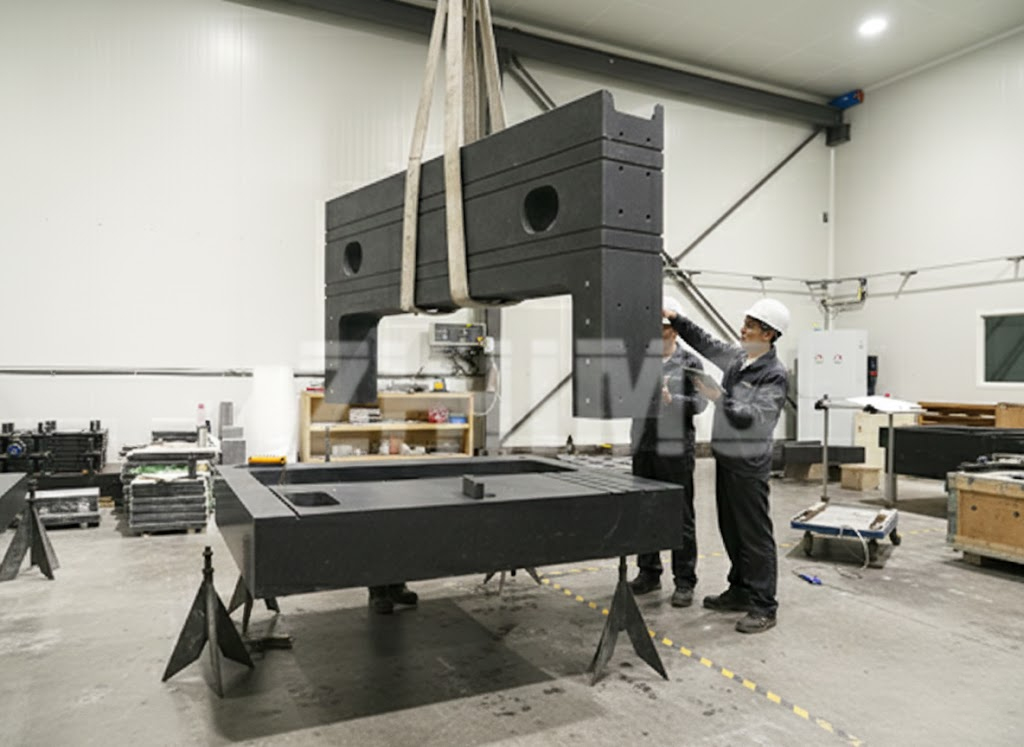
The shift toward granite as a preferred material for precision platforms began several decades ago and has since become the industry standard for metrology and high-precision CNC applications. Natural granite, particularly varieties like black diabase, offers a level of dimensional stability that is simply unattainable with metals. Because granite has been seasoned by the earth over millions of years, it is virtually free from internal stresses. Once it is precision-lapped to a specific flatness, it maintains that geometry with remarkable consistency. Granite is also chemically inert and non-porous, making it immune to rust and highly resistant to the chemicals and coolants used in manufacturing. Its low coefficient of thermal expansion and high thermal mass make it exceptionally stable in environments where temperature control is a challenge. For static platforms and reference planes, granite remains the gold standard.
In recent years, advanced ceramics have emerged as a high-performance alternative for the most demanding precision applications. Materials such as alumina (aluminum oxide) and silicon carbide offer a combination of properties that surpass both granite and cast iron in certain areas. Ceramics are incredibly stiff—often twice as stiff as steel—and have a very high hardness, making them extremely resistant to wear and deformation. They also possess a very low coefficient of thermal expansion, even lower than that of granite, and can operate at much higher temperatures without losing their accuracy. The primary advantage of ceramic platforms is their high stiffness-to-weight ratio, which makes them ideal for moving components in high-speed, high-precision machines. However, the high cost of raw materials and the difficulty of machining ceramics mean that they are typically reserved for specialized applications where no other material will suffice.
The choice between these three materials often comes down to a balance of performance, cost, and the specific requirements of the application. For large-scale, heavy-duty machine bases where complex internal structures are needed, cast iron remains a viable and cost-effective choice, provided that the environmental conditions are well-controlled. For metrology labs, inspection stations, and high-precision CNC machines where long-term stability and environmental resistance are paramount, granite is the clear winner. Its ability to provide a stable, flat reference plane with minimal maintenance makes it an essential component of modern quality assurance. Meanwhile, for ultra-precision motion systems in the semiconductor and optical industries, where high acceleration and sub-micron accuracy are required, advanced ceramics provide the necessary performance edge.
The integration of these materials into hybrid structures is another growing trend in the industry. Manufacturers are increasingly combining the strengths of different materials to create platforms that offer the best of all worlds. For example, a machine might feature a massive granite base for stability and vibration damping, paired with ceramic guideways for high-speed motion and wear resistance. This modular approach allows for the optimization of each component based on its specific function, resulting in machines that are more accurate, more productive, and more reliable. The rise of mineral casting—a composite of granite aggregates and epoxy resin—has also provided a bridge between natural granite and cast iron, offering many of the benefits of granite with the design flexibility of casting.
As we look toward the future of precision manufacturing, the role of these materials will only become more critical. The ongoing development of new ceramic formulations and the refinement of granite processing techniques are pushing the limits of what can be achieved. At the same time, the integration of digital technology and sensor systems is allowing for the real-time monitoring of platform stability and environmental conditions. This data-driven approach to manufacturing relies on the predictability and reliability of the physical platform, and the choice of material is the first step in ensuring that reliability. Whether it is the ancient stability of granite, the versatile strength of cast iron, or the cutting-edge performance of ceramics, these materials are the silent partners in the creation of the world’s most advanced technological marvels.
In conclusion, the landscape of precision manufacturing platforms is one of constant evolution and refinement. By understanding the unique properties and trade-offs of granite, ceramic, and cast iron, manufacturers can make informed decisions that align with their specific precision goals. The investment in a high-quality platform is an investment in the future of the manufacturing process, providing the stable foundation upon which all accuracy and quality are built. As the demand for precision continues to grow across all sectors of industry, the importance of choosing the right material for the job will only become more pronounced, making these advanced solutions the key to unlocking the next level of industrial excellence.
The technical comparison of these materials also extends to their behavior under dynamic loads. In high-speed machining, the ability of a platform to dissipate energy and resist resonance is crucial. While granite is excellent at damping low-frequency vibrations, advanced ceramics can be engineered to have specific resonant frequencies that are outside the operating range of the machine. This allows for even higher speeds and accelerations without compromising accuracy. Cast iron, while good at damping, can sometimes suffer from “ringing” at certain frequencies, which must be addressed through careful design and the use of additional damping materials. The study of modal analysis and structural dynamics is therefore an essential part of the design process for any high-precision platform, regardless of the material chosen.
Furthermore, the environmental impact and sustainability of these materials are becoming increasingly important considerations for manufacturers. Natural granite is a sustainable choice, as it is a natural resource that requires minimal processing compared to the energy-intensive production of metals and ceramics. Its extreme durability also means that granite components can be reused or repurposed at the end of a machine’s life, further reducing its environmental footprint. Cast iron, while recyclable, requires significant energy for melting and casting. Ceramics, although durable, are difficult to recycle and require high temperatures for their manufacture. As global regulations on carbon emissions and waste continue to tighten, the sustainability profile of manufacturing materials will play an even larger role in the decision-making process.
The economic implications of choosing one material over another are also complex. While the initial cost of a ceramic platform may be several times that of a granite or cast iron one, the potential for increased productivity and reduced maintenance can lead to a lower total cost of ownership over the life of the machine. For example, in the semiconductor industry, where even a few minutes of downtime can cost millions of dollars, the reliability and performance of a ceramic motion stage can easily justify its higher price tag. Conversely, for a general-purpose machine shop, the cost-effectiveness and versatility of cast iron or the long-term stability of granite may be the more appropriate choice. Manufacturers must carefully evaluate their specific production goals and budget constraints to determine which material provides the best return on investment.
The manufacturing and finishing processes for these materials are also highly specialized. Granite requires precision lapping by skilled technicians to achieve the required flatness and surface finish. Cast iron requires careful machining and often manual scraping to ensure the accuracy of its mounting surfaces. Ceramics, due to their extreme hardness, can only be machined using diamond tools and specialized grinding processes. The availability of skilled labor and the necessary equipment to process these materials can also influence the choice of material. As the industry moves toward more automation, the development of robotic lapping and grinding systems is helping to improve the consistency and reduce the cost of producing high-precision platforms in all three materials.
Looking ahead, the development of new composite materials that combine the best properties of granite, ceramics, and metals is a promising area of research. For example, metal-matrix composites (MMCs) that incorporate ceramic particles into a metal base can offer high stiffness and low thermal expansion with the machinability of metal. Similarly, the use of carbon fiber-reinforced polymers (CFRP) in combination with granite or ceramic components is becoming more common in high-speed motion systems. These advanced materials represent the next frontier in precision manufacturing, offering the potential for even higher levels of performance and efficiency. The ongoing dialogue between material scientists and machine tool designers is what drives this innovation, ensuring that the manufacturing industry always has the tools it needs to meet the challenges of the future.
In summary, the choice of material for a precision manufacturing platform is a multifaceted decision that requires a deep understanding of the technical, economic, and environmental factors involved. Whether it is the time-tested reliability of cast iron, the unmatched stability of granite, or the high-performance edge of ceramics, each material has its place in the modern industrial landscape. By carefully evaluating the specific needs of their applications and staying abreast of the latest developments in material science, manufacturers can build the foundations for success in an increasingly competitive and demanding market. The pursuit of precision is a journey without end, and the materials we choose to build our machines upon are the essential companions on that journey, providing the stability and accuracy needed to turn the visions of today into the realities of tomorrow.
Post time: May-19-2026