
In the world of precision engineering and metrology, the surface plate is the silent foundation upon which all accuracy is built. Whether it is used for manual inspection with height gauges or as the base for a sophisticated Coordinate Measuring Machine (CMM), the surface plate provides the essential reference plane that makes precise measurement possible. However, the accuracy of a surface plate is not a permanent quality; it is a state that must be carefully maintained through a combination of proper usage, environmental control, and regular calibration. This article explores the key factors that influence the accuracy of precision surface plates and provides a comprehensive guide to the best practices for maintaining their integrity in a manufacturing or laboratory environment.
The most fundamental factor in maintaining the accuracy of a surface plate is cleanliness. In a manufacturing environment, surface plates are constantly exposed to dust, metal chips, oil, and other contaminants. Even a microscopic particle of grit can act as an abrasive, causing wear on the plate’s surface and the base of the measuring instruments used on it. Over time, this wear can lead to “low spots” that compromise the flatness of the plate. To prevent this, surface plates should be cleaned regularly using a specialized surface plate cleaner. These cleaners are designed to remove oil and grime without leaving a residue or affecting the stone’s properties. It is also important to wipe the plate down before and after every use, and to keep it covered with a protective vinyl or wooden cover when it is not in service.
The material of the surface plate itself plays a significant role in its long-term accuracy. While cast iron surface plates were once the standard, granite has become the preferred material for most modern applications. Granite offers several advantages, including superior hardness, natural vibration damping, and resistance to corrosion. Furthermore, granite is less affected by temperature changes than cast iron. However, not all granite is created equal. High-quality surface plates are typically made from black diabase or other dense, fine-grained granite varieties that offer the best combination of stiffness and stability. Understanding the properties of the specific granite used in a surface plate is essential for predicting how it will respond to environmental factors and wear over time.
Environmental control is perhaps the most critical, yet often overlooked, factor in maintaining measurement accuracy. Temperature fluctuations are the primary enemy of precision. Even though granite has a low coefficient of thermal expansion, a large surface plate can still experience significant dimensional changes if the temperature is not controlled. Ideally, a metrology lab should be maintained at a constant 20 degrees Celsius, the international standard for dimensional measurements. More importantly, the temperature must be uniform across the entire plate. If one side of the plate is warmer than the other—perhaps due to proximity to a window or a heat source—the plate can “bow” or warp, leading to significant measurement errors. Humidity control is also important, as extreme changes in moisture can affect the stability of the granite and the performance of electronic measuring instruments.
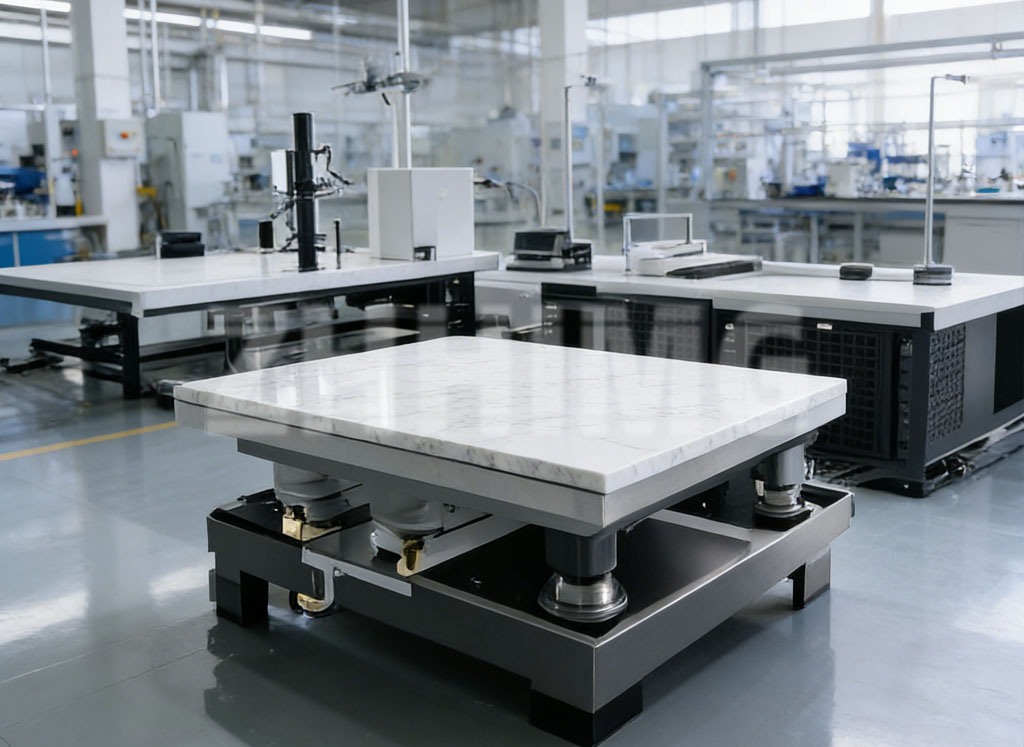
The way a surface plate is supported is another key factor in its accuracy. A surface plate is not a perfectly rigid body; it will deflect under its own weight and the weight of the parts being measured. To minimize this deflection, surface plates should be supported at specific points, known as Airy points, which are designed to provide the most stable and flat configuration. Most surface plates come with a dedicated stand that is designed to support the plate at these points. It is essential that the stand is level and that the plate is not subjected to any twisting or uneven forces. Regularly checking the level of the stand and ensuring that the support points are properly adjusted is a vital part of surface plate maintenance.
Calibration is the only way to verify the accuracy of a surface plate and to identify any wear that has occurred. A comprehensive calibration involves measuring both the overall flatness of the plate and its repeatability. Flatness is typically measured using a laser interferometer or an electronic level, which maps the entire surface of the plate to ensure it meets the required grade (such as Grade AA, A, or B). Repeatability, on the other hand, is measured using a high-precision repeat-o-meter, which checks for local wear by moving a sensitive indicator across the surface. Calibration should be performed at regular intervals, typically every six to twelve months, depending on the frequency of use and the required level of precision. A certified calibration report provides the necessary traceability and confidence that the surface plate is fit for its intended purpose.
Proper usage techniques are also essential for preserving the life of a surface plate. One of the most common causes of premature wear is the repeated use of the same area of the plate. To prevent this, operators should be encouraged to use the entire surface of the plate, rotating the setup and moving the measuring instruments to different locations. Additionally, heavy parts should be lowered onto the plate gently to avoid impact damage, which can cause “bruising” or chipping of the granite. When using height gauges or other instruments, it is important to ensure that their bases are clean and free of burrs, as any roughness can scratch the plate’s surface.
In conclusion, the accuracy of a precision surface plate is the result of a holistic approach to maintenance and environmental control. By keeping the plate clean, controlling the temperature and humidity, providing proper support, and adhering to a regular calibration schedule, manufacturers can ensure that their foundational reference plane remains reliable for years to come. The investment in a high-quality surface plate is only the beginning; the true value is realized through the diligent application of best practices that safeguard its precision. As the demand for tighter tolerances and higher quality continues to grow, the role of the surface plate as the bedrock of metrology will only become more important, making its maintenance a top priority for any precision-focused organization.
The role of the surface plate in the broader context of a quality management system is also worth considering. In many industries, such as aerospace and medical device manufacturing, the ability to demonstrate the accuracy of measurements is a regulatory requirement. A well-maintained and regularly calibrated surface plate is a key component of this demonstration. The documentation provided by calibration reports serves as a record of the plate’s performance over time, allowing for the identification of trends and the prediction of when the plate might need to be resurfaced or replaced. This proactive approach to maintenance not only ensures the accuracy of current measurements but also provides a level of risk management that is essential in high-stakes manufacturing environments.
Furthermore, the training of personnel who interact with surface plates is a critical factor that is often overlooked. Operators must be aware of the sensitivity of the equipment and the impact that their actions can have on its accuracy. This includes understanding the importance of cleaning the plate before use, the proper way to handle and place parts, and the need to report any accidental damage or unusual readings. A culture of care and respect for precision equipment is one of the most effective ways to maintain the long-term accuracy of a surface plate. Regular training sessions and the clear communication of maintenance procedures can help ensure that everyone in the lab or on the shop floor is working toward the same goal of measurement excellence.
The physical location of the surface plate within a facility can also have a significant impact on its performance. Beyond the obvious need for a climate-controlled environment, the plate should be situated away from sources of vibration, such as heavy machinery, loading docks, or high-traffic areas. Even subtle vibrations can interfere with high-precision measurements, especially when using sensitive indicators or electronic levels. In some cases, it may be necessary to install the surface plate on a dedicated, vibration-isolated foundation to ensure the required level of stability. Additionally, the plate should be kept away from direct sunlight and air conditioning vents, as these can create localized temperature gradients that lead to warping.
As technology continues to advance, the tools used to calibrate and monitor surface plates are also becoming more sophisticated. Wireless electronic levels and laser-based mapping systems allow for faster and more accurate calibration, providing a more detailed picture of the plate’s surface geometry. Some modern surface plates are even being equipped with embedded sensors that can monitor temperature and vibration in real-time, providing an early warning if environmental conditions fall outside of the acceptable range. These “smart” surface plates represent the next step in the evolution of metrology, offering a level of insight and control that was previously impossible.
The process of resurfacing a worn surface plate is another important aspect of its lifecycle. When a plate no longer meets its required flatness or repeatability specifications, it can often be restored through a process of lapping. This involves using abrasive compounds and specialized tools to manually remove material from the high spots until the plate is once again flat. Resurfacing is a highly skilled task that should only be performed by experienced technicians. A properly resurfaced plate can be as accurate as a brand-new one, providing a cost-effective way to extend the life of a valuable asset. However, there is a limit to how many times a plate can be resurfaced before it becomes too thin or its structural integrity is compromised, at which point it must be replaced.
In the global marketplace, the adherence to international standards for surface plates, such as ISO 8512 or ASME B89.3.7, is essential for ensuring the compatibility and reliability of measurements across different facilities and countries. These standards define the requirements for material, design, and accuracy grades, providing a common language for manufacturers and metrologists. When purchasing a new surface plate or having an existing one calibrated, it is important to ensure that the work is performed in accordance with these standards. This not only ensures the quality of the plate but also facilitates the exchange of parts and data in an increasingly interconnected world.
In summary, the maintenance of a precision surface plate is a continuous process that requires attention to detail and a commitment to quality. From the daily routine of cleaning and covering the plate to the periodic tasks of calibration and resurfacing, every action taken to protect the plate’s integrity contributes to the overall accuracy of the manufacturing process. By understanding the key factors that influence surface plate performance—cleanliness, material properties, environmental control, proper support, and usage techniques—manufacturers can build a solid foundation for their metrology operations. As we move toward an era of even greater precision and automation, the humble surface plate will remain an indispensable tool, serving as the ultimate reference for the quality and excellence of the products we create. The pursuit of accuracy begins at the surface, and its maintenance is the key to unlocking the full potential of modern engineering.
Post time: May-19-2026