
In the modern manufacturing landscape, the ability to measure with extreme precision is not just a technical requirement; it is a fundamental pillar of quality assurance and competitive advantage. As products become more complex and tolerances shrink to the micron level, the role of the manufacturing lab has never been more critical. Choosing the right precision measuring tools is a strategic decision that impacts everything from product development cycles to long-term operational costs. This article explores the essential considerations for selecting metrology equipment, the various types of tools available, and the emerging trends that are shaping the future of precision measurement in the industrial sector.
The first step in selecting the right measuring tools is a thorough assessment of the specific requirements of the manufacturing process. This involves understanding the geometry of the parts being produced, the materials involved, and the required level of accuracy. A common rule of thumb in metrology is the “Rule of Ten,” which suggests that a measuring instrument should be at least ten times more accurate than the tolerance of the part being measured. For example, if a part has a tolerance of 0.1 millimeters, the measuring tool should be capable of measuring to 0.01 millimeters. However, as tolerances continue to tighten, this rule is often pushed to its limits, requiring labs to invest in increasingly sophisticated equipment that can provide the necessary resolution and repeatability.
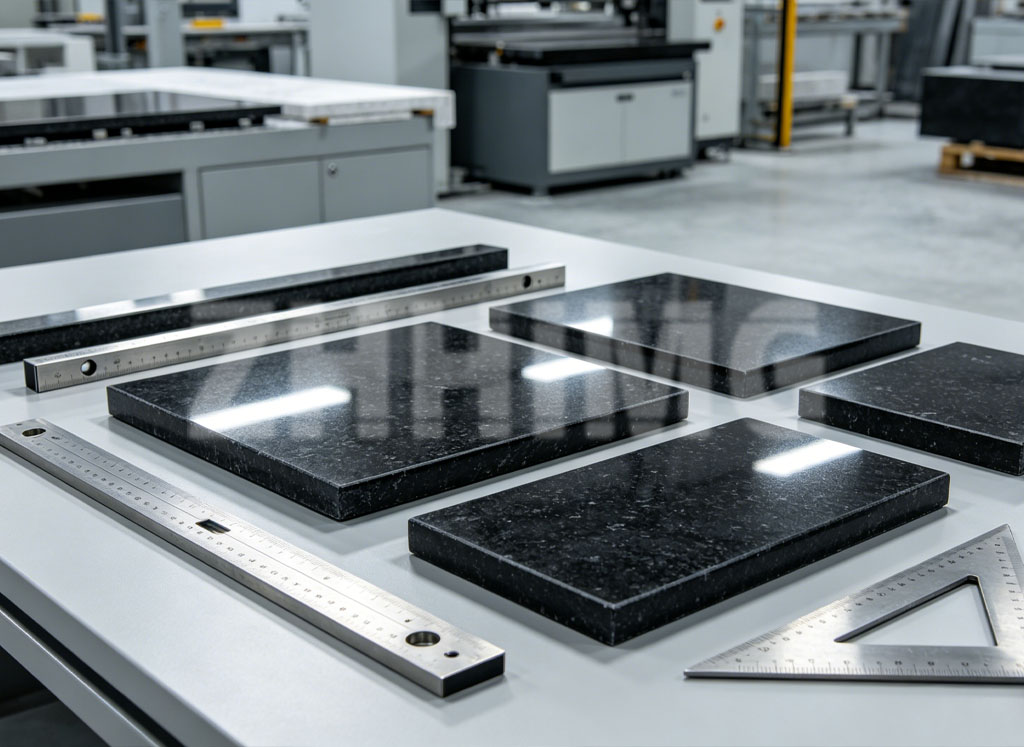
Accuracy and precision are often used interchangeably, but in the context of a manufacturing lab, they have distinct and equally important meanings. Accuracy refers to how close a measurement is to the true value, while precision, or repeatability, refers to the consistency of the measurements when taken multiple times under the same conditions. A tool can be precise without being accurate, or accurate without being precise. For a manufacturing lab, the ideal tool is both. Achieving this requires not only high-quality equipment but also a controlled environment where factors such as temperature, humidity, and vibration are carefully managed. The stability of the measuring platform, often provided by precision granite surface plates, is also a critical factor in ensuring that measurements are both accurate and repeatable.
The variety of precision measuring tools available today is vast, ranging from simple hand tools to complex automated systems. At the most basic level are calipers and micrometers, which remain essential for quick, on-the-spot measurements of length, depth, and diameter. While these tools have become more advanced with digital displays and wireless data output, they still rely on the skill of the operator. For more complex geometries and higher levels of accuracy, Coordinate Measuring Machines (CMMs) have become the industry standard. CMMs use a probe to capture the X, Y, and Z coordinates of a part’s surface, allowing for the measurement of complex 3D shapes with extreme precision. The choice between a manual or automated CMM depends on the volume of parts being inspected and the required level of throughput.
In recent years, optical and vision-based measuring systems have gained significant traction in manufacturing labs. These non-contact systems use high-resolution cameras and specialized software to measure parts without physically touching them. This is particularly advantageous for delicate or flexible parts that might be deformed by a physical probe. Optical systems are also capable of measuring thousands of points in a matter of seconds, making them ideal for high-speed inspection in production environments. As sensor technology continues to improve, the line between contact and non-contact measurement is blurring, with many modern CMMs offering both capabilities in a single platform.
Surface metrology is another critical area of focus for manufacturing labs. The surface finish of a part can have a profound impact on its performance, affecting factors such as friction, wear, and fatigue life. Tools such as profilometers and surface roughness testers are used to measure the microscopic peaks and valleys of a surface. In industries like aerospace and medical device manufacturing, where surface integrity is paramount, these tools are essential for ensuring that parts meet the required specifications. The ability to characterize surface texture in 3D is also becoming more common, providing a more comprehensive understanding of how a part will behave in its intended application.
The integration of digital technology is perhaps the most significant trend in the world of precision measurement. The rise of Industry 4.0 has led to the development of “smart” measuring tools that can communicate with other machines and systems in the factory. This connectivity allows for real-time data collection and analysis, enabling manufacturers to identify trends and potential issues before they lead to scrap or rework. Digital metrology also facilitates the creation of “digital twins,” which are virtual representations of physical parts. By comparing the measured data of a part to its digital twin, manufacturers can gain deep insights into the performance of their production processes and make data-driven decisions to improve quality and efficiency.
Traceability and calibration are also vital considerations when choosing measuring tools. To ensure that measurements are valid, they must be traceable to a recognized national or international standard. This requires regular calibration of all measuring equipment by a certified laboratory. When selecting tools, it is important to consider the ease of calibration and the availability of support services from the manufacturer. Investing in tools from reputable brands that offer comprehensive calibration and maintenance programs can save a lab significant time and money in the long run. Furthermore, the use of gauge blocks and other reference standards within the lab allows for frequent internal checks to ensure that equipment remains within its specified accuracy limits.
In conclusion, choosing the right precision measuring tools is a complex but essential task for any manufacturing lab. It requires a deep understanding of the measurement requirements, a clear distinction between accuracy and precision, and an awareness of the various types of tools and technologies available. By investing in the right equipment and maintaining a controlled environment, manufacturers can ensure that their products meet the highest standards of quality and reliability. As technology continues to advance, the role of metrology will only become more integrated into the manufacturing process, providing the data and insights needed to drive innovation and excellence in the industrial sector. The right tools are not just instruments of measurement; they are the keys to unlocking the full potential of modern manufacturing.
The human element in precision measurement is another factor that cannot be overlooked. Even the most advanced tools require skilled operators who understand the principles of metrology and the nuances of the equipment. Training and education are therefore essential components of a successful manufacturing lab. When choosing tools, it is important to consider the user interface and the ease of use. Modern software packages for CMMs and vision systems have become increasingly intuitive, with graphical interfaces and automated programming features that reduce the risk of operator error. However, a solid foundation in the basics of measurement—such as understanding the effects of parallax, the importance of proper part alignment, and the impact of environmental factors—remains indispensable. A lab that invests in both high-quality tools and the professional development of its staff will always have a competitive edge.
Furthermore, the long-term cost of ownership should be a key part of the decision-making process. The initial purchase price of a precision measuring tool is just one part of the total investment. Other factors to consider include the cost of maintenance, calibration, software updates, and potential repairs. Some tools may have a lower upfront cost but require more frequent calibration or have higher maintenance requirements. It is also important to consider the versatility of the equipment. A tool that can be used for a wide range of applications and can be easily upgraded as technology advances will provide a better return on investment over its lifetime. Manufacturers should look for equipment that offers a modular design or can be integrated with other systems, allowing the lab to grow and adapt to changing requirements.
The physical environment of the lab itself plays a crucial role in the performance of precision measuring tools. As mentioned earlier, temperature and humidity can significantly affect the accuracy of measurements. Most high-precision labs are climate-controlled to maintain a constant temperature, typically around 20 degrees Celsius, which is the international standard for dimensional measurements. Vibration is another critical factor, especially for tools like CMMs and surface profilometers that are sensitive to even the slightest movements. Many labs are built on isolated foundations or use specialized vibration-damping tables to ensure a stable measuring environment. The use of precision granite surface plates as a base for many measuring operations is also a standard practice, as granite provides a stable, flat, and vibration-resistant surface that is essential for accurate metrology.
As the manufacturing industry moves toward more sustainable practices, the role of metrology in reducing waste and improving efficiency is becoming increasingly important. By providing accurate and timely data on the quality of parts, precision measuring tools allow manufacturers to identify and correct issues early in the production process, minimizing the amount of scrap and rework. This not only saves money but also reduces the environmental impact of manufacturing. Furthermore, the use of advanced metrology can help optimize the design of parts, leading to more efficient use of materials and energy. In this context, the choice of measuring tools is not just a technical or economic decision; it is also a contribution to the broader goal of sustainable manufacturing.
The future of precision measurement is likely to be shaped by the continued advancement of artificial intelligence and machine learning. These technologies have the potential to revolutionize metrology by automating the analysis of complex data sets and identifying patterns that would be impossible for a human to detect. For example, AI-powered vision systems could automatically identify and classify defects on a part’s surface, while machine learning algorithms could predict when a measuring tool is likely to go out of calibration based on its historical performance. As these technologies become more integrated into measuring equipment, the speed and accuracy of metrology will continue to increase, further driving the evolution of modern manufacturing.
In summary, the process of choosing the right precision measuring tools for a manufacturing lab is a multifaceted endeavor that requires a strategic approach. It begins with a clear understanding of the technical requirements and extends to considerations of accuracy, precision, technology, traceability, and the human element. By taking a holistic view of the metrology needs and investing in high-quality equipment and staff training, manufacturers can build a lab that is not only a center for quality assurance but also a driver of innovation and efficiency. The right tools, supported by a controlled environment and a commitment to continuous improvement, are the foundation upon which the future of precision manufacturing is built. As we look ahead, the integration of digital technology and artificial intelligence will continue to transform the field of metrology, offering new opportunities for manufacturers to achieve even higher levels of excellence.
Post time: May-19-2026